

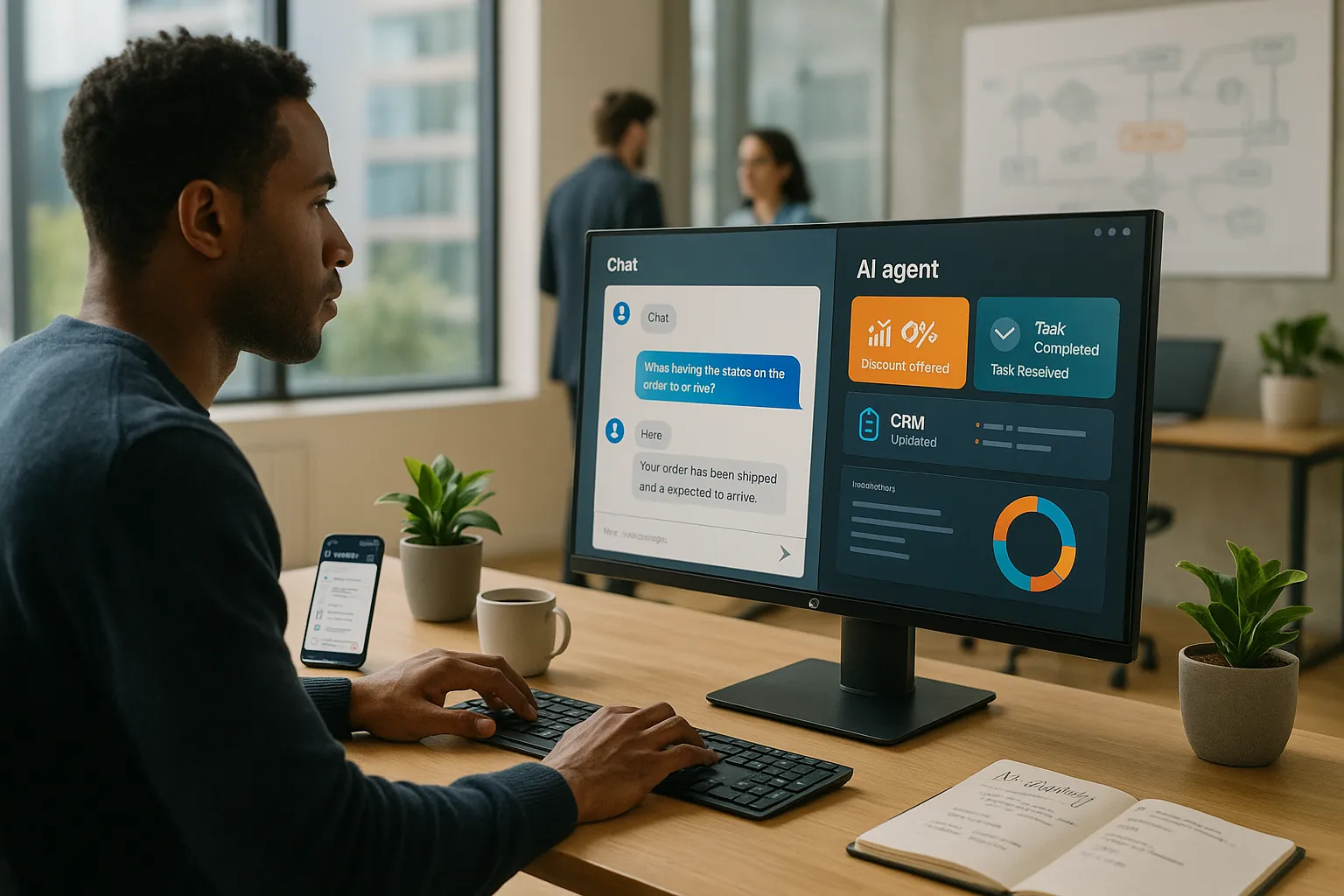
A customer asks your AI: “What is the status of my order?” The chatbot retrieves the information and responds with tracking details. The interaction ends. The customer is satisfied, but nothing has changed.
Now imagine a different scenario. A customer asks the same question, but this time an AI agent responds. It retrieves the tracking information, notices the shipment is delayed, proactively offers a discount on the next order, updates the CRM with a note about the issue, and flags the shipping carrier’s performance for review. One question triggered five valuable actions.
This is the fundamental difference between chatbots and AI agents. One provides information. The other provides impact.
As organizations invest billions in AI capabilities, understanding this distinction has become critical for making smart technology decisions. The wrong choice does not just waste money—it creates organizational skepticism about AI that can delay adoption of truly transformative solutions.
The Evolution from Response to Action
Chatbots emerged as the first wave of conversational AI. They represented a genuine advance: natural language interfaces that could understand user intent and provide relevant responses. For many use cases, particularly customer support FAQ handling, chatbots delivered real value.
But chatbots have an architectural limitation that no amount of improvement can overcome: they are fundamentally reactive. A chatbot waits for input, processes it, and produces output. Then it waits again. It cannot take initiative, pursue goals, or work autonomously.
AI agents represent the second wave of conversational AI. They inherit the natural language capabilities of chatbots but add something transformational: the ability to take action. An agent does not just process language—it uses language as one input among many to pursue objectives.
sequenceDiagram
    participant U as User
    participant C as Chatbot
    participant A as AI Agent
    participant S as Business Systems

    U->>C: "What's my order status?"
    C->>S: Query order
    S->>C: Order data
    C->>U: "Your order shipped Tuesday"
    Note over C: Interaction complete

    U->>A: "What's my order status?"
    A->>S: Query order
    S->>A: Order data (delayed)
    A->>A: Detect delay issue
    A->>S: Generate discount code
    A->>S: Update CRM
    A->>S: Flag carrier issue
    A->>U: "Shipped Tuesday, delayed. Here's 15% off your next order."
    Note over A: Multiple actions taken
The Technical Differences That Matter
Understanding the technical architecture of chatbots versus agents helps explain why their business impact differs so dramatically.
Chatbot Architecture
Traditional chatbots, even sophisticated ones powered by large language models, follow a straightforward pattern:
- Receive user input
- Process through NLU (natural language understanding)
- Match intent to predefined responses or generate response
- Return output to user
- Clear context (or retain limited session context)
- Wait for next input
This architecture works well for question-answering and simple task routing. But it cannot handle processes that require multiple steps, system integrations, or autonomous decision-making.
AI Agent Architecture
AI agents add several critical capabilities:
- Tool Use: Agents can call APIs, query databases, send emails, update records, and interact with external systems
- Planning: Agents can break complex goals into sub-tasks and execute them sequentially or in parallel
- Memory: Agents maintain context not just within sessions but across interactions over time
- Reasoning: Agents can handle exceptions, make judgment calls, and adapt to unexpected situations
- Autonomy: Agents can work without continuous human input, pursuing goals proactively
The Tool Use Difference
The ability to use tools is the single most important technical distinction between chatbots and agents. A chatbot can tell you it would be helpful to send an email. An agent can actually send the email, wait for a response, and take follow-up actions based on what happens.
| Capability | Chatbot | AI Agent |
|---|---|---|
| Natural language understanding | Yes | Yes |
| Intent classification | Yes | Yes |
| Response generation | Yes | Yes |
| Tool/API integration | Limited/None | Extensive |
| Multi-step task execution | No | Yes |
| Persistent memory | Session only | Long-term |
| Autonomous operation | No | Yes |
| Goal pursuit | No | Yes |
| Exception handling | Escalate to human | Attempt resolution |
| System of record updates | No | Yes |
Business Impact: The ROI Comparison
The architectural differences translate directly into business impact. Chatbots and agents address fundamentally different business problems.
What Chatbots Do Well
Chatbots excel at:
- Answering frequently asked questions
- Routing inquiries to appropriate teams
- Collecting initial information from users
- Providing 24/7 availability for simple queries
- Deflecting low-value support tickets
A well-implemented chatbot can reduce support ticket volume by 20-40% by handling routine inquiries. This is valuable, but it is fundamentally about cost reduction for existing work.
What Agents Do Differently
Agents enable:
- Autonomous execution of multi-step processes
- Proactive outreach and follow-up
- Cross-system workflow coordination
- Intelligent exception handling
- Continuous monitoring and response
An agent does not just reduce costs—it creates capacity. Work that previously required human attention happens automatically. Tasks that were too labor-intensive to perform at scale become feasible.
Customer Success Team
❌Before AI
- •Chatbot answers renewal FAQ questions
- •CSMs manually track contract dates
- •Renewal outreach starts 30 days before expiration
- •At-risk accounts identified through quarterly reviews
- •Expansion opportunities spotted inconsistently
✨With AI
- •Agent monitors engagement signals continuously
- •Contract renewals tracked and flagged automatically
- •Proactive nurture sequences start 90 days out
- •Real-time risk scoring with immediate alerts
- •Expansion triggers identified and acted upon instantly
📊 Metric Shift: Customer Success teams using agents report 25% higher renewal rates and 40% less time on administrative tasks
The Cost-Benefit Analysis
Understanding the true ROI of chatbots versus agents requires looking beyond initial deployment costs.
Chatbot Economics
Typical investment: $10,000-$100,000 for implementation, $500-$5,000/month ongoing
Value creation: Ticket deflection (cost avoidance)
Calculation: If a chatbot deflects 1,000 tickets per month that would each cost $15 to handle, annual savings are approximately $180,000
Limitations: Value is capped by ticket volume. Cannot generate revenue or create new capabilities.
Agent Economics
Typical investment: $50,000-$500,000 for implementation, $2,000-$20,000/month ongoing
Value creation: Human-Equivalent Hours (productive work output)
Calculation: If an agent performs work that would require 40 hours of human labor per week at $75/hour fully loaded, annual value is approximately $156,000 per agent
Advantages: Value scales with use cases. Can generate revenue through proactive actions. Creates new capabilities not previously feasible.
The Hidden Cost of Chatbot Limitations
Many organizations deploy chatbots expecting agent-level results. When the chatbot cannot handle complex requests, users abandon it, support teams inherit frustrated customers, and the organization concludes that “AI does not work.” This chatbot hangover can delay adoption of genuinely transformative agent technology by years.
Real-World Comparison: Sales Follow-Up
Consider how chatbots and agents handle the common business challenge of sales follow-up.
The Chatbot Approach
A sales chatbot can:
- Answer prospect questions about products
- Schedule meetings with sales reps
- Provide pricing information
- Qualify leads through conversational forms
These are valuable capabilities. But the chatbot waits for prospects to engage. It cannot proactively pursue opportunities.
The Agent Approach
A sales agent can:
- Monitor CRM for stalled opportunities
- Research prospects using multiple data sources
- Draft personalized outreach based on prospect context
- Send follow-up sequences with timing optimized for engagement
- Update CRM records with all activities
- Alert reps when human intervention is needed
- Track responses and adjust approach based on results
The agent does not wait for prospects to engage—it proactively works the pipeline. It performs work that previously required dedicated sales development resources.
The Business Outcome
A chatbot might improve conversion rates for inbound inquiries by 10-20% through faster response times and 24/7 availability.
An agent might increase overall pipeline velocity by 30-50% through systematic, personalized follow-up that no human team could execute consistently at scale.
The chatbot helps with what is already happening. The agent makes new things happen.
When to Choose Chatbots vs. Agents
The chatbot versus agent decision should be driven by the nature of the problem you are solving.
Choose Chatbots When:
- The primary need is answering questions
- Interactions are single-turn or very short
- No actions in external systems are required
- Volume is high but complexity is low
- Budget is limited and timeline is short
- The use case is primarily cost reduction
Choose Agents When:
- The need is executing work, not just providing information
- Processes require multiple steps across systems
- Proactive outreach or monitoring is valuable
- Judgment calls and exception handling are needed
- You want to create capacity, not just reduce costs
- The use case involves revenue generation or strategic value
graph TD
    A[AI Use Case] --> B{Does it require<br/>taking actions?}
    B -->|No| C{Is it primarily<br/>Q&A?}
    B -->|Yes| D{Are actions<br/>multi-step?}
    C -->|Yes| E[Chatbot]
    C -->|No| F{Does it need<br/>proactive work?}
    D -->|No| G[Simple Automation]
    D -->|Yes| H[AI Agent]
    F -->|No| E
    F -->|Yes| H
    E --> I[FAQ, Support deflection,<br/>Lead qualification]
    H --> J[Sales follow-up, Workflow<br/>execution, Monitoring]
The Hybrid Approach
Many organizations benefit from deploying both chatbots and agents strategically. The key is matching the technology to the use case.
Chatbot layer: Handles high-volume, low-complexity interactions. Provides immediate responses to common questions. Serves as the first line of customer engagement.
Agent layer: Operates behind the scenes on complex, multi-step processes. Takes over when chatbot interactions require action. Proactively works on goals without waiting for user input.
This hybrid approach maximizes ROI by using the simpler, cheaper technology where it suffices while deploying more powerful agents where their capabilities are needed.
The Role of Context
Both chatbots and agents benefit from business context, but agents require it. A chatbot can function with limited context—it just provides less personalized responses. An agent without context cannot function effectively at all, because it lacks the information needed to take appropriate actions.
This is where Enterprise Context Engineering becomes essential. Agents need:
- Access to CRM and customer data
- Understanding of business processes and rules
- Knowledge of company products and services
- Visibility into communication history
- Integration with systems where actions occur
Without this context, agents produce generic outputs that require human review and correction, eliminating much of their efficiency advantage. With rich context, agents can operate autonomously with confidence, performing work that actually moves the business forward.
Context Is the Multiplier
The same agent architecture, deployed with different levels of context, can vary by 10x in effectiveness. Organizations that invest in context engineering—giving agents access to the information they need—see dramatically better results than those that deploy agents with minimal integration.
Migration Path: From Chatbot to Agent
Organizations with existing chatbot deployments can evolve toward agent capabilities through a structured migration path.
Phase 1: Extend Chatbot with Tool Use
Add simple integrations that allow your chatbot to take limited actions—scheduling meetings, creating tickets, looking up order status. This builds organizational comfort with AI taking actions while keeping the interaction model familiar.
Phase 2: Add Proactive Capabilities
Implement triggers that cause your AI to initiate contact rather than just respond. Start with low-risk scenarios like appointment reminders or shipping notifications.
Phase 3: Deploy Autonomous Agents
For specific high-value use cases, deploy true agents that can work independently on complex, multi-step processes. Monitor closely and expand autonomy as trust builds.
Phase 4: Orchestrate Multi-Agent Systems
For complex business processes, coordinate multiple specialized agents that work together—each handling its area of expertise while an orchestration layer manages the overall workflow.
Making the Right Investment
The chatbot versus agent decision is ultimately about matching investment to opportunity. Both technologies have their place, and the wrong choice in either direction wastes resources.
Underinvesting—deploying a chatbot when an agent is needed—leaves transformative value on the table. Your competitors who deploy agents will gain advantages you cannot match with chatbot technology.
Overinvesting—deploying an agent when a chatbot would suffice—wastes money on capabilities you do not need. Agent implementations are more complex and expensive than chatbot deployments.
The key is honest assessment of your business needs. If you need AI that answers questions, chatbots are mature, affordable, and effective. If you need AI that does work, agents are the necessary investment despite their greater complexity.
For many organizations, the right answer is both—chatbots for the simple interactions that make up the majority of volume, and agents for the complex processes that create the majority of value.
Not Sure Which AI Approach Fits Your Needs?
Get expert guidance on whether chatbots, agents, or a hybrid approach will deliver the best ROI for your specific business challenges. Our AI strategy sessions help you invest wisely.
Frequently Asked Questions
Can I upgrade my existing chatbot to an AI agent?
In most cases, no—the architectures are fundamentally different. However, you can often keep your chatbot for simple interactions while deploying agents alongside it for complex use cases. Some modern platforms are designed to support both chatbot and agent capabilities, making gradual migration easier.
Are AI agents more expensive than chatbots?
Yes, initially. Agent implementations typically cost 2-5x more than chatbot deployments due to integration complexity. However, agents also deliver significantly more value because they perform actual work rather than just answering questions. ROI calculations often favor agents despite higher costs when the use case involves revenue generation or significant operational efficiency gains.
How do I measure ROI for chatbots vs agents?
Chatbot ROI is typically measured in ticket deflection and cost avoidance—how many support requests were handled without human intervention. Agent ROI is measured in Human-Equivalent Hours—the productive work output the agent delivers. Agent metrics often show higher returns because they measure value creation, not just cost reduction.
What are the risks of deploying AI agents?
The primary risks are inappropriate actions (agents doing things they should not), quality issues (agents producing subpar work), and security concerns (agents accessing sensitive data). These risks are managed through guardrails that limit agent capabilities, human-in-the-loop oversight for sensitive decisions, comprehensive logging and monitoring, and careful access control design.
Can chatbots and agents work together?
Yes, and this hybrid approach is often optimal. Chatbots handle high-volume, simple interactions efficiently, while agents tackle complex, multi-step processes that create more value. The chatbot serves as a front-end that escalates to agents when needed, or agents work behind the scenes while chatbots handle customer-facing interactions.
How long does it take to deploy an AI agent vs a chatbot?
Basic chatbots can be deployed in days to weeks using modern platforms. AI agents typically require 8-12 weeks for initial deployment due to integration requirements and the need to engineer proper context access. Complex multi-agent systems may take 3-6 months for full deployment.
What skills does my team need to manage AI agents?
Managing agents requires different skills than managing chatbots. Key capabilities include understanding of business processes being automated, ability to design and refine agent prompts and workflows, basic knowledge of integrations and APIs, and skills in monitoring and optimizing agent performance. Many organizations partner with specialists for initial deployment while building internal capabilities.
Sources:
- Gartner, “Market Guide for AI Agents and Autonomous Systems 2025”
- Forrester Research, “The State of Chatbots and Conversational AI 2025”
- McKinsey Global Institute, “The State of AI in 2024”
- IBM Watson, “The Business Value of AI”