

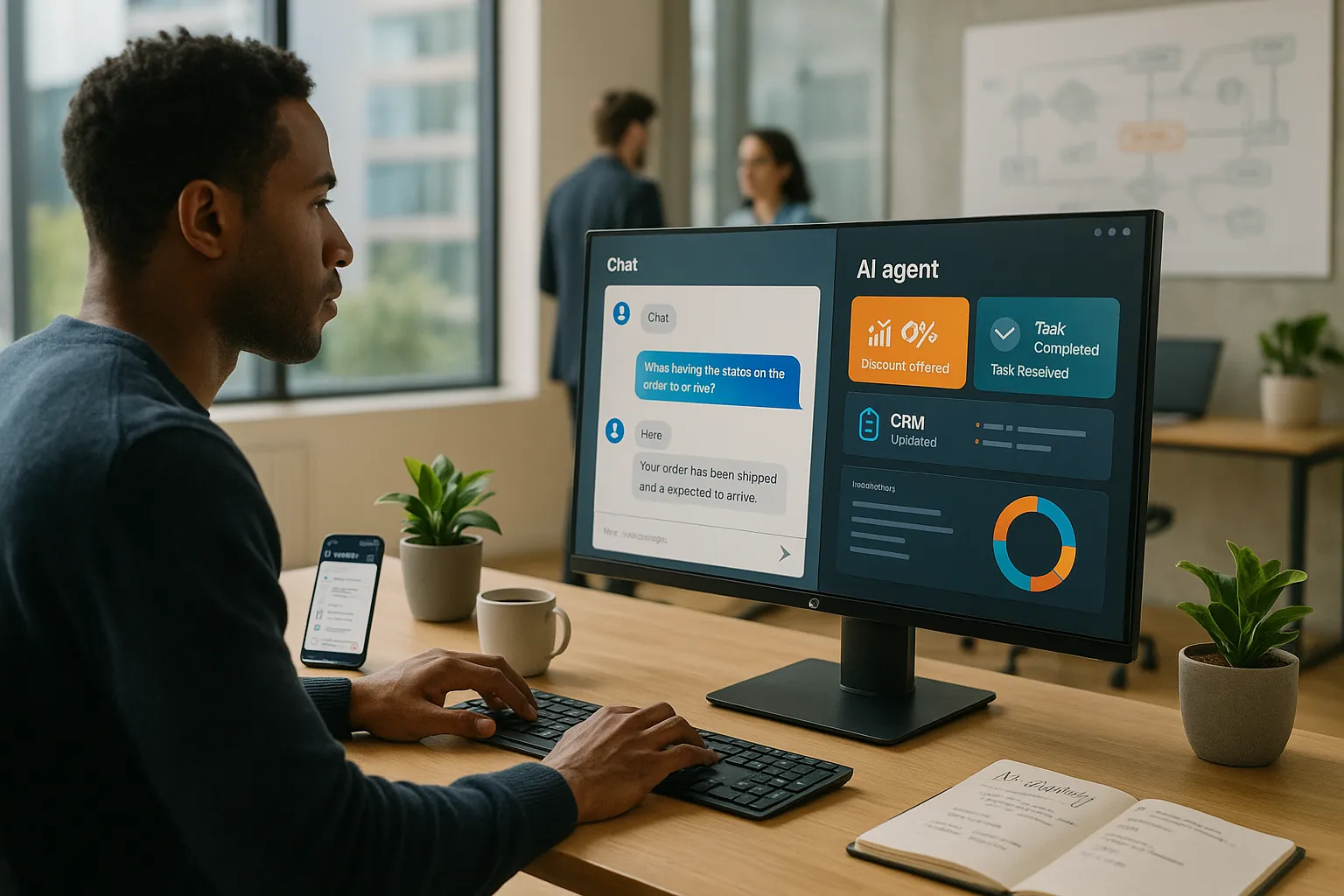
A single AI agent, no matter how sophisticated, eventually hits limits. Context windows constrain how much information it can process at once. Specialization trade-offs mean that agents optimized for one type of task underperform on others. Sequential processing creates bottlenecks when multiple independent tasks need to happen simultaneously.
Multi-agent systems solve these problems through division of labor. Rather than building one agent that does everything, you build multiple specialized agents that collaborate. A research agent gathers information. An analysis agent interprets it. A writing agent drafts communications. A review agent checks quality. Each agent excels at its specific function, and together they accomplish work that would overwhelm any individual agent.
This is not a theoretical architecture. Production multi-agent AI systems are handling customer service escalations, processing complex documents, managing sales pipelines, and coordinating business workflows across thousands of organizations. As of May 2026, frameworks like AutoGen v0.4, CrewAI, LangGraph, and the OpenAI Agents SDK have matured into production-grade tooling, and open standards like Anthropic’s Model Context Protocol (MCP) and Google’s Agent-to-Agent (A2A) protocol are making cross-platform agent collaboration practical. The shift from single-agent to multi-agent thinking represents the next maturity level in AI deployment.
Understanding how to design, coordinate, and monitor multi-agent LLM systems has become essential knowledge for anyone building serious AI automation. The patterns are still emerging, but clear best practices have developed from the systems that work in production.
What you'll learn
This guide covers the four canonical multi-agent patterns (supervisor, hierarchical, network, swarm), how the leading 2026 multi-agent frameworks compare (AutoGen v0.4 vs CrewAI vs LangGraph vs OpenAI Agents SDK), how MCP and A2A fit together, and how to design agent communication, observability, and conflict resolution for production.
Why Multi-Agent Architecture Matters
Before diving into architecture patterns, let us understand why multi-agent systems outperform single agents for complex tasks.
The Specialization Advantage
Just as human organizations benefit from specialized roles, AI systems benefit from specialized agents. A single general-purpose agent faces contradictory optimization pressures:
- Detailed knowledge in one domain means less attention to others
- Prompts optimized for analysis may be suboptimal for creative writing
- Security constraints for customer-facing actions may limit internal operations
- Context windows fill up quickly when handling multiple concerns
Specialized agents resolve these tensions by focusing each agent on what it does best.
The T-Shaped Agent Principle
Effective multi-agent systems use “T-shaped” agents: broad enough capabilities to communicate with other agents and understand overall context, deep expertise in their specific domain. This mirrors effective human team composition.
Parallel Processing Capability
Single agents process tasks sequentially. Multi-agent systems can parallelize independent tasks:
Single Agent Approach:
Gather data from CRM (30 seconds)
→ Analyze customer history (45 seconds)
→ Research market context (60 seconds)
→ Draft proposal (90 seconds)
→ Review for quality (30 seconds)
Total: 4+ minutes
Multi-Agent Approach:
Parallel:
  - Data Agent: Gather CRM data (30 seconds)
  - Research Agent: Market context (60 seconds)
  - History Agent: Customer analysis (45 seconds)
Wait for all
→ Synthesis Agent: Draft proposal (90 seconds)
→ Review Agent: Quality check (30 seconds)
Total: 3 minutes (25% faster)
For tasks with more parallel opportunities, the speedup becomes even more significant.
Fault Isolation
When a single agent fails, the entire system fails. Multi-agent architectures provide natural fault isolation. If the research agent encounters an API error, other agents continue working while the research agent retries or degrades gracefully. The overall system maintains partial functionality instead of complete failure.
The Multi-Agent System Reference Architecture
Before diving into specific patterns, it helps to see the layers that every production multi-agent system shares. Whether you build on AutoGen, CrewAI, LangGraph, or the OpenAI Agents SDK, the same stack appears:
graph TD
    U[User / Trigger] --> O[Orchestration Layer<br/>routing, planning, handoffs]
    O --> A1[Specialist Agent 1<br/>research]
    O --> A2[Specialist Agent 2<br/>analysis]
    O --> A3[Specialist Agent 3<br/>writing]
    A1 --> T[Tool Layer<br/>MCP servers, APIs, DBs]
    A2 --> T
    A3 --> T
    A1 --> M[Shared Memory & State<br/>blackboard, vector store, scratchpad]
    A2 --> M
    A3 --> M
    O --> COMM[Inter-Agent Communication<br/>A2A protocol, message bus]
    COMM --> EXT[External Agents<br/>partner systems]
    O --> OBS[Observability<br/>traces, evals, replay]
Five layers matter: orchestration (who decides what happens next), specialist agents (the actual workers), a tool layer (typically exposed via MCP), shared memory and state, and observability. Inter-agent communication via Google’s A2A protocol increasingly bridges across organizational boundaries. The patterns below describe different ways of wiring the orchestration and communication layers.
Core Multi-Agent Patterns
Four canonical multi-agent architecture patterns have emerged in production systems and are now first-class primitives in frameworks like LangGraph and the OpenAI Agents SDK: supervisor, hierarchical, network, and swarm. Each suits different use cases and complexity levels. For a broader catalog that includes single-agent pipelines and routing topologies, see our guide to AI agent orchestration patterns.
Pattern 1: Supervisor (Hierarchical Orchestration)
The most common pattern uses a central supervisor or orchestrator agent that coordinates specialist agents. This is the default in CrewAI’s “Crew” model, the OpenAI Agents SDK’s manager pattern, and LangGraph’s create_supervisor prebuilt:
graph TD
    A[User Request] --> B[Orchestrator Agent]
    B --> C{Task Decomposition}
    C --> D[Research Agent]
    C --> E[Analysis Agent]
    C --> F[Writing Agent]
    D --> G[Results]
    E --> G
    F --> G
    G --> B
    B --> H[Synthesized Response]
    H --> I[User]
How It Works:
- Orchestrator receives the request and breaks it into subtasks
- Orchestrator delegates subtasks to appropriate specialist agents
- Specialist agents execute and return results
- Orchestrator synthesizes results into coherent output
Strengths:
- Clear accountability and control flow
- Easy to understand and debug
- Natural escalation path to humans
Weaknesses:
- Orchestrator becomes bottleneck and single point of failure
- May not scale well for highly dynamic tasks
- Orchestrator must understand all specialists well enough to delegate effectively
Best For: Well-defined workflows with clear task decomposition, situations requiring human oversight of the overall process.
Pattern 2: Hierarchical (Supervisor of Supervisors)
When a single supervisor becomes overloaded, you nest supervisors. A top-level supervisor delegates to mid-level supervisors, each of which manages their own team of specialists. This is the structure Anthropic’s Claude Code sub-agents and LangGraph’s hierarchical teams expose:
graph TD
    U[User Request] --> Top[Top Supervisor]
    Top --> S1[Research Supervisor]
    Top --> S2[Build Supervisor]
    S1 --> R1[Web Researcher]
    S1 --> R2[Doc Researcher]
    S2 --> B1[Code Agent]
    S2 --> B2[Test Agent]
    R1 --> S1
    R2 --> S1
    B1 --> S2
    B2 --> S2
    S1 --> Top
    S2 --> Top
    Top --> Out[Final Output]
How It Works:
- A top-level supervisor decomposes the request into domain-level subgoals
- Mid-level supervisors own each domain and manage their own specialists
- Specialists run with isolated context windows (a key benefit of Claude Code sub-agents)
- Results bubble back up the tree
Strengths:
- Scales beyond what a single supervisor can manage
- Context isolation at each level prevents prompt bloat
- Mirrors how human organizations structure work
Weaknesses:
- More handoffs mean more latency
- Errors compound across levels
- Requires careful design of what each layer knows about
Best For: Large workflows (research-heavy, multi-domain proposals) where one supervisor cannot reasonably hold the whole task in context.
Pattern 3: Network (Peer-to-Peer Collaboration)
Agents communicate directly with each other without a central orchestrator. This is LangGraph’s “network” topology and the default in many AutoGen GroupChat configurations:
graph TD
    A[Research Agent] <--> B[Analysis Agent]
    B <--> C[Writing Agent]
    C <--> D[Review Agent]
    A <--> D
    A <--> C
    B <--> D
How It Works:
- Agents are aware of each other’s capabilities
- Each agent can request help from others when needed
- Work flows organically based on task requirements
- No single point of control
Strengths:
- More flexible and adaptive
- No single point of failure
- Can handle emergent workflows
Weaknesses:
- Harder to debug and monitor
- Risk of circular dependencies or infinite loops
- Coordination overhead scales with agent count
Best For: Exploratory tasks where workflow cannot be predetermined, creative work requiring iterative refinement.
Pattern 4: Swarm (Handoff-Based)
Popularized by OpenAI’s experimental Swarm framework (now superseded by the OpenAI Agents SDK) and adopted as a first-class pattern in LangGraph’s create_swarm, the swarm pattern uses explicit handoffs between peer agents. There is no orchestrator; the active agent decides when to transfer control to a more appropriate teammate:
graph LR
    U[User] --> Triage[Triage Agent]
    Triage -->|handoff: billing| Billing[Billing Agent]
    Triage -->|handoff: tech| Tech[Tech Agent]
    Billing -->|handoff: refund| Refund[Refund Agent]
    Tech -->|handoff: account| Account[Account Agent]
    Billing -.->|handoff back| Triage
    Tech -.->|handoff back| Triage
How It Works:
- One agent is active at any moment and owns the conversation
- Agents are equipped with
handofftools that transfer control to a named peer - The receiving agent inherits the conversation context and continues
- Routing decisions are made locally, not by a central planner
Strengths:
- Extremely lightweight, fewer moving parts than supervisor patterns
- Natural fit for customer service routing and tiered support
- Each agent stays focused on its specialty
Weaknesses:
- No global view of the workflow
- Risk of handoff loops between agents
- Harder to enforce SLAs or budgets without a supervisor
Best For: Customer service triage, sales qualification, any workflow where a single conversation moves through specialized stages.
Pattern 5: Pipeline Architecture
Agents arranged in sequence, each transforming input for the next:
graph LR
    A[Input] --> B[Collection Agent]
    B --> C[Enrichment Agent]
    C --> D[Analysis Agent]
    D --> E[Formatting Agent]
    E --> F[Output]
How It Works:
- Data flows through agents in fixed sequence
- Each agent transforms and enriches the data
- Output of one agent becomes input of the next
- Final agent produces the deliverable
Strengths:
- Simple to understand and implement
- Easy to test and debug
- Clear responsibility boundaries
Weaknesses:
- Inflexible to varying task requirements
- Later agents wait for earlier agents
- Error propagation through the chain
Best For: Document processing, data transformation, content generation workflows with consistent structure.
Pattern 6: Blackboard Architecture
Agents share a common workspace and contribute when they have relevant input:
graph TD
    A[Shared Blackboard/State]
    B[Research Agent] --> A
    C[Analysis Agent] --> A
    D[Synthesis Agent] --> A
    E[Quality Agent] --> A
    A --> B
    A --> C
    A --> D
    A --> E
How It Works:
- Central “blackboard” holds shared state and partial results
- Agents monitor blackboard for work they can contribute to
- Agents write their outputs to the blackboard
- Process continues until blackboard reaches completion criteria
Strengths:
- Highly flexible and adaptive
- Agents can work asynchronously
- Good for problems where the solution emerges iteratively
Weaknesses:
- Complex coordination logic
- Potential for race conditions
- Harder to predict completion time
Best For: Complex problem-solving requiring multiple perspectives, situations where the path to solution is unclear.
Pattern Selection at a Glance
| Pattern | Coordination | Best For | Avoid When |
|---|---|---|---|
| Supervisor | One central planner | Well-defined workflows, audit-heavy domains | You need flexible, emergent behavior |
| Hierarchical | Nested supervisors | Large, multi-domain tasks needing context isolation | Latency is critical, task is narrow |
| Network | Peer-to-peer | Exploratory, creative, research tasks | You need deterministic outcomes |
| Swarm | Handoff between peers | Triage, routing, tiered support | You need global plan visibility |
| Pipeline | Fixed sequence | Document processing, ETL-style flows | Inputs are highly variable |
| Blackboard | Shared workspace | Open-ended problem-solving with multiple experts | Coordination overhead is unacceptable |
Multi-Agent Frameworks in 2026
The multi-agent framework landscape has consolidated significantly. By May 2026, four production-ready options dominate: AutoGen v0.4, CrewAI, LangGraph, and the OpenAI Agents SDK. Each takes a different philosophical bet on how multi-agent LLM systems should be built.
AutoGen v0.4 (Microsoft)
Microsoft’s AutoGen v0.4 was a ground-up rewrite released in early 2025 that replaced the original synchronous chat-oriented design with an asynchronous, event-driven, actor-based runtime. Agents communicate via typed messages on a message bus, which makes distributed deployment, observability, and long-running workflows far more practical than in v0.2. AutoGen Studio provides a low-code visual designer, and the Magentic-One system ships as a production-grade generalist multi-agent reference.
- Best at: Distributed, long-running multi-agent workflows; research-oriented systems
- Trade-off: Steeper learning curve; the event-driven model is unfamiliar to teams used to LangChain
- Native pattern support: GroupChat (network), nested teams (hierarchical)
CrewAI
CrewAI emphasizes a role-based mental model: you define agents with role, goal, and backstory, then organize them into Crews (collaborative teams) or Flows (event-driven processes). It is the easiest framework to read out loud to a non-engineer stakeholder, which has made it the most popular framework for business workflow automation. CrewAI Enterprise adds managed deployment, monitoring, and a no-code crew builder.
- Best at: Business process automation, fast prototyping with non-technical collaborators
- Trade-off: Less flexible than LangGraph for non-standard topologies
- Native pattern support: Supervisor (Crews), Pipeline (Flows)
LangGraph (LangChain)
LangGraph models multi-agent systems as stateful graphs where nodes are agents or tools and edges are control-flow decisions. It is the most flexible of the four — any of the canonical patterns above can be expressed directly — and ships with prebuilt helpers like create_supervisor, create_swarm, and create_react_agent. LangGraph Platform provides managed deployment with built-in persistence and human-in-the-loop checkpoints.
- Best at: Complex, stateful workflows requiring precise control; human-in-the-loop systems
- Trade-off: More verbose than CrewAI; you write graph code, not declarative roles
- Native pattern support: Supervisor, hierarchical, network, swarm, custom
OpenAI Agents SDK
Released in March 2025 as the production successor to the experimental Swarm framework, the OpenAI Agents SDK is intentionally minimal: agents, tools, handoffs, guardrails, and tracing — and not much else. It pairs tightly with OpenAI’s Responses API and built-in tools (web search, file search, code interpreter, computer use). For teams already committed to OpenAI models, it is the lowest-friction path to production multi-agent systems.
- Best at: OpenAI-native stacks, swarm and supervisor patterns, fast time to production
- Trade-off: Less portable across model providers than LangGraph or AutoGen
- Native pattern support: Swarm (handoffs), supervisor (manager pattern)
Framework Comparison: AutoGen vs CrewAI vs LangGraph vs OpenAI Agents SDK
| Dimension | AutoGen v0.4 | CrewAI | LangGraph | OpenAI Agents SDK |
|---|---|---|---|---|
| Mental model | Event-driven actors | Role-based crews | Stateful graphs | Agents + handoffs |
| Best pattern | Network, hierarchical | Supervisor, pipeline | All canonical patterns | Swarm, supervisor |
| Async / distributed | First-class | Limited | Via LangGraph Platform | Via Responses API |
| Model portability | High (any provider) | High (any provider) | High (any provider) | OpenAI-first |
| Learning curve | Steep | Gentle | Moderate | Gentle |
| Best for | Research, distributed agents | Business workflows | Stateful production systems | OpenAI-native production |
Which framework should you pick?
Default to LangGraph if you need maximum control and plan to evolve the topology. Pick CrewAI when business stakeholders need to read the code. Choose AutoGen v0.4 for distributed, long-running research-style workflows. Use the OpenAI Agents SDK when you are already all-in on OpenAI and want the fastest path to production.
Open Protocols: MCP and A2A
Two open protocols ratified in 2024–2025 now anchor how multi-agent systems integrate with the broader ecosystem. Treating these as separate concerns is the single biggest architectural lever for keeping multi-agent systems maintainable.
Model Context Protocol (MCP)
Anthropic introduced the Model Context Protocol in November 2024 as an open standard for connecting LLMs and agents to external tools and data sources. By 2026, MCP has been adopted by OpenAI, Google, Microsoft, and most major framework vendors. An MCP server exposes tools, resources, and prompts; any MCP-compatible agent can use them without custom integration code.
In a multi-agent context, MCP solves the agent-to-tool problem: every agent in your system can reach the same set of MCP servers (CRM, file storage, internal APIs) through a single, audit-friendly protocol. If you are exposing internal systems to agents this way, our guide to building MCP servers for production AI agents covers the implementation details.
Agent-to-Agent Protocol (A2A)
Google announced the Agent-to-Agent (A2A) protocol in April 2025 as the complement to MCP. Where MCP standardizes how agents talk to tools, A2A standardizes how agents talk to other agents — including agents owned by other organizations, built on other frameworks, or running on other infrastructure.
A2A defines agent discovery (via agent.json cards), task lifecycle, structured message exchange, and streaming updates. It makes cross-platform agent collaboration practical: a CrewAI sales agent can hand work to a LangGraph procurement agent at a partner company without either side reimplementing the other’s SDK.
How MCP and A2A Fit Together
graph TD
    A[Agent A<br/>your org] -- A2A --> B[Agent B<br/>partner org]
    A -- A2A --> C[Agent C<br/>internal team]
    A -- MCP --> T1[CRM Tool]
    A -- MCP --> T2[Database Tool]
    B -- MCP --> T3[Partner ERP]
    C -- MCP --> T4[Internal API]
The mental model is clean: MCP is south-bound (agent to tool), A2A is east-west (agent to peer agent). Designing around both protocols from day one is the difference between a multi-agent system you can extend and one you have to rebuild every time a new partner or tool appears.
Designing Agent Communication
Effective multi-agent systems require well-designed communication protocols. Agents must exchange information reliably, efficiently, and in ways that preserve meaning.
Message Structure
Agent messages should be structured and explicit:
| Component | Purpose | Example |
|---|---|---|
| Task ID | Track related messages | “proposal-2026-04-28-001” |
| Sender | Identify source | “research-agent” |
| Recipient | Identify destination | “synthesis-agent” |
| Message Type | Indicate purpose | “data-delivery” / “clarification-request” |
| Payload | Actual content | Structured data or text |
| Context | Relevant background | References to related messages |
| Priority | Urgency indicator | “normal” / “high” / “critical” |
Avoid Ambiguous Communication
Natural language between agents works in demos but fails in production. Agents misinterpret each other, lose context, and make assumptions. Production multi-agent systems use structured formats (JSON, typed messages) for reliability.
Communication Patterns
Request-Response: One agent requests information or action, another responds. Simple and reliable but synchronous.
Publish-Subscribe: Agents publish updates to topics, interested agents subscribe. Good for status updates and non-blocking communication.
Event-Driven: Agents emit events when significant things happen. Other agents react to relevant events. Enables loose coupling.
Streaming: Continuous data flow between agents. Useful for real-time processing of long-running tasks.
Context Sharing Strategies
Agents need shared context to collaborate effectively, but sharing everything creates bloat and confusion. Effective strategies include:
Hierarchical Summarization: Each agent maintains its full context internally but shares summarized versions with collaborators.
Shared Memory Store: Key facts and decisions stored in a common location all agents can access.
Context Handoffs: When work transfers between agents, the sender packages relevant context explicitly rather than expecting the receiver to figure it out.
Building Specialist Agents
The quality of a multi-agent system depends on the quality of its component agents. Here is how to design effective specialist agents.
Agent Role Definition
Each agent needs a clear role definition that includes:
Purpose: What problem does this agent solve? What value does it add?
Capabilities: What can this agent do? What tools and data does it access?
Constraints: What is this agent NOT allowed to do? What are its boundaries?
Interfaces: How do other agents interact with this one? What inputs does it accept, what outputs does it produce?
Agent Role Definition
❌Before AI
- •Vague purpose: 'Handle research tasks'
- •Unlimited scope leading to inconsistent behavior
- •No clear boundaries with other agents
- •Ad-hoc communication format
- •Unclear quality standards
✨With AI
- •Specific purpose: 'Gather and validate company information from public sources'
- •Defined capabilities: web search, SEC filings, news retrieval
- •Clear boundaries: no direct customer contact, read-only data access
- •Structured input/output specifications
- •Explicit quality criteria and validation rules
📊 Metric Shift: Agent reliability improves by 60% with clear role definition
Common Specialist Roles
Certain specialist roles appear frequently in production multi-agent systems:
Research Agent: Gathers information from various sources, validates accuracy, synthesizes findings. Excels at breadth of knowledge retrieval.
Analysis Agent: Interprets data, identifies patterns, draws conclusions, makes recommendations. Optimized for reasoning depth.
Writing Agent: Produces clear, contextually appropriate text. May specialize in tone (formal, casual) or format (email, report, proposal).
Review Agent: Evaluates quality, identifies errors, suggests improvements. Provides quality assurance for other agents’ work.
Orchestrator Agent: Coordinates other agents, manages workflow, handles exceptions. Sees the big picture.
Tool Agent: Interfaces with specific external systems (CRM, databases, APIs). Abstracts technical complexity from other agents. In 2026, most tool agents are thin wrappers around MCP servers.
Anthropic Sub-Agents as a Specialist Pattern
Anthropic’s Claude Code sub-agents (introduced in 2025) implement specialist agents as isolated context children of a primary agent. Each sub-agent gets a fresh context window, a focused system prompt, and a tightly scoped tool list. This pattern — strict context isolation per specialist — is now standard practice across all four major multi-agent frameworks and is one of the most effective ways to keep agent orchestration affordable at scale.
Agent Autonomy Levels
Just as individual agents require appropriate autonomy decisions, multi-agent systems need autonomy design at the system level:
| Agent Type | Typical Autonomy | Rationale |
|---|---|---|
| Research | High | Read-only, reversible, low risk |
| Analysis | High | Internal processing, no external effects |
| Writing | Medium | Output may need human review before sending |
| Action | Low-Medium | External effects require oversight |
| Orchestrator | Variable | Depends on overall system autonomy |
Coordination and Conflict Resolution
When multiple agents work together, they inevitably encounter coordination challenges and conflicts that must be resolved.
Task Allocation
How do you decide which agent handles which task? Several strategies exist:
Capability-Based: Route tasks to agents based on declared capabilities. Simple but requires accurate capability declarations.
Load-Based: Distribute tasks to balance work across agents. Important for high-volume systems.
Auction-Based: Agents “bid” on tasks based on their confidence and availability. More complex but can optimize allocation.
Fixed Routing: Predetermined rules assign task types to specific agents. Simplest to implement and debug.
Handling Disagreements
Agents may produce conflicting outputs or make incompatible decisions. Resolution strategies include:
Voting: Multiple agents weigh in, majority or weighted vote determines outcome.
Hierarchy: Designated agent (or human) breaks ties.
Evidence-Based: Agent that provides strongest supporting evidence wins.
Escalation: Conflicting outputs trigger human review.
graph TD
    A[Conflict Detected] --> B{Severity Level?}
    B -->|Low| C[Automated Resolution]
    B -->|Medium| D[Orchestrator Decides]
    B -->|High| E[Human Review]

    C --> F{Resolution Strategy}
    F -->|Voting| G[Majority Wins]
    F -->|Evidence| H[Best Supported Wins]
    F -->|Default| I[Use Fallback Policy]

    D --> J[Orchestrator Weighs Options]
    J --> K[Decision Logged]

    E --> L[Human Makes Decision]
    L --> M[Agents Learn from Decision]
Deadlock Prevention
Multi-agent systems can deadlock when agents wait for each other indefinitely. Prevention strategies:
Timeouts: Agents do not wait forever. After timeout, they proceed with defaults or escalate.
Dependency Analysis: Avoid creating circular dependencies in task assignment.
Resource Ordering: When multiple resources are needed, acquire in consistent order to prevent deadlock.
Monitoring: Track agent states and detect potential deadlocks before they fully form.
Observability for Multi-Agent Systems
Debugging multi-agent systems is notoriously difficult. You need observability strategies designed for distributed agent execution.
Distributed Tracing
Trace requests across all agents involved in processing:
- Trace ID: Unique identifier following the request through the entire system
- Span per Agent: Each agent’s processing recorded as a span within the trace
- Parent-Child Relationships: Show how work was delegated and returned
- Timing Information: Duration of each span enables bottleneck identification
Tracing Best Practices
Every message between agents should carry trace context. This enables reconstructing the complete path of any request, essential for debugging issues that span multiple agents.
Key Metrics for Multi-Agent Systems
| Metric | What It Measures | Why It Matters |
|---|---|---|
| End-to-end latency | Total time from request to response | User experience |
| Per-agent latency | Time each agent takes | Identifies slow agents |
| Handoff latency | Time between agents | Identifies communication bottlenecks |
| Agent utilization | How busy each agent is | Capacity planning |
| Conflict rate | How often agents disagree | System design quality |
| Escalation rate | How often humans are needed | Autonomy calibration |
Debugging Complex Interactions
When multi-agent systems fail, the cause may not be in any single agent. Debugging strategies:
Replay Capability: Record all messages and be able to replay scenarios for debugging.
State Snapshots: Capture system state at key points to understand how it evolved.
Counterfactual Analysis: What would have happened if a specific message had been different?
Blame Assignment: When output is wrong, which agent’s contribution caused the problem?
Production Considerations
Moving multi-agent systems from development to production introduces additional challenges.
Scaling Strategies
Multi-agent systems scale differently than single-agent systems:
Horizontal Agent Scaling: Run multiple instances of bottleneck agents.
Load Balancing: Distribute requests across agent instances.
Queue-Based Architecture: Decouple agents with message queues to handle traffic bursts.
Auto-Scaling: Spin up additional agent capacity based on demand.
Failure Modes and Recovery
Production multi-agent systems must handle failures gracefully:
Agent Failure: Another instance takes over, or graceful degradation occurs.
Communication Failure: Retry with backoff, or route through alternative path.
Cascade Failure: Circuit breakers prevent one failing agent from overwhelming others.
State Corruption: Checkpoints enable recovery to last known good state.
Cost Management
Multi-agent systems can have complex cost profiles:
- Each agent interaction may incur model API costs
- Communication overhead adds latency and resource usage
- Redundant processing when multiple agents analyze the same data
Strategies for cost control:
Result Caching: Share expensive operation results between agents rather than recomputing.
Batching: Aggregate similar requests to reduce per-request overhead.
Model Tiering: Use cheaper models for routine agent tasks, expensive models only when needed.
Conversation Pruning: Limit inter-agent conversation length to control context costs.
Real-World Multi-Agent Examples
Let us examine how multi-agent patterns apply to concrete business scenarios.
Example 1: Customer Support Escalation
Customer Message
→ Triage Agent: Categorize and assess urgency
→ [If simple] FAQ Agent: Provide standard response
→ [If complex] Research Agent: Gather customer history
         ↓
    Analysis Agent: Understand issue context
         ↓
    Resolution Agent: Propose solution
         ↓
    Review Agent: Verify appropriateness
→ Response delivered or escalated to human
This system handles 70% of inquiries autonomously while ensuring quality through the review agent.
Example 2: Proposal Generation
Opportunity Context
→ Orchestrator: Plan proposal approach
→ Parallel:
    - Research Agent: Company background, industry context
    - Pricing Agent: Historical pricing, discount rules
    - Technical Agent: Solution requirements
→ Synthesis Agent: Draft proposal sections
→ Writing Agent: Polish prose
→ Compliance Agent: Verify terms and claims
→ Review Agent: Final quality check
→ Ready for human review and sending
This system reduces proposal creation time from days to hours.
Example 3: Financial Document Processing
Document Upload
→ Classification Agent: Identify document type
→ Extraction Agent: Pull relevant data fields
→ Validation Agent: Cross-check extracted data
→ Enrichment Agent: Add contextual information
→ Reconciliation Agent: Compare with existing records
→ Exception Agent: Flag discrepancies for review
→ Processed data enters downstream systems
This pipeline processes thousands of documents daily with minimal human intervention.
metacto’s Multi-Agent Approach
At metacto, we design and implement production multi-agent systems as part of our Enterprise Context Engineering offering. Our experience spans from simple two-agent systems to complex multi-agent architectures handling critical business processes.
Our approach emphasizes:
Right-Sized Architecture: Not every problem needs a multi-agent solution. We help you identify when single-agent, multi-agent, or hybrid approaches best fit your needs.
Production-First Design: Our Agentic Workflows incorporate multi-agent patterns designed for reliability, observability, and maintainability from day one.
Graceful Scaling: Systems designed to grow with your needs, from initial deployment through enterprise-wide adoption.
Context Integration: Multi-agent systems that leverage your company’s data and context through our Autonomous Agents methodology.
For organizations building sophisticated AI automation, our AI development services include multi-agent architecture design, implementation, and ongoing optimization.
Ready to Explore Multi-Agent AI?
Complex problems deserve sophisticated solutions. Talk with our team about designing multi-agent systems that deliver capabilities beyond what single agents can achieve.
Frequently Asked Questions
When should I use multi-agent systems instead of a single agent?
Consider multi-agent systems when tasks require multiple types of expertise, when independent subtasks can be parallelized, when you need fault isolation between different functions, or when single-agent context windows are insufficient. If your single agent is handling diverse tasks with different requirements, multi-agent architecture often improves both quality and reliability.
How do I prevent multi-agent systems from becoming too complex?
Start with the minimum number of agents needed, add new agents only when clear value is demonstrated, use consistent patterns across all agents, implement strong observability from the start, and document agent responsibilities clearly. Complexity should be justified by corresponding value.
How do agents communicate with each other?
Production systems use structured message formats (typically JSON) with explicit schemas rather than natural language. Messages include task IDs for tracking, sender and recipient identification, message type, structured payload, and relevant context. This structured approach provides reliability that natural language communication lacks.
What happens when agents disagree?
Multi-agent systems need explicit conflict resolution strategies. Options include voting (majority wins), hierarchy (designated agent decides), evidence-based resolution (best-supported position wins), or escalation to human review for high-stakes conflicts. The appropriate strategy depends on the nature of the conflict and its potential impact.
How do I debug multi-agent systems?
Implement distributed tracing with trace IDs that follow requests across all agents. Record all inter-agent messages for replay. Capture state snapshots at key points. Track per-agent metrics to identify which agents contribute to problems. Invest in observability infrastructure early - debugging without it is extremely difficult.
Are multi-agent systems more expensive to run?
Multi-agent systems have more complex cost profiles but are not necessarily more expensive. They can reduce costs through parallelization (faster completion), specialization (using smaller models for appropriate tasks), and caching (sharing results between agents). However, communication overhead and potential redundant processing require careful cost management.
How many agents should a system have?
Start with the minimum needed to address your core use case - often 2-4 agents. Add agents only when specific needs justify them. Each agent adds coordination complexity, so additional agents must provide value that exceeds their overhead. Production systems typically range from 3 to 10 agents depending on task complexity.
AutoGen vs CrewAI vs LangGraph: which multi-agent framework should I use?
Pick LangGraph when you need maximum control over a stateful workflow and expect the topology to evolve - it supports all canonical patterns (supervisor, hierarchical, network, swarm) and ships with prebuilt helpers. Pick CrewAI when business stakeholders need to read the code; its role-based 'crew' model is the most readable. Pick AutoGen v0.4 for distributed, event-driven, long-running research-style workflows where its actor-based runtime shines. Pick the OpenAI Agents SDK when you are already committed to OpenAI's stack and want the fastest path to production with the swarm or supervisor pattern.
What is the difference between MCP and A2A?
Anthropic's Model Context Protocol (MCP) standardizes how an agent talks to tools and data sources - it is 'south-bound' from the agent to its environment. Google's Agent-to-Agent (A2A) protocol standardizes how agents talk to other agents, including agents owned by other organizations or built on other frameworks - it is 'east-west' between peers. They are complementary: production multi-agent systems in 2026 typically use MCP for tool access and A2A for cross-platform agent collaboration.
What is an agent swarm and when should I use one?
An agent swarm is a multi-agent pattern where peer agents transfer control to each other via explicit handoffs, with no central orchestrator. The currently active agent decides when to hand off to a more appropriate teammate. This pattern, popularized by OpenAI's Swarm framework and adopted into the OpenAI Agents SDK and LangGraph, is ideal for customer service triage, sales qualification, and other workflows where a single conversation moves through specialized stages. Avoid swarms when you need a global view of the workflow or strict SLA enforcement.
Sources: