

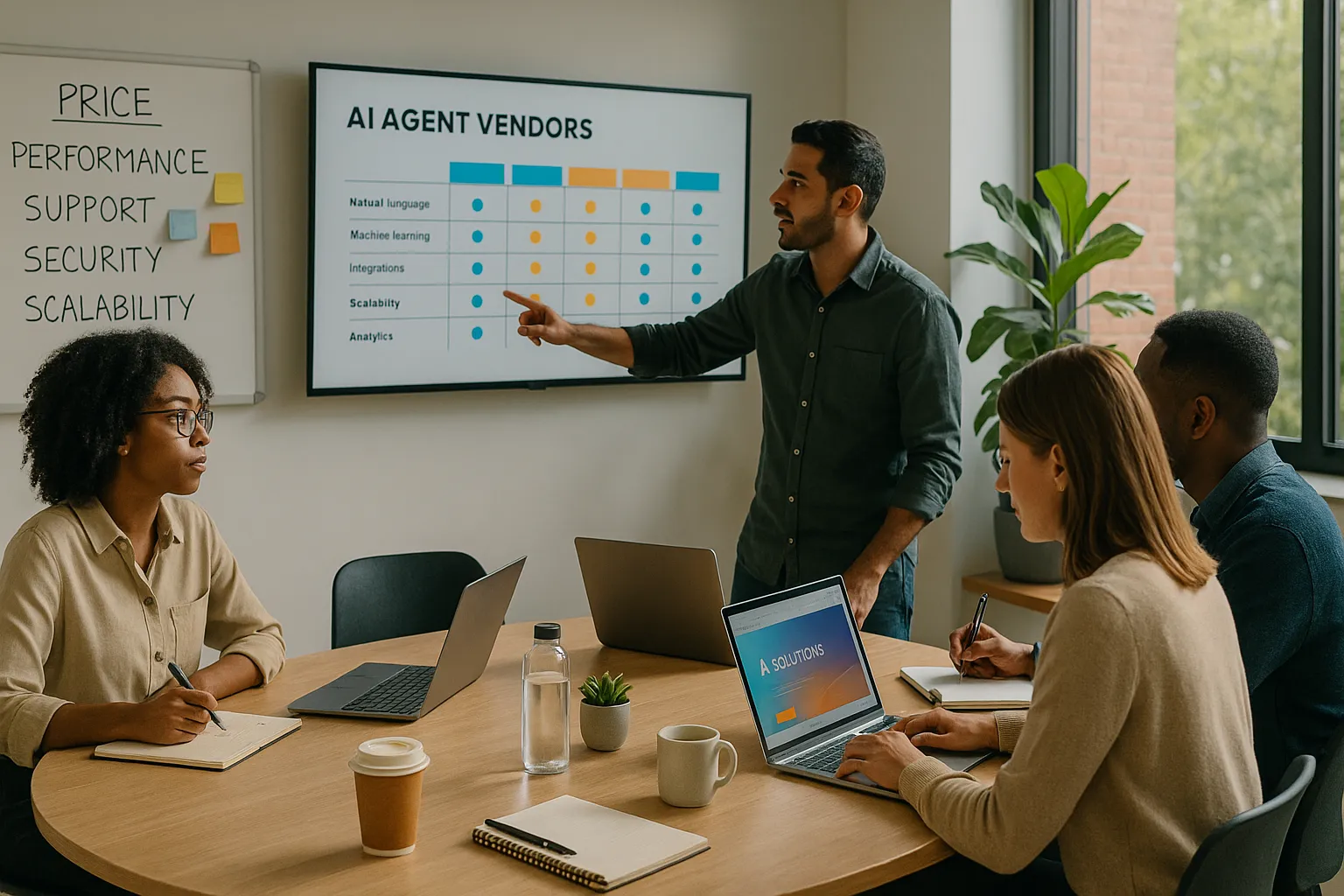
A CTO recently described her AI agent vendor evaluation as “drinking from a firehose of marketing claims.” Every platform promises transformative results. Every vendor claims enterprise-readiness. Yet by May 2026, the market has actually sorted itself into recognizable categories with clear leaders - and the gap between the demo and production reality has only widened.
This guide ranks the AI agent vendors that matter right now, compares them in a single table near the top so you can scan quickly, then gives you the evaluation framework metacto uses with mid-market and enterprise clients. We focus on capabilities and trade-offs rather than rankings that will be obsolete in six months.
The 2026 AI Agent Vendor Landscape at a Glance
The market consolidated faster than most analysts predicted. Google acqui-hired Windsurf’s founders for $2.4 billion in 2025, Cognition acquired the rest of Windsurf for $250 million and embedded Devin Cloud inside the IDE in the April 2026 Windsurf 2.0 release, and Microsoft Copilot Studio now reports over 160,000 organizations running 400,000+ custom agents. Vendors that looked competitive 12 months ago have been absorbed, repositioned, or quietly shelved.
The current field sorts into four categories:
| Category | Leading Vendors | Buyer | Typical Price |
|---|---|---|---|
| Coding agents | Claude Code, Cursor, Devin/Windsurf, OpenAI Codex, GitHub Copilot | Engineering teams | $10-$200/user/month |
| Customer service agents | Salesforce Agentforce, Sierra, Decagon, Ada | CX and support orgs | $2-$5 per resolved conversation, or seat-based |
| Internal automation / low-code | Microsoft Copilot Studio, UiPath AI Agents, IBM watsonx Orchestrate | IT, ops, business analysts | $200-$2,000/user/month + consumption |
| Enterprise agent infrastructure | AWS Bedrock AgentCore, Google Vertex AI Agent Builder, Azure AI Foundry | Platform engineering teams | Consumption-based (tokens + compute) |
| Developer frameworks | LangChain / LangGraph, CrewAI, Vercel AI SDK, Anthropic Agent SDK | Engineering teams building custom | Open source + LLM costs |
The vendor you should pick depends almost entirely on which row you’re in - and most enterprises end up in two or three rows simultaneously, which is the real source of buyer confusion.
Coding Agents: The Most Mature Category
Coding agents are the most battle-tested AI agents in production today. The leaders have differentiated by workflow rather than raw model quality.
Claude Code (Anthropic) is the terminal-first agent for senior engineers doing multi-file refactors, complex debugging, and codebase-wide reasoning. Pricing starts at $20/month Pro (Sonnet 4.7) with a $200/month Max tier that unlocks Opus 4.7. It’s the strongest choice for engineers who already live in the terminal and want an agent that respects their existing workflow.
Cursor remains the default IDE-native answer. At $1.2B ARR, it owns the “best completions plus file-aware editing” segment. Best for teams that want autocomplete on steroids without leaving the editor.
Devin / Windsurf 2.0 (Cognition) is the most autonomous coding agent on the market. Devin runs in a sandboxed cloud environment with its own IDE, browser, terminal, and shell. You assign a task, Devin plans, writes, tests, and submits a pull request. The April 2026 Windsurf 2.0 release embedded Devin Cloud directly into the IDE on every self-serve plan. Pro is $20/month, Max is $200/month, Teams is $40/user/month.
OpenAI Codex moved to the top of independent rankings in April 2026 after GPT-5.5 materially improved code quality and agentic execution inside OpenAI’s multi-surface coding workflow.
GitHub Copilot at $10/month remains the right answer for a large segment of the market - especially for organizations already standardized on GitHub and looking for predictable per-seat pricing without surprise consumption bills.
Why metacto Recommends Hybrid Stacks
Most metacto engineering pods run two coding agents simultaneously - typically Claude Code for architecture-level work plus Cursor or Copilot for line-level completions. Sticking to a single vendor leaves capability on the table. The marginal cost of a second tool is small compared to the productivity delta.
Customer Service Agents: The Highest-ROI Category
If you process thousands of support tickets per month, customer service agents are where the unit economics already work. The leaders charge $2-$5 per resolved conversation, which is dramatically cheaper than human-handled tickets.
Salesforce Agentforce is the safe enterprise choice if you’re already on Service Cloud. Deep CRM integration, the strongest governance story among CX-focused agents, and a familiar admin surface.
Sierra (founded by Bret Taylor) and Decagon have emerged as the high-end alternatives, particularly for D2C brands and SaaS companies that want polished conversational quality without the Salesforce platform tax.
Ada continues to compete strongly in the mid-market with a no-code builder and a results-based pricing model.
The selection criterion here is rarely the agent itself - it’s whether the vendor’s data connectors reach your knowledge base, ticketing system, and customer records cleanly. Integration determines outcomes.
Enterprise Platforms: Where the Real Money Goes
This is the category where the largest deals get signed and where the most buyer confusion exists.
Microsoft Copilot Studio leads by volume in 2026. Over 160,000 organizations and 400,000+ custom agents in production. Strengths: deep integration with Microsoft 365, Dynamics 365, Azure, and Teams; Microsoft Graph access to organizational knowledge; enterprise security inherited from Azure. Weakness: strong Microsoft lock-in. Agents that need to act outside the Microsoft estate require significant additional integration work.
Google Vertex AI Agent Builder provides a managed environment for building and deploying agents in Google Cloud. Strong fit if you’re already on GCP and want persistent memory, retrieval from internal data, and secure code execution managed for you.
AWS Bedrock Agents / AgentCore expanded materially at the April 2026 “What’s Next with AWS” event with new model availability, Codex integration, and expanded AgentCore managed agent capabilities. For engineering teams operating in AWS, Bedrock provides the lowest-friction path to production. The catch: Bedrock is infrastructure. Orchestration logic still needs to be built or imported from a framework like LangGraph or CrewAI. It is not a low-code business-user platform.
Salesforce Agentforce, IBM watsonx Orchestrate, UiPath AI Agents, Sana (Workday) round out the enterprise field. Each ranks highest for governance, scalability, integration depth, and SLAs in their respective ecosystem.
Developer Frameworks: The Build Path
If your team is going to build custom agents, four frameworks dominate in 2026:
LangChain / LangGraph is the production-grade standard for stateful multi-agent workflows. At v1.0, it includes durable execution and native human-in-the-loop. This is what most serious custom builds run on today.
CrewAI is the open-source multi-agent framework with 100,000+ certified developers and adoption at Deloitte, Oracle, KPMG, and Accenture. Specializes in team-of-agents setups with clear role separation.
Vercel AI SDK has matured into the standard for TypeScript-based agent development with first-class streaming, tool use, and edge deployment. The companion AI Gateway gives you unified access to OpenAI, Anthropic, Google, and others through a single API with usage tracking and failover.
Anthropic Agent SDK is the new entrant - tighter integration with Claude’s tool use and computer use features for teams that want to build directly on Anthropic’s stack.
flowchart TD
    A[What does the agent need to do?] --> B{Write code?}
    A --> C{Handle customer conversations?}
    A --> D{Automate internal workflows?}
    A --> E{Custom multi-system orchestration?}

    B --> B1[Claude Code, Cursor, Codex, Devin, Copilot]
    C --> C1[Agentforce, Sierra, Decagon, Ada]
    D --> D1[Copilot Studio, UiPath, watsonx Orchestrate]
    E --> E2{Strong AI engineering team?}

    E2 -->|Yes| E3[LangGraph, CrewAI, Vercel AI SDK on Bedrock/Vertex]
    E2 -->|No| E4[Implementation partner + framework]
Core Evaluation Criteria
Regardless of category, certain criteria apply to every vendor.
1. Enterprise Integration Capabilities
AI agents are only as useful as the data they can access and the systems they can affect.
Data source connectivity: Can the platform connect to your existing CRM, ERP, databases, document stores, and communication tools? Are connectors pre-built or does integration require custom development?
Authentication and authorization: Does it support SSO, OAuth, API keys, and your existing identity provider?
Data refresh and synchronization: How does company data get into the agent’s context? How frequently? What happens when source data changes?
Action capabilities: Beyond reading data, can agents take actions in your systems? Update records, send communications, trigger workflows?
Integration Is Still the Bottleneck
The most common cause of delayed AI agent deployments in 2026 is not the AI itself - it is the integration work required to connect agents to enterprise data and systems. Evaluate integration capabilities with particular care, and assume the vendor’s “pre-built connectors” list is optimistic.
| Integration Aspect | Key Questions |
|---|---|
| Pre-built connectors | Which systems have native integration? What development is required for others? |
| Real-time vs. batch | Can agents access live data or only periodic exports? |
| Write capabilities | Can agents update source systems or only read from them? |
| Security model | How is data access controlled? Is data encrypted in transit and at rest? |
2. Context Engineering Architecture
As we emphasize in our Enterprise Context Engineering approach, context is the foundation of effective AI agents.
Context retrieval: How does the platform find relevant information for each interaction? Vector search, keyword search, knowledge graphs?
Context size and management: How much context can fit in each interaction? How is it prioritized when more relevant information exists than fits?
Context freshness: How current is the information agents access? What mechanisms exist to update context as business information changes?
Multi-source context: Can agents combine context from multiple systems in a single interaction? How is conflicting information from different sources handled?
3. Guardrails and Governance
AI agents can cause significant harm without appropriate boundaries.
Output constraints: Can you define what agents should and should not say? How are constraints enforced?
Action limitations: Can you restrict what actions agents can take? Are there approval workflows for high-risk actions?
Compliance support: HIPAA, SOC 2, GDPR, industry-specific requirements?
Audit logging: Are all agent interactions logged? Can you reconstruct what happened and why?
Human-in-the-loop: How easily can human oversight be incorporated into agent workflows?
Governance Evaluation
❌Before AI
- •Assumed AI tools are safe by default
- •No review of constraint mechanisms
- •Compliance requirements not considered
- •Audit capabilities not verified
- •Human oversight added as afterthought
✨With AI
- •Explicit evaluation of safety features
- •Testing of guardrails with adversarial prompts
- •Compliance certification requirements met
- •Comprehensive audit logging confirmed
- •Human-in-the-loop designed from start
📊 Metric Shift: Organizations with strong governance evaluation experience 60% fewer AI incidents
4. Observability and Operations
Production AI systems require robust monitoring.
Performance monitoring: What metrics does the platform track? Can you set alerts for performance degradation?
Cost visibility: How granular is cost tracking? Can you see token consumption by interaction, user, or use case? In 2026, runaway agent token spend is now a board-level topic - cost visibility is no longer optional.
Quality measurement: Does the platform provide tools for measuring response quality? Can you track user satisfaction and resolution rates?
Debugging tools: When something goes wrong, what tools exist to diagnose the problem?
Update mechanisms: How are model updates, prompt changes, and configuration modifications deployed?
This is where Continuous AI Operations becomes critical. Evaluate not just initial capabilities but the operational tooling for ongoing management.
5. Scalability and Reliability
Throughput capacity: How many concurrent interactions can the system handle? What happens under load?
Latency guarantees: What response times can you expect? Are there SLAs?
Availability: What uptime guarantees exist? What redundancy and failover mechanisms are in place?
Rate limiting: How are external API rate limits handled? What happens when limits are approached?
Vendor-Specific Evaluation Questions
For Coding Agent Vendors
- How well does the agent handle our codebase size and language mix?
- What is the cost ceiling per developer per month at typical usage?
- How does the agent handle proprietary code and what are the data retention policies?
- Can the agent operate on our private repos without exposing code to model providers?
For Enterprise Platforms (Copilot Studio, Agentforce, Bedrock, Vertex)
- How much customization is possible within platform constraints?
- What is the migration path if we outgrow the platform?
- How does pricing scale with usage - particularly token consumption?
- How do you handle multi-model architectures (using different LLMs for different tasks)?
- What is the lock-in radius if we want to move agent logic to a different cloud?
For Developer Frameworks (LangGraph, CrewAI, Vercel AI SDK)
- What production deployments can you reference at our scale?
- How do you handle breaking changes in updates?
- What tooling exists for testing, evaluation, and debugging?
- What is the learning curve for our engineering team?
For Customer Service Agents (Agentforce, Sierra, Decagon, Ada)
- What is the typical containment rate at our complexity level?
- How is pricing structured - per resolved conversation, per seat, or hybrid?
- What is the implementation timeline including knowledge base preparation?
- How does the agent handle escalation and handoff?
For Implementation Partners
- What is your track record with deployments similar to ours?
- How do you approach knowledge transfer and team enablement?
- What ongoing support and maintenance do you provide?
- How do you handle cost management and optimization?
- What is your approach to context engineering?
Beware Demo-Driven Selection
Vendors are expert at creating impressive demos. Evaluate based on production capabilities, reference customers at your scale, and hands-on testing with your actual data and use cases. A demo that works perfectly on prepared data may fail with your real-world complexity. This is more true in 2026 than it was in 2025 - the demo-to-production gap has widened as vendors have gotten better at scripted demos.
The Build vs. Buy vs. Partner Decision
A fundamental question underlies vendor evaluation: should you build custom AI agents, buy a platform or solution, or partner with an implementation firm?
flowchart TD
    A[AI Agent Need] --> B{Strategic Differentiator?}
    B -->|Yes| C{Strong AI Team?}
    B -->|No| D{Complex Integration?}

    C -->|Yes| E[Build Custom]
    C -->|No| F[Partner + Build]

    D -->|Yes| G[Partner for Implementation]
    D -->|No| H{Standard Use Case?}

    H -->|Yes| I[Buy Vertical Solution]
    H -->|No| J[Buy Platform + Customize]

    E --> K[Full Control]
    F --> L[Capability Building]
    G --> M[Speed to Value]
    I --> N[Fastest Deployment]
    J --> O[Balance of Speed and Flexibility]
Build when:
- AI agents are a core strategic differentiator
- You have strong AI/ML engineering talent
- Your requirements are highly unique
- You need maximum control and flexibility
- Long-term cost optimization is critical
Buy (platform) when:
- Speed to deployment is the priority
- Your use cases are relatively standard
- You lack deep AI engineering expertise
- You want predictable costs and support
- Integration requirements are modest
Partner when:
- You need to move quickly but have complex requirements
- You want to build internal capability while deploying
- Your integration landscape is complex
- You need expertise you don’t have internally
- You want ongoing optimization and support
Most organizations end up with hybrid approaches - perhaps using Bedrock or Vertex as foundation, LangGraph for orchestration, Claude Code for engineering productivity, and Agentforce for customer-facing work. The job is integrating these, not picking one.
Red Flags in Vendor Evaluation
Vague on production deployments: If a vendor cannot provide specific references from customers running production workloads at your scale, they may not be ready for your requirements.
Demo-only capabilities: Insist on evaluating with your actual data and realistic scenarios.
Lock-in without portability: How difficult would migration be? Extreme lock-in creates risk and limits future options - especially as the model layer continues to commoditize.
Opaque pricing: If you cannot clearly model how costs will scale with usage, you risk budget surprises. Token-based pricing models in particular need stress-testing at projected volumes.
Security theater: Claiming “enterprise security” without specific certifications, audit reports, or detailed documentation suggests claims may not be substantiated.
Overselling AI capabilities: Vendors who promise AI will solve problems that still require human judgment may be setting unrealistic expectations.
Making the Final Decision
After evaluation, synthesis remains challenging. A structured approach helps.
Weight criteria by importance: Not all criteria matter equally. Define weights that reflect your priorities.
Score candidates objectively: Rate each option against each criterion. Involve multiple stakeholders to reduce individual bias.
Conduct proof-of-concept testing: For finalists, invest in hands-on testing with real data and scenarios. Paper evaluations miss practical issues.
Consider total cost of ownership: Include implementation, ongoing operations, integration development, and the opportunity cost of your team’s time. Total first-year costs for a production agent deployment typically range from $100,000 for a focused single-use-case deployment to $1 million+ for enterprise-wide deployments, with ongoing annual costs typically 40-60% of the first-year investment.
Plan for evolution: The AI landscape changes rapidly. Choose vendors and architectures that can adapt.
| Evaluation Phase | Duration | Activities |
|---|---|---|
| Initial research | 2-3 weeks | Market scan, long list development, requirement definition |
| Detailed evaluation | 3-4 weeks | Deep dives on short list, reference calls, documentation review |
| Proof of concept | 4-8 weeks | Hands-on testing with finalists |
| Decision and contracting | 2-4 weeks | Final selection, negotiation, agreement |
The metacto Alternative: AI Expert Pods Instead of Vendor Sprawl
metacto functions as an implementation partner specializing in Enterprise Context Engineering. For mid-market and enterprise clients, our AI Expert Pods deliver an alternative to traditional staff augmentation and to single-vendor lock-in.
A typical AI Expert Pod is 2-3 senior AI-native engineers who replace the work of 5-8 traditional engineers. Pods use the best tool for each problem - LangGraph for orchestration, Bedrock or Vertex for managed infrastructure, Claude Code and Cursor for engineering productivity, and custom context infrastructure designed around your data.
This approach differs from platform vendors in five ways:
Architecture-first: We design AI agent architectures tailored to your specific context, integration requirements, and use cases rather than fitting your needs to a pre-built platform.
Technology-agnostic: We select and combine the best tools for each situation. This might mean LangGraph for orchestration, Pinecone for vector search, Bedrock for managed infrastructure, and specific LLMs chosen for particular capabilities.
Context engineering focus: Our Autonomous Agents and Agentic Workflows are built on robust context infrastructure that ensures agents have access to the information they need.
Operational excellence: We design for production from day one, with Continuous AI Operations capabilities built into every deployment.
Knowledge transfer: We build your team’s capability to manage and evolve AI agents rather than creating dependency on ongoing engagement.
This is not right for every situation. Organizations seeking the fastest path to a standard use case may be better served by Agentforce or Copilot Studio. Teams with strong existing AI engineering may prefer to build in-house. But for organizations that need custom AI agents with complex integration requirements and a path to internal capability, the implementation partner model with senior pods often delivers the best outcomes.
Get Expert Guidance on AI Agent Selection
Navigating the AI vendor landscape is complex. Talk with our team about your specific requirements and get honest guidance on the best approach for your situation.
Frequently Asked Questions
Who are the top AI agent vendors in 2026?
The 2026 leaders split by category. Coding agents: Claude Code, Cursor, Devin/Windsurf, OpenAI Codex, GitHub Copilot. Customer service: Salesforce Agentforce, Sierra, Decagon, Ada. Enterprise platforms: Microsoft Copilot Studio (160,000+ orgs), Google Vertex AI Agent Builder, AWS Bedrock AgentCore, IBM watsonx Orchestrate, UiPath AI Agents. Developer frameworks: LangChain/LangGraph, CrewAI, Vercel AI SDK, Anthropic Agent SDK. Most enterprises end up using vendors from three or four categories simultaneously.
What is the best AI agent platform for enterprise in 2026?
There is no single best platform. Microsoft Copilot Studio leads by volume because of Microsoft 365 integration. AWS Bedrock and Google Vertex AI Agent Builder lead for teams already in those clouds. Salesforce Agentforce leads for customer service if you are on Service Cloud. The right choice depends on which systems your agents need to read from and act on, and which cloud you are standardized on.
How much do AI agent platforms cost?
Pricing ranges widely. Coding agents are $10-$200 per user per month (Copilot $10, Cursor and Claude Code $20, Max tiers $200). Customer service agents typically charge $2-$5 per resolved conversation. Enterprise platforms run $200-$2,000 per user per month plus consumption. Total first-year costs for a production deployment typically range from $100,000 for a single use case to $1 million+ for enterprise-wide, with annual ongoing costs at 40-60% of first-year investment.
What is the most important criterion when evaluating AI agent vendors?
Integration capabilities typically matter most. An AI agent is only as useful as its access to your data and systems. Evaluate how easily the vendor connects to your existing technology stack, how data is kept current, and whether agents can take actions in your systems, not just read from them. Integration work remains the largest cause of delayed AI agent deployments in 2026.
Should we build our own AI agents or use a platform?
Build custom when AI is a strategic differentiator, you have strong AI talent, and your requirements are unique - typically on a framework like LangGraph or CrewAI running on Bedrock or Vertex. Use platforms like Copilot Studio or Agentforce when speed matters more than customization, your use cases are standard, and you lack deep AI expertise. Many organizations use hybrid approaches combining platform foundations with custom components built on frameworks.
How do we evaluate AI vendors without getting fooled by demos?
Insist on proof-of-concept testing with your actual data and realistic scenarios. Ask for references from customers at your scale with similar use cases. Evaluate production capabilities, not just demo features. Have your technical team assess the underlying architecture, not just the user interface. The demo-to-production gap widened in 2026 as vendors got better at scripted demos.
What questions should we ask AI vendor references?
Ask about implementation timeline versus expectations, actual costs versus projections, challenges encountered and how they were resolved, ongoing support quality, and whether they would choose the same vendor again. Ask about specific situations similar to your planned use cases rather than general satisfaction. Probe token cost variance month-over-month - this is the #1 surprise in 2026 deployments.
What is the difference between AI Expert Pods and traditional AI vendor selection?
Traditional vendor selection commits you to a single platform's architecture and roadmap. metacto AI Expert Pods are 2-3 senior AI-native engineers who replace 5-8 traditional engineers and design technology-agnostic solutions. Pods pick the best tool for each problem - LangGraph for orchestration, Bedrock or Vertex for managed infrastructure, Claude Code for engineering productivity - rather than fitting your needs to a single vendor's platform.
How important are AI vendor certifications and compliance?
Certifications matter significantly in regulated industries. SOC 2, HIPAA, GDPR, and industry-specific compliance requirements should be non-negotiable if they apply to your situation. Even outside regulated industries, certifications indicate operational maturity. Request audit reports, not just claims of compliance.