

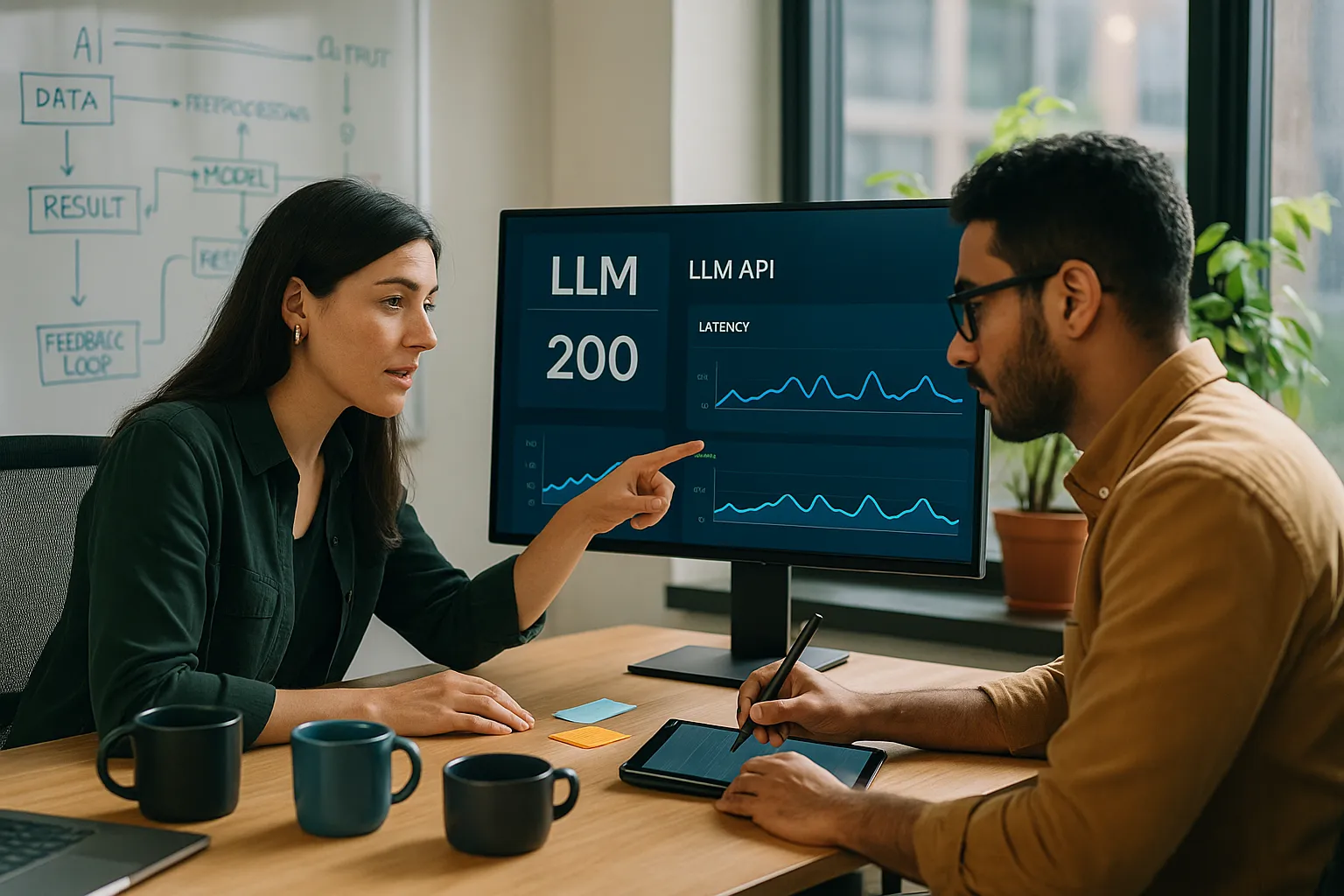
A production AI agent can fail in a way no traditional service can: gracefully. The HTTP request returns 200. No exception is thrown. The latency is fine. The dashboards stay green. And the answer the user just received is wrong, or expensive, or compliant-leaking, or all three.
Standard application monitoring cannot detect this. It was built to answer the question “did the request succeed?” It was not built to answer “what did the agent decide, why, what tools did it call, what tokens did it burn, and was the final output any good?” That second question is what AI agent observability has to make answerable.
This piece is the umbrella concept. It is the operational property a production AI system has to expose — not the dashboard you bolt on after launch. Inside that umbrella sit the deep-dive practices: tracing tool calls and LLM hops, running an evals regression suite on every release, and the operational playbook for keeping agents running. We will link to each. It is also part of the larger question of why your AI experiments are failing — many fail because nobody can answer the “why” when an answer goes wrong.
Observability vs Monitoring: Get the Distinction Right
The terms get used interchangeably. They are not interchangeable.
Monitoring is the practice of watching predefined signals to detect known failure modes. Latency spike? Error rate climbing? Token budget breached? Page someone. Monitoring is reactive, dashboard-driven, and rooted in conditions you anticipated when you built the system.
Observability is a property of the system itself: the degree to which you can ask new questions of it after the fact, including questions you did not anticipate when you built it. An observable system emits enough structured telemetry that an engineer six hours after an incident — or six months after a customer complaint — can reconstruct what happened, why, and what changed.
For traditional services, the gap between the two is narrow. Most failure modes are known: a timeout, a 500, a saturated CPU. Monitoring catches them; observability is a luxury for the unusual cases.
For AI agents, the gap is enormous. Agents can fail in ways that look identical to success at the systems level. A wrong answer, a confidently fabricated citation, a tool called with hallucinated arguments that happened to validate — none of these throw exceptions. The OpenTelemetry observability for AI agents post puts it precisely: agent telemetry must include not just “did it run?” but “what did it decide, and why?”
The practical synthesis: monitoring is a practice; observability is a system property; you need both, and the property has to come first. A monitored-but-not-observable AI agent is one where every incident becomes archaeology. Our operational playbook for the monitoring practice lives at monitoring AI agents in production. This piece covers the property.
Green Dashboards, Wrong Answers
The most dangerous AI agent failure mode is the one where every dashboard stays green. HTTP 200. P95 latency normal. Error rate below threshold. Tokens within budget. And the user got a confidently wrong answer that no monitoring rule will ever catch. Observability is what you reach for after that incident — to reconstruct the decision and put a guardrail in place. If your system is not observable, that reconstruction is impossible.
What an Observable AI Agent Has to Expose
A production AI agent is observable when it emits, in structured form, every signal a future engineer would need to answer a question they have not asked yet. The minimum set:
1. Traces, end to end
Every user request produces a distributed trace that spans the agent’s reasoning, every LLM call, every tool call, every downstream API call, and every guardrail evaluation. The trace is the spine. Without it, every other signal is disconnected. With it, an engineer can pick any production interaction and reconstruct exactly what happened in what order with what data.
OpenTelemetry’s GenAI semantic conventions are the standard converging in 2026 (OpenTelemetry GenAI observability). They define a vendor-neutral schema for the model called, input and output token counts, tool calls, tool results, and (where opted in) the prompt and completion content. Following these conventions matters because it makes traces portable — the same trace works in Datadog, Honeycomb, Langfuse, Arize, Phoenix, or your own backend. We cover the implementation depth in LLM tracing in production.
2. Token and cost attribution, per call and per dimension
Every span in the trace carries token counts. Every token count rolls up to a cost. Every cost is attributable along the dimensions your business cares about: per tenant, per feature, per user cohort, per workflow, per agent version. Token attribution is the financial spine of AI operations.
Teams that ship observable agents commonly find that a single workflow step — usually context inclusion — dominates token consumption, and that attribution visibility surfaces 30-50% cost reduction opportunities that were invisible in aggregate dashboards. Cost is not a finance concern. It is an engineering signal.
3. Latency, broken down by component
End-to-end latency is the user-facing number. Component latency is the engineering number. Where in the workflow does the time go? LLM call? Vector retrieval? Tool execution? Downstream API? An observable agent answers this without an engineer attaching a debugger.
4. Evaluation results, in production
This is the dimension traditional observability does not have. Production agents need to run evaluations — automated quality checks — on a sampled or all-traffic basis, and the results must be queryable next to the traces.
The minimum evals to run in production:
- Task completion — did the agent accomplish what the user asked?
- Faithfulness / grounding — for tasks with retrieval, did the answer reflect the retrieved context?
- Refusal correctness — when the agent refused, was the refusal correct?
- Guardrail compliance — did any guardrail fire? Did any should have fired?
- Tool selection accuracy — when the agent had a choice, did it pick the right tool?
These run on sampled production traffic, on every release as a regression suite, and on flagged interactions in near-real-time. The discipline of building the regression suite lives at LLM evals: a regression suite that ships with every release. Without evals tied to traces, you cannot detect quality regressions — only system-level ones.
5. Tool-call records with arguments and results
Every tool invocation: the tool name, the arguments the model supplied (with PII handled per policy), the result, the duration, the error class if any, the user and agent identities, and the reasoning step that followed. Without this, debugging a bad answer six hours later is archaeology. With it, debugging is forensics.
6. Prompt and model version provenance
Which prompt version produced this answer? Which model? Which model version? Which evaluation gates did this version pass before release? When a quality regression appears, the first question is “what changed?” — and the first answer should be in the trace, not in a chat log of “who deployed last night?”
7. Authorization decisions
Every “permitted” and every “denied” — by whom, on what, for what user. Compliance auditors will ask. Incident reviewers will too. The audit trail is part of the observability property, not a separate compliance system.
The Observability Stack Most Production Teams Converge On
There is no single tool. There is a stack with three layers, and most production teams converge on this shape:
| Layer | Purpose | Common choices |
|---|---|---|
| Instrumentation | Emit OTel-compatible traces, metrics, logs from agents and tools | OpenLLMetry, OpenInference, OpenTelemetry GenAI conventions |
| LLM / agent platform | Trace UI, eval runner, prompt-versioning, cost attribution | Langfuse, LangSmith, Arize Phoenix, Braintrust, Logfire |
| Infrastructure observability | Whole-stack APM, infra metrics, log aggregation | Datadog, Honeycomb, New Relic, Grafana stack |
The LangChain observability tools roundup and the Latitude 2026 platform comparison both reflect this division. Most production teams pick a primary LLM-platform vendor (LangSmith, Langfuse, or Arize) for the agent-specific signals and pair it with their existing infrastructure observability for whole-stack coverage.
The vendor choice matters less than the instrumentation layer being OpenTelemetry-compatible. Tooling will keep changing through 2026 and 2027. The trace data is the asset. If your instrumentation is OTel-native, you can change vendors without re-instrumenting.
Pricing Models Will Surprise You
LLM observability pricing is more variable than infrastructure observability pricing — by an order of magnitude. A 2026 comparison reported that at moderate production scale (5 users, 50M spans), Logfire was roughly 8× cheaper than Arize, 27× cheaper than Langfuse-hosted, and 40× cheaper than LangSmith for similar coverage. Self-hosted Langfuse is free, with operational cost. The economics flip wildly depending on trace volume and eval volume. Model the cost at your actual production scale before committing.
What Observability Lets You Actually Do
The point of building this property is not the dashboard. It is the operational capabilities the property unlocks.
Reconstruct any production interaction. A customer complaint arrives Tuesday about an answer they got Friday. With observability, you find the trace, replay the reasoning, see the prompt version, the model version, the retrieved context, the tool calls, the eval scores that passed. Root cause in minutes, not days.
Detect silent quality regression. Eval scores trend down 4% over a week. No system-level signal fired. Without observability you would have caught it from user complaints six weeks later. With observability you investigate Tuesday afternoon.
Validate every change. A new prompt version, a new model, a new tool — does it improve the metrics that matter or degrade them? Observability turns this from a debate into a measurement. We cover the gating discipline in the LLM evals regression suite piece.
Attribute cost to the work that produced it. A workflow that costs $4 per task and produces $40 of value is a great workflow. A workflow that costs $4 per task and produces $0.40 of value should be killed. Without attribution, both look like “AI is expensive.”
Investigate incidents forensically. When an agent did the wrong thing, the trace, tool-call records, prompt version, and authorization log together tell the story. Without observability, the post-mortem is “we think the model hallucinated.” With observability, it is “the retrieval pipeline returned a stale document because cache invalidation skipped this tenant; here is the fix.”
Detect the unknown unknowns. This is the property’s most valuable use. Observability lets you ask questions of the system you did not anticipate. It is how you discover that one tenant is consuming 60% of the inference budget. How you discover that one tool is responsible for 80% of retries. How you discover that one prompt version is failing one specific user cohort.
Make Your AI Agents Observable, Not Just Monitored
The gap between an AI demo and production AI is the discipline of making the system explain itself. Tracing, evals, cost attribution, audit logs — built in, not bolted on. metacto's Operational AI work is, in large part, building this property for clients shipping AI to customers. Talk with us about your observability architecture.
A Pragmatic Implementation Sequence
Most teams cannot do all of this on day one. A defensible sequence:
Phase 1 — Foundation (week 1-3): Instrument the agent with OpenTelemetry following GenAI semantic conventions. Capture end-to-end traces, LLM call spans with token counts, tool-call spans with arguments and results. Pick a primary platform (Langfuse self-hosted is the cheapest defensible starting point; LangSmith or Arize if you want hosted). Build the basic trace-search workflow.
Phase 2 — Cost and attribution (week 4-6): Add per-tenant, per-feature, per-workflow attribution to every span. Build cost dashboards keyed on the dimensions your business cares about. Surface the top-cost workflows to engineering, not just finance.
Phase 3 — Evals in production (week 6-10): Build the offline regression suite using a labeled golden dataset (see LLM evals: regression suite). Wire it into CI gates. Add sampled production evals (task completion, faithfulness, refusal correctness) and tie the scores to traces. This is where the property starts paying back.
Phase 4 — Prompt and version provenance (week 10-12): Every trace carries the prompt version, model version, and the evaluation gates the version passed pre-release. This is what makes “what changed?” answerable in the trace itself.
Phase 5 — Continuous (ongoing): Quarterly review of trace coverage gaps, eval coverage gaps, attribution dimensions that no longer match the business. The property degrades silently as the agent surface grows; review keeps it sharp.
The detailed operational practice — what to alert on, how to tier severity, how to build dashboards — is the monitoring AI agents in production playbook. The two pieces compose: observability is the property; monitoring is the practice the property makes possible.
Where Observability Sits in the Production AI Stack
Observability is not a tool. It is one layer of the system underneath the chat box — the discipline that lets you ask the system to explain itself. Above it sits orchestration (AI agent orchestration patterns). Beside it sit the operational practices of evals (LLM evals regression suite) and tracing (LLM tracing in production). Below it sit the tool surfaces (building MCP servers) and the operational monitoring playbook (monitoring AI agents in production).
metacto’s Operational AI work treats observability as a precondition for production, not a follow-on. An agent your business depends on is an agent that can explain itself. If it cannot, it is a prototype with customers attached.
Frequently Asked Questions
What is the difference between AI observability and AI monitoring?
Monitoring is the practice of watching predefined signals to detect known failure modes. Observability is a property of the system: the degree to which you can ask new questions of it after the fact, including questions you did not anticipate when you built it. For AI agents the distinction matters more than for traditional services because agents can fail in ways that look identical to success at the systems level — wrong answers with HTTP 200s. You need both; observability has to come first because monitoring without observability turns every incident into archaeology.
What is the minimum AI agent observability stack?
Three layers: OpenTelemetry-compatible instrumentation in the agent (so traces are portable), an LLM platform for traces, evals, prompt versioning, and cost attribution (Langfuse, LangSmith, Arize Phoenix, or Braintrust are the common choices), and your existing infrastructure observability for whole-stack coverage (Datadog, Honeycomb, Grafana). The vendor choice matters less than committing to OTel-native instrumentation, because tooling will change and the trace data is what you cannot afford to lose.
Do I need OpenTelemetry for AI agent observability?
Yes, in practice. OpenTelemetry's GenAI semantic conventions are the emerging 2026 standard for capturing model attributes, token usage, tool calls, and latency in a vendor-neutral schema. Following OTel conventions makes your trace data portable across observability backends — Datadog, Honeycomb, Langfuse, Arize, and others all support them. The conventions do not yet cover output evaluation or safety scoring, which remain platform-specific.
What should I run evals against in production?
Five core eval dimensions: task completion (did the agent do what was asked), faithfulness or grounding (did the answer reflect retrieved context), refusal correctness (when the agent refused, was the refusal right), guardrail compliance (did any guardrail fire when it should or fail to fire when it should have), and tool-selection accuracy (when the agent had a choice, did it pick the right tool). Run these on sampled production traffic continuously, on every release as a regression suite, and in near-real-time on flagged interactions.
How do I attribute LLM costs in production?
Every span in the agent trace carries token counts; every token count rolls up to a cost; every cost is keyed on the dimensions your business cares about — per tenant, per feature, per user cohort, per workflow, per agent version. Attribution is not a finance concern, it is an engineering signal that consistently reveals that one workflow step (usually context inclusion) dominates token spend and surfaces 30-50% cost-reduction opportunities that aggregate dashboards hide.
How does observability connect to AI agent monitoring?
Observability is the system property: the agent emits enough structured telemetry to answer questions you did not anticipate. Monitoring is the practice: you watch specific signals from that telemetry to detect known failure modes and alert on them. The practice depends on the property — you cannot monitor what the system does not expose. Build the observability property first, then layer the monitoring practice on top of it. The detailed monitoring playbook is a separate operational discipline.