

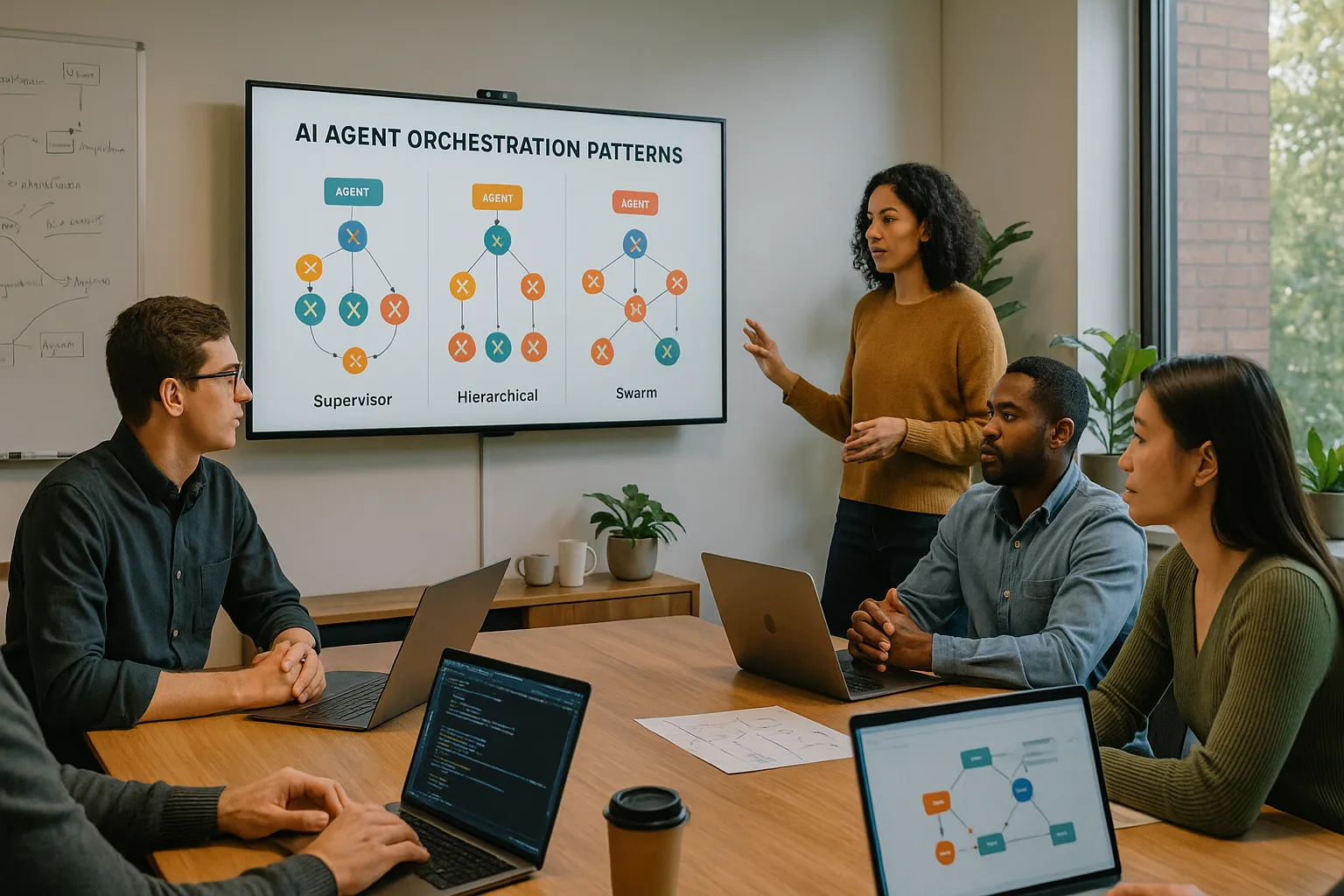
A retail company built a customer-service agent system with seven specialized agents - an intent classifier, a knowledge-base agent, a return-policy agent, an order-status agent, an escalation agent, a tone-checker, and a summarizer - all wired together as a swarm where any agent could hand off to any other. It demoed beautifully. In production, the agents got stuck in handoff loops. The tone-checker would defer to the escalation agent, which would defer to the policy agent, which would defer back to the tone-checker. Average response time was 47 seconds. Token cost per conversation was $1.80. The pilot was killed at month three.
The bug was not in any individual agent. The bug was the orchestration pattern. Swarm topology was the wrong choice for a workflow that had a clear hierarchy of authority. A supervisor pattern with a single decision-maker would have shipped it.
This is the most expensive mistake we see in production AI: teams that pick an orchestration pattern based on what the framework demo showed, not on what the workload requires. Single-agent loops get extended into multi-agent swarms because “more agents felt smarter.” Linear pipelines get rebuilt as hierarchical trees because “hierarchical is what enterprises use.” The wrong pattern compounds: latency multiplies, costs explode, debugging becomes impossible, and the system fails 24/7 in production exactly the way agent orchestration almost always fails.
This guide is for engineers and CTOs choosing how to wire multiple agents together. It is part of the larger question of why your AI experiments are failing - the system underneath the chat box that determines whether a multi-agent pilot becomes a production capability.
What “Orchestration Pattern” Actually Means
Before we compare patterns, a precision point. In the AI agent literature, “orchestration” is overloaded. It can mean two distinct things:
-
Execution flow within a single agent or workflow - sequential, parallel, conditional, loop. This is what our existing guide to AI workflow orchestration patterns covers. It is about how steps relate to each other inside one execution graph.
-
Topology between multiple agents - who calls whom, who decides handoffs, who owns global state. This is what this guide covers.
Both matter. Both are independent. You can run a supervisor pattern (multi-agent topology) where each agent internally uses a parallel workflow (execution flow). They are layered concerns. Conflating them is how teams end up with a “hierarchical swarm parallel sequential” architecture that nobody can debug.
The Four Patterns That Actually Get Deployed
Production multi-agent systems converge on four topologies. Each has a clean problem shape it solves and a failure mode it exhibits at scale.
1. Orchestrator-Worker (a.k.a. Router-Specialist)
A single orchestrator agent receives the task, decomposes it into subtasks, dispatches each subtask to a specialized worker agent, and aggregates the results. Workers do not talk to each other. All coordination flows through the orchestrator.
This is the most widely deployed pattern in production AI. Industry analyses of production multi-agent deployments suggest the orchestrator-worker pattern accounts for the majority of working systems (Padiso, 2026). It is the workhorse.
When to use it:
- Workload decomposes cleanly into independent subtasks
- Subtasks can be specified before they run (no mid-flight discovery)
- You have 2-6 specialist agents with non-overlapping responsibilities
- Result aggregation is straightforward (concatenate, summarize, score-and-pick)
Failure modes:
- Orchestrator becomes a bottleneck under high concurrency
- A bad orchestrator decision propagates to every worker
- Workers that need to share context have to do it through the orchestrator, increasing token cost
Concrete shape: A research assistant where the orchestrator parses “compare three vendors on price, support, and security,” dispatches each vendor to a “company researcher” worker, then synthesizes the comparison.
2. Supervisor (a.k.a. Manager-Subordinate)
A supervisor agent receives the task, decides which subordinate agent should act next, observes the result, and decides again. Unlike orchestrator-worker, the supervisor stays in the loop after each subordinate action and can adapt the plan as evidence comes in.
The supervisor pattern is the right architecture when the next step depends on the previous result - when planning cannot be done upfront and the supervisor needs to “think between turns.”
When to use it:
- Multi-step tasks with branching that depends on prior results
- Mid-flight discovery is common (results change the plan)
- You need a single point of authority for “should I escalate to a human?” decisions
- 3-8 subordinates with clear specializations
Failure modes:
- Supervisor token cost dominates the workflow (the supervisor reads every result)
- “Supervisor over-delegation” - supervisor passes nearly every decision to subordinates and adds no value
- “Supervisor under-delegation” - supervisor does the work itself and the subordinates become decoration
Concrete shape: A customer-service triage agent where the supervisor classifies intent, calls a knowledge-base agent, evaluates the answer, decides whether to call a policy agent, decides whether to escalate to a human.
3. Hierarchical (a.k.a. Multi-Level Supervisor)
A tree structure with multiple levels of delegation. A top-level manager delegates to mid-level supervisors, which delegate to leaf-level workers. Each level abstracts away the detail below it.
Hierarchical is what you reach for when the workload is too big for a single supervisor to hold in context. A four-quadrant research task with 12 sub-questions each becomes a top-level manager (overall report), four mid-level supervisors (one per quadrant), and 12 leaf workers.
When to use it:
- The problem decomposes into 3+ levels of abstraction
- A single supervisor would not fit the full task in its context window
- Different domains require different specialist supervisors
- The organization you are mirroring (often a real org chart) has natural levels
Failure modes:
- Coordinator failure halts the entire branch underneath it (Aihola, 2026)
- Information lost in translation between levels (manager’s summary of supervisor’s summary of worker’s output)
- Token cost grows roughly linearly with tree depth even when work does not
- Debugging is hard because the failure can be at any level
Concrete shape: A consulting-report generator with one editor-in-chief, three section editors, and a dozen researcher agents.
4. Swarm (a.k.a. Peer-to-Peer Handoff)
A set of peer agents that hand off control to each other based on local decisions. No central coordinator. Each agent can call any other agent. The system self-organizes around the task.
Swarm is the most architecturally elegant pattern and the most operationally dangerous. It is resilient to single-agent failure (no central point of failure) and scales horizontally by adding agents, but it is significantly harder to debug, observe, and predict. Handoff loops are a common failure mode. In a fully connected swarm, the failure surface grows quadratically with agent count, and above 8 agents, the combinatorial failure surface typically exceeds what end-to-end tests can cover (Aihola, 2026).
When to use it:
- Workload is genuinely peer-collaborative (no natural hierarchy)
- Agents share a common goal but specialize in different aspects
- Failure of any single agent should not halt the system
- You have strong observability and have invested in handoff-loop detection
- 2-5 agents max; do not push the agent count
Failure modes:
- Handoff loops (agent A defers to B, B defers to A)
- “Hot potato” handoffs where agents avoid responsibility
- Emergent behavior that was not in any single agent’s spec
- Debugging requires reconstructing a directed graph of handoffs from logs
Concrete shape: A code-review system with a security agent, a performance agent, and a style agent, where any agent can comment and any agent can mark “ready for human review.”
flowchart TB
    subgraph "Orchestrator-Worker"
        O[Orchestrator] --> W1[Worker 1]
        O --> W2[Worker 2]
        O --> W3[Worker 3]
        W1 --> O
        W2 --> O
        W3 --> O
    end

    subgraph "Supervisor"
        S[Supervisor]
        S --> A1[Agent A]
        A1 --> S
        S --> A2[Agent B]
        A2 --> S
        S --> A3[Agent C]
        A3 --> S
    end

    subgraph "Hierarchical"
        M[Manager]
        M --> SV1[Supervisor 1]
        M --> SV2[Supervisor 2]
        SV1 --> L1[Leaf 1]
        SV1 --> L2[Leaf 2]
        SV2 --> L3[Leaf 3]
        SV2 --> L4[Leaf 4]
    end

    subgraph "Swarm"
        P1[Peer A] <--> P2[Peer B]
        P2 <--> P3[Peer C]
        P3 <--> P1
        P1 <--> P4[Peer D]
    end
A Decision Framework: How to Actually Choose
The wrong way to choose is “which one is most powerful.” The right way is to start from the workload and let the workload eliminate options.
Five Questions That Pick the Pattern
1. Can you specify the full plan before any work runs? If yes → orchestrator-worker. If no → supervisor or above.
2. Does the next step depend on the previous result? If heavily → supervisor. If lightly → orchestrator-worker.
3. Can a single agent hold the full task in its context? If no → hierarchical.
4. Is there a clear authority hierarchy in the domain? If yes → supervisor or hierarchical. If no → swarm may apply.
5. Is debugging-in-production a hard requirement? If yes (it almost always is) → avoid swarm unless you have invested in handoff observability.
For most production workloads inside Engine 2 buyers - operations, finance, customer support, internal tooling - the answer is orchestrator-worker or supervisor. Hierarchical earns its keep on complex multi-domain analytical tasks. Swarm earns its keep in research-style problems where peer collaboration is the actual structure.
The pattern that almost never earns its keep in production: “let’s make every agent autonomous and see what happens.” That is not orchestration. That is gambling.
What Breaks at Scale (and How to Catch It Early)
Each pattern has characteristic failure modes that only appear under production load. Knowing them lets you instrument for them on day one.
| Pattern | Characteristic Failure | Early Signal | Mitigation |
|---|---|---|---|
| Orchestrator-Worker | Orchestrator bottleneck | P95 orchestrator latency grows faster than worker latency | Cache orchestrator decisions, route warm subtasks directly |
| Supervisor | Token cost dominates | Supervisor’s share of total tokens exceeds 60% | Trim supervisor context, summarize subordinate results before return |
| Hierarchical | Information loss across levels | End-to-end accuracy drops while leaf accuracy is high | Pass structured summaries up, not free-text |
| Swarm | Handoff loops | Average handoffs per conversation grows over time | Loop detection middleware, max-handoff caps |
| All | “Agent shrug” - agents defer to humans when they shouldn’t | Escalation rate exceeds workload’s natural escalation rate | Calibrate confidence thresholds, expand training set |
The orchestration layer is where most real-world deployments hit a wall. Multi-agent systems fall apart in production when running 24/7, handling failures gracefully, and staying within budget (MindStudio, 2026). The instrumentation has to be there from day one, not bolted on after the first incident.
Orchestration Sits on Top of Durable Execution
A critical layering point. Orchestration pattern (this guide) decides the shape of multi-agent interaction. Durable execution decides whether that interaction survives failure. These are independent choices.
You can run a supervisor pattern with no durability and it will technically work - until the first pod restart kills a 20-minute conversation mid-flight. You can run a swarm with durable execution and the durability will not save you from handoff loops; it will just durably loop forever until the workflow timeout fires.
The right sequence:
- Pick the orchestration pattern that matches the workload shape.
- Decide whether activities should be modeled as an explicit state machine or a freer prompt loop.
- Wrap the whole thing in a durable runtime so it survives infrastructure failures.
- Then add observability, evals, guardrails, and the rest of the production AI agent stack.
Steps 1 and 2 are independent of steps 3 and 4. Conflating them is why teams end up with brittle, opinionated frameworks that work for one shape of workload and break for everything else.
Tool Calls Are an Orchestration Concern Too
A subtle point that catches teams off guard. Every tool call an agent makes is a node in the orchestration graph. The choice of whether to call a tool synchronously, asynchronously, with a timeout, with a retry policy, or with an idempotency key is an orchestration decision, not a “tool” decision. The blast radius of a misbehaving tool depends on where it sits in the topology.
In an orchestrator-worker pattern, a tool call inside a worker is contained - its failure can be retried, its results validated, its blast radius bounded. In a swarm, a tool call inside any peer can change global state that another peer reads next. The same tool, the same code, very different operational properties.
This is why tool calling in production is its own discipline. If you are using MCP servers as your tool layer, the orchestration pattern decides whether MCP server failures cascade or stay contained.
Picking the Wrong Orchestration Pattern Is the Most Expensive AI Decision You Will Make
If you are scaling from a working agent prototype to a production multi-agent system, the topology you choose now will determine your cost, latency, and debugging story for years. metacto helps mid-market and enterprise teams design orchestration architectures that match the workload, not the framework demo. Talk to us before you commit.
When Multi-Agent Is the Wrong Answer
A heretical observation worth stating clearly: many production AI workloads do not need multi-agent orchestration at all. A single agent with well-designed tool calls, good context, and a tight prompt outperforms a 5-agent system on a remarkable number of tasks. The multi-agent system adds latency, cost, debugging surface, and failure modes the single-agent system does not have.
The right question is not “which orchestration pattern do I use?” The right question is “do I need multi-agent at all?” If the work is genuinely separable across specialties, multi-agent earns its keep. If you are introducing agents because “more agents felt smarter,” the right move is to delete them.
When you do need multiple agents, choose the orchestration pattern with care. It is the most expensive decision you will make. The framework demos will not save you from it. The vendor sales call will not save you from it. Only deliberate engineering choice will.
This is one layer of the system underneath the chat box - the gap between an impressive agent demo and a production-ready AI system that scales without falling apart. The orchestration pattern you pick is the difference between a system that compounds and a system that buckles. Choosing that architecture for a real workload is exactly what our Operational AI practice does with mid-market engineering teams.
Frequently Asked Questions
What are the main AI agent orchestration patterns?
Four patterns dominate production deployments: orchestrator-worker (a central orchestrator dispatches subtasks to specialist workers, which is the most common production pattern), supervisor (a single supervisor agent stays in the loop and adapts the plan as each subordinate returns), hierarchical (a tree structure with multiple levels of delegation, useful when a single supervisor cannot hold the full task in context), and swarm (peer agents that hand off to each other with no central coordinator, useful for research-style problems but operationally risky).
What is the difference between orchestrator-worker and supervisor patterns?
In orchestrator-worker, the orchestrator decomposes the task into subtasks before dispatching them, and workers operate in parallel without further orchestrator input. In supervisor, the supervisor stays in the loop after every subordinate action, observing results and adapting the plan. Use orchestrator-worker when you can specify the full plan upfront. Use supervisor when the next step depends on the previous result.
When should I use a swarm pattern for AI agents?
Swarm patterns suit genuinely peer-collaborative workloads with no natural hierarchy - typically research, code review, or multi-perspective analysis tasks. Keep agent counts small (2-5) because failure surface grows quadratically with agent count. Invest in handoff-loop detection and strong observability before going to production. For most operations, finance, and customer-support workloads, swarm is the wrong pattern - the work has a clear authority structure that a supervisor pattern fits better.
How is this different from sequential, parallel, and conditional workflow orchestration?
Workflow orchestration patterns (sequential, parallel, conditional) describe how steps relate inside a single execution graph. Agent orchestration patterns (orchestrator-worker, supervisor, hierarchical, swarm) describe how multiple agents interact across the system. They are independent layers. You can run a supervisor pattern of agents where each agent internally uses parallel workflow steps. Conflating them produces architectures that nobody can debug.
What is the biggest failure mode for AI agent orchestration in production?
Choosing the wrong pattern for the workload. Swarm topologies suffer handoff loops when applied to problems that have a clear authority hierarchy. Orchestrator-worker bottlenecks when applied to problems where the next step depends on the previous result. Hierarchical loses information across levels when applied to problems that could fit in a single supervisor's context. The pattern compounds: the wrong choice multiplies latency, cost, and debugging difficulty over time.
Do I need multi-agent orchestration, or can a single agent do the job?
Many production AI workloads do not need multi-agent at all. A single agent with well-designed tool calls, good context, and a tight prompt often outperforms a 5-agent system. Multi-agent adds latency, cost, debugging surface, and failure modes. The right question is not 'which orchestration pattern do I use?' but 'do I need multi-agent at all?' If the work is genuinely separable across specialties, multi-agent earns its keep. Otherwise, delete the extra agents.
How does orchestration relate to durable execution and state machines?
Orchestration patterns decide the shape of multi-agent interaction. Durable execution decides whether that interaction survives infrastructure failure. State machine design decides whether workflow logic is modeled explicitly or as a freer prompt loop. These are independent layers. Pick the orchestration pattern first based on the workload, then decide on state machine vs. prompt loop, then wrap the whole thing in a durable runtime. Conflating these decisions leads to brittle architectures that work for one workload shape and break for everything else.