

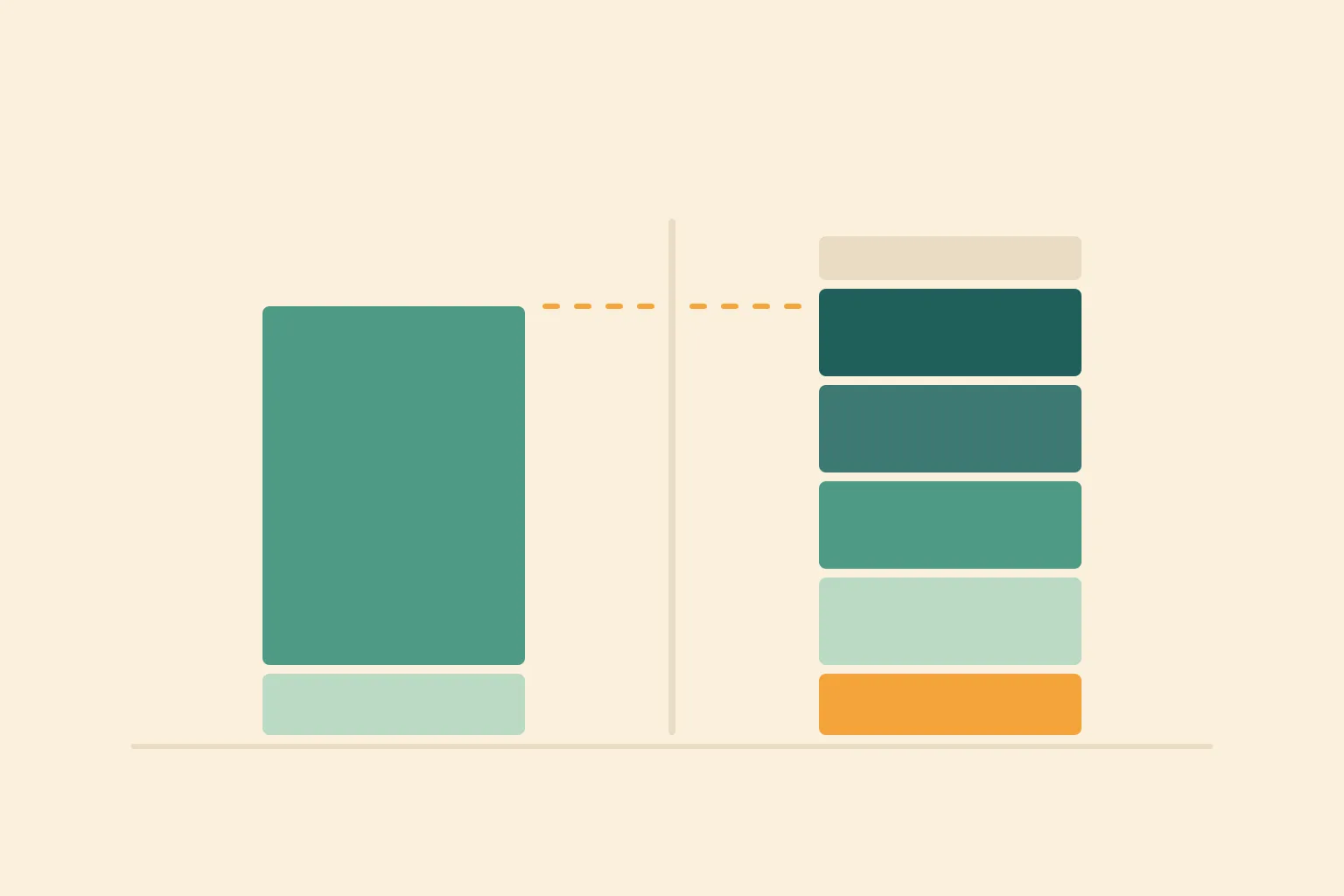
AI can make custom software faster and less expensive to build. It does not remove the ongoing work of operating a dependable application. Before replacing a SaaS subscription, compare the full cost of both options over three years and name who will own the system after launch.
Our recommendation is simple. Build when a focused workflow creates meaningful business value and the company can support it. Buy when a standard product meets the need economically. And often the strongest option is the third one: keep the core SaaS system and build a narrow integration or workflow around it.
What the “SaaS killer” thesis gets right
AI lowers the effort required to prototype interfaces, write routine code and connect systems. That changes the economics of narrow internal tools, and it is real.
But reproducing the screens employees use is only part of replacing a product. Permissions, data integrity, integrations, recovery, support and the unusual business cases still require deliberate engineering.
Claims of 10 to 100 times lower software production costs appear in industry commentary, including Y Combinator’s public discussion. Treat them as a thesis to test against your workflow, not a planning assumption.
Compare the same responsibilities
The fair comparison is not subscription versus build cost. It is who carries each responsibility, and what it costs them.
| Dimension | Purchased SaaS | Custom internal application |
|---|---|---|
| Upfront effort | Configuration, integration, migration and training. | Requirements, design, build, validation, migration and training. |
| Ongoing cost | Subscription, administration, add-ons and integration support. | Engineering, hosting, monitoring, dependencies, support and improvements. |
| Security | Vendor operates product controls; you manage access, settings and use. | You, or your contracted team, own application security and operational controls. |
| Business fit | Established features and edge cases, within vendor constraints. | Precise fit is possible; every business rule and exception must be captured. |
| Dependency | Vendor pricing, roadmap, service continuity and export options. | Maintainer availability, documentation, cloud services and software dependencies. |
One note on compliance: a SaaS vendor’s certifications do not automatically make your deployment compliant. And a custom application needs its own controls, appropriate to its data and business use.
Where the hidden costs appear
Production readiness and security
A prototype may omit role-based access, audit logs, secrets management, backups, restore testing, alerting and safe deployment. Budget for these before anyone relies on the system. NIST’s Secure Software Development Framework (SP 800-218) is a useful baseline for secure development and vulnerability response.
Maintenance and rework
Applications need fixes as business rules, APIs and dependencies change. AI helps with this work, but generated changes still need review and validation. Track support effort, escaped defects and failed releases alongside build speed.
Comprehension and continuity
If nobody can explain the application’s business rules or architecture, every future change gets harder to assess. Preserve decision records, tests, integration contracts and operating instructions. Before handover, require a second maintainer to demonstrate a change and a recovery procedure.
Infrastructure and model costs
Every application has operating costs. Runtime model inference, retrieval pipelines and model evaluations apply only when the application actually uses AI in production. Using AI to write the code does not, by itself, mean retraining a model or maintaining a vector database.
Opportunity cost
Internal engineering time has a cost even when nobody new is hired. Count the work displaced by building and supporting the replacement. Include business disruption during migration and any period of paying for both systems.
What the evidence supports
DORA’s discussion of its 2025 research reports that greater AI adoption was associated with higher delivery throughput and higher instability. That is an association, not proof that AI caused either outcome. It does support measuring production results alongside developer activity.
METR’s early 2025 randomized study found that 16 experienced open-source developers took 19% longer on 246 tasks when AI tools were allowed. The result concerns those developers, repositories and tools. In February 2026, METR said newer results were affected by selection issues and did not support a reliable estimate of current speedups.
Neither study establishes a universal productivity rate. The practical conclusion: measure end-to-end delivery in your own setting. Faster code generation can be valuable without producing an equivalent reduction in total application cost.
When each approach makes sense
| Approach | Best fit |
|---|---|
| Buy | Standard business functions; strong existing fit; substantial security or support needs; limited internal ownership capacity. |
| Build | Narrow, differentiated workflows; clear requirements; measurable value; manageable integrations; funded maintenance and a named technical owner. |
| Extend | A useful core SaaS system with a specific workflow gap. Keep the system of record and add automation or a focused interface through supported APIs. |
Use a three-year ownership model
Compare equivalent scope and service levels. Include only the SaaS costs you can actually eliminate, not the entire contract if some licenses or modules must remain. Keep cash savings, capacity released and new business value in separate columns.
| Illustrative cost | Keep SaaS | Replace with custom |
|---|---|---|
| Initial implementation or migration | $10,000 | $60,000 |
| Annual subscription | $60,000 | $0 |
| Annual administration or engineering support | $12,000 | $36,000 |
| Annual hosting and operating tools | Included in subscription | $12,000 |
| Annual security review and recovery testing | Included in admin | $8,000 |
| Annual change and rework allowance | Included in admin | $12,000 |
| Three-year total | $226,000 | $264,000 |
Illustrative assumptions only, not market benchmarks or a quote. Totals are the initial cost plus three years of annual costs.
In this scenario the custom option costs $38,000 more over three years, before any difference in business value. Its $68,000 annual run cost is only $4,000 below the SaaS run cost, so the extra $50,000 upfront would take 12.5 years to recover on direct savings alone.
That doesn’t make building wrong. It means the case for building has to rest on value the SaaS product can’t deliver, not on the subscription line.
Stress-test your own version against maintenance demand, engineer availability, usage growth, model costs where relevant, and vendor price changes. Avoid counting the same labor in both engineering support and the rework allowance. Add migration overlap and exit costs where they are material.
Approve ownership before approving replacement
Before anyone signs off on replacing a SaaS product, get these five things in writing:
- The minimum workflow and its acceptance criteria, including exceptions and integration failures.
- A named business owner, technical maintainer and backup maintainer, with their ongoing capacity funded.
- Access controls, data handling, service expectations, recovery targets and support coverage.
- A pilot of one workflow, measuring delivery time, defects, support hours, adoption and business outcomes.
- A retirement plan that cancels the SaaS product only after migration reconciliation, rollback testing and operating acceptance.
AI changed what software costs to build. It didn’t change what it costs to own. The companies that come out ahead will make the second number visible before they commit to the first.
Sources
- Y Combinator. Public SaaS thesis discussion. Commentary, not a general cost benchmark.
- NIST. SP 800-218, Secure Software Development Framework, version 1.1.
- DORA. Balancing AI tensions, 10 March 2026.
- METR. Early 2025 developer productivity study.
- METR. Experiment design update, 24 February 2026.
A note on numbers we left out: figures that circulate in this debate, such as a 2.7 times vulnerability rate for AI-generated code, 25% persistent technical debt, or a 15 times cost for production bugs, are not used here because their applicability to an individual internal application has not been established. Global AI spending and hiring anecdotes don’t establish ownership cost either.