

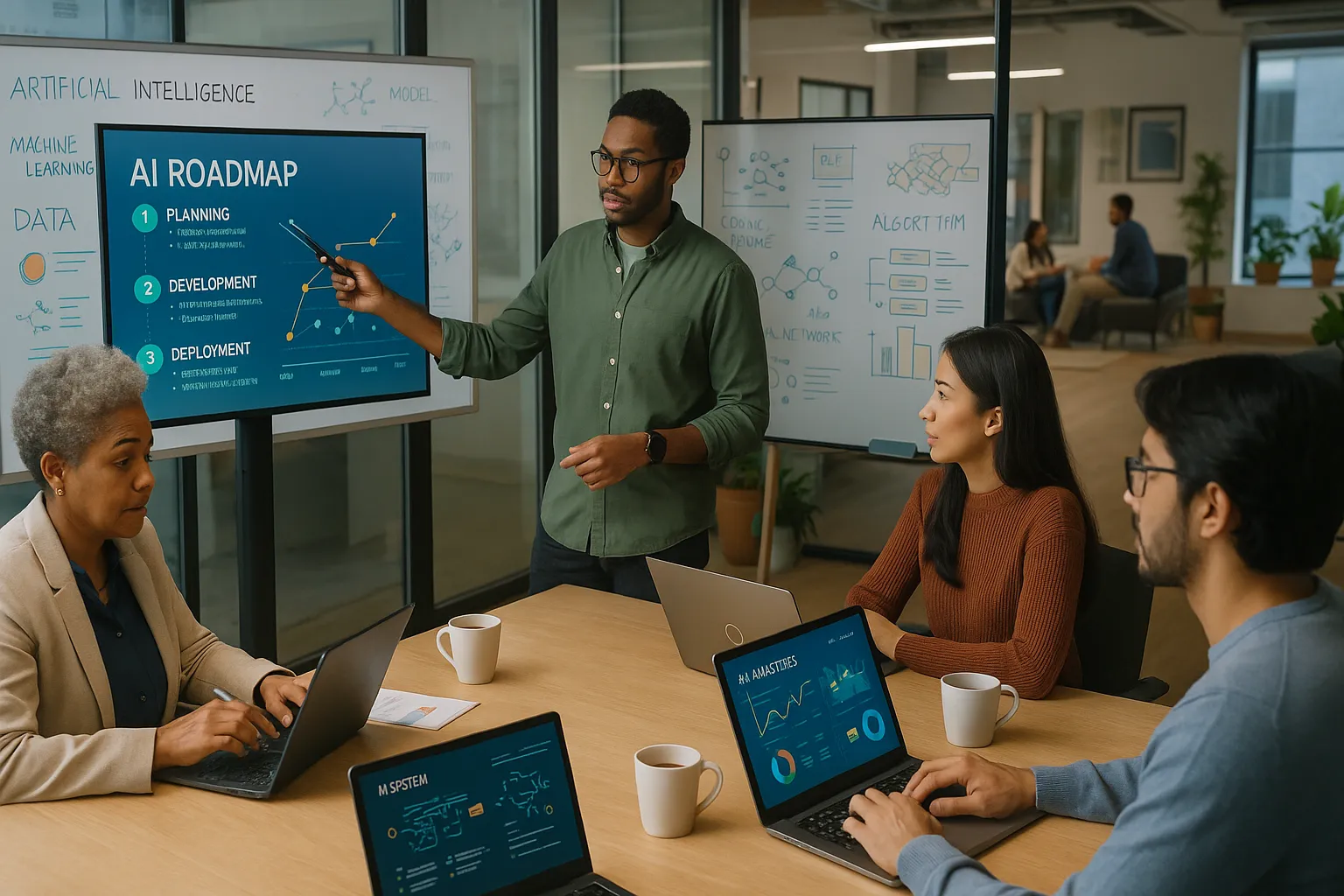
The AI workflows deployed today will look primitive within 18 months.
This is not hyperbole. The rate of capability advancement in AI systems is compressing what would normally be decade-long evolution cycles into quarters. Organizations that invested in AI workflow automation in 2024 are already upgrading their systems to leverage capabilities that did not exist when they started.
Understanding where AI workflows are heading is not academic curiosity. It is strategic planning. The architectural decisions you make today determine whether you can adopt tomorrow’s capabilities or whether you will need to rebuild from scratch.
This analysis examines the AI workflow capabilities emerging in 2027 and beyond, their implications for business operations, and how to position your organization to capture value from these advances.
The Evolution from Automation to Orchestration
The AI workflows of 2024-2025 automated individual tasks. The AI workflows of 2027 orchestrate entire business functions.
This distinction matters. Task automation handles discrete activities: processing an invoice, routing a support ticket, generating a report. Orchestration manages complete business processes: running an entire procurement operation, managing customer lifecycle from acquisition through retention, or coordinating product development cycles.
The shift from automation to orchestration requires three capabilities that are maturing rapidly:
Multi-Agent Coordination: Instead of single AI models handling individual tasks, teams of specialized AI agents collaborate on complex objectives. Each agent has expertise in specific domains; orchestration systems coordinate their work.
Dynamic Process Adaptation: Rather than following fixed workflows, AI systems adapt processes in real-time based on context, constraints, and outcomes. The same business objective may be achieved through different paths depending on circumstances.
Autonomous Goal Pursuit: Given a business objective, AI systems determine and execute the steps required to achieve it without explicit workflow definition. Humans define what should happen; AI determines how to make it happen.
flowchart TD
    subgraph 2024["2024-2025: Task Automation"]
        A1[Human Defines Steps] --> A2[AI Executes Steps]
        A2 --> A3[Human Reviews Output]
    end

    subgraph 2026["2026: Process Automation"]
        B1[Human Defines Process] --> B2[AI Orchestrates Steps]
        B2 --> B3[AI Handles Exceptions]
        B3 --> B4[Human Reviews Outcomes]
    end

    subgraph 2027["2027+: Goal-Driven Orchestration"]
        C1[Human Defines Goals] --> C2[AI Determines Strategy]
        C2 --> C3[Multi-Agent Execution]
        C3 --> C4[Continuous Optimization]
        C4 --> C5[AI Reports Progress]
        C5 --> C1
    end
Emerging Capability: Autonomous Multi-Agent Systems
The most significant capability arriving in 2027 is practical multi-agent orchestration at enterprise scale. Research prototypes demonstrated this capability in 2024-2025; production-ready systems are now emerging.
How Multi-Agent Systems Work
Multi-agent systems decompose complex problems into specialized subtasks, assign them to agents with relevant expertise, and coordinate results into coherent outcomes.
Consider a complex sales proposal. A multi-agent system might involve:
Research Agent: Analyzes the prospect’s business, industry trends, and competitive landscape. Produces briefing documents and identifies key concerns.
Technical Agent: Reviews prospect requirements against product capabilities. Identifies configuration options, integration requirements, and potential implementation challenges.
Pricing Agent: Models pricing scenarios based on deal parameters, competitive positioning, and historical win rates. Recommends optimal pricing strategy.
Content Agent: Generates proposal content incorporating inputs from other agents. Ensures messaging alignment with prospect needs and brand guidelines.
Quality Agent: Reviews the assembled proposal for completeness, accuracy, and compliance. Flags issues for human review or agent revision.
Orchestration Agent: Coordinates the work of all agents, manages dependencies, resolves conflicts, and presents the final output.
This architecture achieves outcomes no single agent could produce while maintaining the efficiency of automated systems.
Implications for Business Operations
Multi-agent systems transform what can be automated:
Complex Knowledge Work: Tasks previously considered too complex for automation become feasible. Legal document review, financial analysis, strategic planning support, and creative production all become candidates for multi-agent approaches.
Adaptive Responses: Because agents can coordinate in real-time, systems can respond to unexpected situations by assembling appropriate agent teams dynamically.
Continuous Improvement: Specialized agents can be individually improved without redesigning entire systems. An organization might upgrade its research agent capabilities without touching other components.
The Coordination Challenge
Multi-agent systems introduce coordination complexity. Agents can conflict, duplicate work, or produce inconsistent outputs. Mature orchestration frameworks are essential for production deployment. This is an active area of development with significant advances expected through 2027.
Emerging Capability: Predictive Workflow Generation
Current AI workflows require human definition. Someone must specify the steps, conditions, and actions that constitute a workflow. Predictive workflow generation changes this by having AI create workflows based on observed patterns and stated objectives.
From Observation to Automation
The path works like this:
Behavioral Observation: AI systems observe how humans accomplish tasks. They track screen interactions, communication patterns, data flows, and decision sequences.
Pattern Extraction: From observations, AI extracts the implicit workflows humans follow. These patterns reveal the actual processes underlying work, which often differ from documented procedures.
Workflow Generation: Based on extracted patterns and stated objectives, AI generates executable workflows. These workflows capture the logic humans apply, expressed in automatable form.
Continuous Refinement: As workflows execute and humans provide feedback, the AI refines generated workflows to improve accuracy and efficiency.
The Zero-Configuration Ideal
The ultimate vision is workflows that configure themselves. Tell the system what you want to accomplish, and it figures out how to do it based on your organization’s context, data, and constraints.
This is not science fiction. Limited versions exist today. By 2027, expect significant progress toward workflows that:
- Discover relevant data sources automatically
- Determine appropriate approval chains based on organizational hierarchy
- Integrate with existing systems without explicit configuration
- Adapt to changes in underlying systems without manual updates
Implications for Workflow Design
Predictive workflow generation shifts the role of workflow designers:
From Builders to Curators: Rather than building workflows from scratch, designers curate and refine AI-generated workflows. They provide strategic direction rather than tactical specification.
From Static to Adaptive: Workflows become living systems that evolve with the organization rather than static definitions that require periodic overhaul.
From Expert-Driven to Democratic: Non-technical users can express workflow needs in natural language. AI translates intent into executable automation.
Workflow Development
❌Before AI
- •Business analyst documents process requirements
- •Developer translates to workflow specification
- •QA tests workflow against requirements
- •Deployment through change management
- •Manual updates as process evolves
- •Timeline: 4-12 weeks per workflow
✨With AI
- •User describes desired outcome in natural language
- •AI generates workflow based on observed patterns
- •Human reviews and adjusts as needed
- •Continuous deployment with automated testing
- •Workflow self-adapts as context changes
- •Timeline: hours to days per workflow
📊 Metric Shift: Workflow development cycle compressed from months to days
Emerging Capability: Self-Optimizing Systems
Current AI workflows execute fixed logic, even if that logic includes conditional branches. Self-optimizing systems continuously improve their own performance without human intervention.
Continuous Learning in Production
Self-optimizing AI workflows:
Track Outcomes: Every workflow execution generates outcome data. Did the process achieve its objective? How efficiently? Were there errors or exceptions?
Identify Improvement Opportunities: AI analyzes outcome patterns to identify where workflows could perform better. This might mean different routing logic, adjusted thresholds, or modified sequences.
Generate and Test Alternatives: Rather than waiting for human optimization, AI generates alternative approaches and tests them in production (with appropriate safeguards).
Deploy Improvements: Successful alternatives are automatically adopted. Failed experiments are rolled back and analyzed.
Guardrails for Autonomous Optimization
Self-optimization without constraints is dangerous. Effective systems include:
Optimization Boundaries: Human-defined limits on what the AI can modify. Some parameters can be optimized freely; others require human approval for changes.
Rollback Capabilities: Automatic rollback when optimization experiments produce worse outcomes. No change is permanent until proven beneficial.
Explanation Requirements: AI must explain why it made changes. This supports human oversight and compliance requirements.
Human Escalation: When optimization encounters constraints or trade-offs it cannot resolve, human decision-makers are engaged.
Implications for Operations
Self-optimizing systems transform operational roles:
From Optimization to Oversight: Operations teams shift from manually optimizing processes to overseeing AI optimization. They set objectives, define constraints, and review AI-recommended changes.
Continuous vs. Periodic Improvement: Instead of periodic optimization projects, improvement becomes continuous. Small enhancements accumulate constantly.
Learning Acceleration: Organizations that deploy self-optimizing systems learn faster than competitors. Every execution generates insights that improve future performance.
Emerging Capability: Cross-Organizational Workflow Networks
Current AI workflows operate within organizational boundaries. Emerging capabilities enable workflows that span organizations, creating interconnected process networks.
Inter-Organizational Orchestration
Consider supply chain coordination. Today, suppliers and buyers exchange information through manual communications, EDI transactions, and portal interactions. Each organization manages its internal workflows independently.
Cross-organizational workflow networks enable:
Coordinated Planning: AI workflows across organizations synchronize demand forecasts, production schedules, and logistics planning automatically.
Exception Collaboration: When disruptions occur, AI workflows across affected organizations coordinate responses without manual communication chains.
Shared Optimization: Instead of each organization optimizing locally, network-wide optimization improves outcomes for all participants.
Trust and Governance Challenges
Cross-organizational workflows require new trust models:
Data Sharing Governance: What information is shared between organizations? How is confidentiality protected while enabling coordination?
Liability Allocation: When automated cross-organizational decisions cause problems, who is responsible?
Standards and Interoperability: How do workflows from different organizations communicate? What standards enable interconnection?
These challenges are not yet solved, but active work is progressing. By 2027, expect early production deployments in supply chain, healthcare coordination, and financial services networks.
flowchart LR
    subgraph Org1["Organization A"]
        A1[Procurement Workflow]
        A2[Inventory Workflow]
    end

    subgraph Org2["Organization B - Supplier"]
        B1[Order Fulfillment]
        B2[Production Planning]
    end

    subgraph Org3["Organization C - Logistics"]
        C1[Shipping Coordination]
        C2[Delivery Scheduling]
    end

    subgraph Network["Cross-Org Orchestration Layer"]
        N1[Coordination Engine]
        N2[Trust Framework]
        N3[Shared Optimization]
    end

    A1 <--> N1
    A2 <--> N1
    B1 <--> N1
    B2 <--> N1
    C1 <--> N1
    C2 <--> N1
    N1 <--> N2
    N1 <--> N3
Emerging Capability: Ambient Intelligence Integration
AI workflows currently operate on defined triggers: a form submission, a scheduled time, a threshold breach. Ambient intelligence integration enables workflows that respond to context without explicit triggers.
Context-Aware Workflow Activation
Ambient systems monitor organizational context continuously:
Communication Analysis: AI analyzes email, chat, and meeting content to detect situations requiring workflow activation. A customer complaint in an email thread might automatically trigger escalation workflows.
Behavioral Signals: Changes in user behavior patterns indicate situations requiring attention. An employee accessing unusual systems might trigger security review workflows.
External Signals: Market movements, news events, or competitor actions detected through continuous monitoring trigger appropriate response workflows.
Proactive vs. Reactive Operations
Ambient intelligence shifts operations from reactive to proactive:
Anticipatory Action: Workflows activate before problems fully manifest. A supply chain workflow might adjust orders based on early indicators of supplier issues, not after delivery failures.
Continuous Adaptation: As context evolves, workflows adapt without waiting for explicit triggers. A customer service workflow might adjust tone and offerings based on detected customer sentiment across interactions.
Invisible Automation: Many workflows become invisible to users. Systems handle situations automatically, surfacing to humans only when necessary.
The Proactive Advantage
Organizations with ambient intelligence capabilities respond to opportunities and threats faster than competitors. The time between signal and response compresses from days to minutes, creating significant competitive advantage.
Preparing for 2027: Strategic Recommendations
The capabilities described above are not equally mature or equally applicable to every organization. Strategic preparation involves understanding your position and building appropriate foundations.
Assess Your Current State
Before planning for advanced capabilities, understand your current AI workflow maturity:
Foundation Level: Basic automation of individual tasks. Rule-based workflows with limited AI involvement.
Developing Level: AI-enhanced workflows with some autonomous decision-making. Integration across multiple systems.
Advanced Level: Sophisticated AI orchestration with multi-step autonomous processes. Comprehensive monitoring and optimization.
Leading Level: Early adoption of emerging capabilities. Multi-agent systems, predictive workflow generation, or self-optimization in production.
Most organizations are at Foundation or Developing levels. The path to advanced capabilities requires building through intermediate stages.
Investment Priorities by Capability
Multi-Agent Systems: If your organization handles complex knowledge work that currently requires multiple specialists, multi-agent systems offer significant potential. Prioritize if you have challenges scaling expert-dependent processes.
Predictive Workflow Generation: If workflow development bottlenecks limit your automation velocity, predictive generation can accelerate deployment. Prioritize if you have many automation candidates but limited development capacity.
Self-Optimizing Systems: If your workflows require frequent manual tuning or if you operate in dynamic environments where optimal behavior changes rapidly, self-optimization provides continuous improvement. Prioritize if maintenance burden limits workflow ROI.
Cross-Organizational Networks: If your value chain involves tight coordination with partners, suppliers, or customers, network capabilities offer coordination benefits. Prioritize if manual inter-organizational coordination is a significant cost or constraint.
Ambient Intelligence: If timely response to events is competitively critical, ambient capabilities enable faster reaction. Prioritize if you currently miss opportunities or suffer problems because signals are detected too late.
Architectural Foundations for Future Capabilities
Regardless of which advanced capabilities you prioritize, certain architectural investments support multiple future scenarios:
Unified Data Access: AI capabilities require access to comprehensive business context. Investing in data integration and unified data platforms enables any advanced AI capability.
Modular Workflow Architecture: Systems built from composable components can adopt new AI capabilities without complete rebuilds. Monolithic workflows are harder to evolve.
Observability Infrastructure: Advanced capabilities require rich operational data. Invest in comprehensive logging, monitoring, and analytics that support AI learning and optimization.
Human Oversight Frameworks: Even as AI becomes more autonomous, human oversight remains essential. Build governance structures that scale with AI capability.
Experimentation Capability: Organizations that can safely experiment with new AI capabilities learn faster than those that cannot. Build the testing, rollback, and monitoring infrastructure that enables rapid experimentation.
The Human Role in 2027 and Beyond
As AI workflow capabilities advance, the human role evolves but does not diminish.
From Executor to Director
Humans shift from executing workflow tasks to directing AI systems:
Goal Setting: Humans define what should be accomplished. AI determines how to accomplish it.
Constraint Definition: Humans specify the boundaries within which AI must operate: budget limits, compliance requirements, ethical constraints, strategic priorities.
Exception Handling: When AI encounters situations outside its competence, humans provide judgment. The scope of exceptions narrows as AI capability expands, but some situations always require human decision-making.
Outcome Evaluation: Humans evaluate whether AI-achieved outcomes actually serve organizational interests. Efficiency is not the only criterion; alignment with values and strategy matters.
New Skill Requirements
The human skills required to direct AI systems differ from those required to execute manual processes:
AI Literacy: Understanding how AI systems work, their capabilities, and their limitations. Not necessarily technical depth, but sufficient understanding to make informed decisions.
Systems Thinking: Understanding how automated components interact and how changes in one area affect others. Managing AI systems requires seeing the whole, not just parts.
Ethical Reasoning: As AI handles more decisions, humans must ensure those decisions align with organizational and societal values. Ethical judgment becomes a core competency.
Continuous Learning: The AI landscape evolves rapidly. Humans must continuously update their understanding and skills.
Organizational Adaptation
Organizations must adapt structures and cultures for AI-augmented operations:
Flatter Hierarchies: When AI handles routine coordination, management layers dedicated to information transfer become less necessary.
Skill-Based Teams: Teams form around capabilities rather than functional silos. AI enables coordination that was previously only possible within departments.
Experimentation Culture: Organizations that learn fastest win. Cultures that encourage experimentation and tolerate failure will outperform those that do not.
Continuous Improvement Mindset: When systems self-optimize, the human role is setting ever-higher targets and expanding the scope of optimization.
Operations Leader
❌Before AI
- •Manages team of process executors
- •Reviews and approves individual decisions
- •Manually identifies optimization opportunities
- •Responds to escalated exceptions
- •Reports on operational metrics
✨With AI
- •Directs portfolio of AI workflow systems
- •Sets objectives and constraints for AI
- •Reviews AI-generated optimization recommendations
- •Handles novel situations AI cannot resolve
- •Guides AI learning and adaptation
📊 Metric Shift: Scope of impact expands as operational details are automated
The Competitive Landscape of 2027
AI workflow capabilities will create new competitive dynamics. Understanding these dynamics helps with strategic positioning.
Capability Asymmetry
Organizations that adopt advanced AI workflow capabilities will operate fundamentally differently from those that do not. The gap is not incremental efficiency improvement; it is categorical capability difference.
A company with self-optimizing multi-agent systems competing against a company with manual processes is not a fair fight. The former can respond faster, adapt continuously, and scale without proportional cost increases.
New Entrant Advantage
Advanced AI capabilities may favor new entrants over incumbents. Organizations built on AI-native architectures avoid the technical debt and organizational resistance that impede incumbent transformation.
Conversely, incumbents with strong data assets may leverage those assets to train superior AI systems, if they can overcome organizational barriers to adoption.
Industry Restructuring
Some industries will restructure around AI workflow capabilities:
Consolidation: When AI enables scale economies in knowledge work, smaller players may struggle to compete. Consolidation follows capability concentration.
Disaggregation: When AI enables coordination without organizational integration, vertically integrated players may face competition from specialized networks.
New Categories: AI capabilities enable business models that were previously not feasible. New categories of competitors may emerge from adjacent or unrelated industries.
Taking Action: Your 2026-2027 Roadmap
The future arrives whether you prepare for it or not. Here is how to position for 2027 AI workflow capabilities:
Q2-Q3 2026: Foundation Strengthening
Data Integration: Invest in connecting data sources and creating unified access for AI systems.
Current Workflow Optimization: Ensure existing AI workflows are performing well and generating learning data.
Capability Assessment: Evaluate which 2027 capabilities are most relevant to your competitive position.
Q4 2026: Pilot Preparation
Vendor Evaluation: Assess emerging platforms and tools for advanced AI workflow capabilities.
Team Development: Build or acquire skills needed for advanced AI workflow management.
Use Case Selection: Identify specific applications for pilot deployment of advanced capabilities.
Q1-Q2 2027: Pilot Deployment
Controlled Experiments: Deploy advanced capabilities in limited scope with strong monitoring.
Learning Capture: Document what works, what does not, and what organizational adaptations are needed.
Scaling Preparation: Prepare infrastructure and processes for broader deployment.
Q3-Q4 2027: Scale and Optimize
Broader Deployment: Extend successful pilots to additional use cases and organizational areas.
Continuous Improvement: Establish processes for ongoing capability enhancement.
Competitive Positioning: Leverage AI workflow capabilities for market advantage.
Prepare for the Future of AI Workflows
metacto helps organizations build AI workflow foundations that support both current operations and future capabilities. Our Enterprise Context Engineering approach creates the architectural and data infrastructure that enables adoption of emerging AI capabilities as they mature.
Frequently Asked Questions
How confident are these predictions about 2027 AI capabilities?
The capabilities described are based on current research trajectories and early production deployments. Multi-agent systems, predictive workflow generation, and self-optimizing systems are already in limited production use. The timeline for mainstream adoption is less certain, as it depends on maturation of supporting infrastructure, cost reduction, and organizational readiness. We expect significant progress by 2027 but acknowledge that specific timelines may shift.
What investments should we make now to prepare for these capabilities?
The most important investments are in data integration and unified access, modular workflow architecture that can adopt new capabilities, comprehensive observability and logging, governance frameworks that scale with AI autonomy, and organizational change management. These foundations support multiple future capability scenarios.
Will these capabilities require replacing our current AI workflow systems?
Not necessarily. Systems built on modular, well-architected foundations can evolve to incorporate new capabilities. Monolithic systems or those with significant technical debt may require more substantial rebuilds. The architectural investments you make now determine your future upgrade path.
How will regulatory environments affect adoption of these capabilities?
Regulatory frameworks are evolving alongside AI capabilities. The EU AI Act, NIST frameworks, and industry-specific regulations are establishing requirements for AI governance. Advanced AI capabilities will need to comply with these frameworks, which means building in explainability, human oversight, and audit capabilities. Organizations that build compliance into their AI architecture will have advantages over those that treat it as an afterthought.
What happens to jobs as AI workflows become more autonomous?
Job roles will evolve rather than disappear. Routine execution tasks will be automated, but roles will shift toward directing AI systems, handling exceptions, making strategic decisions, and ensuring AI alignment with organizational values. The total employment impact is uncertain and will vary by industry and organization. Proactive skill development and organizational adaptation are essential.
How do we evaluate vendors claiming to offer these advanced capabilities?
Request proof of production deployments at scale. Ask for customer references who can speak to real-world performance. Evaluate architectural flexibility to adopt future capabilities. Assess vendor financial stability and roadmap credibility. Be skeptical of capabilities that are only available in demos but not production systems.
What is the relationship between these capabilities and Enterprise Context Engineering?
Enterprise Context Engineering provides the foundation that enables advanced AI workflow capabilities. By connecting AI to comprehensive business context through CRM, documents, communications, and other data sources, ECE creates the unified understanding that multi-agent systems, predictive workflows, and self-optimizing systems require. Without rich context, advanced AI capabilities cannot reach their potential.
Related Resources: