

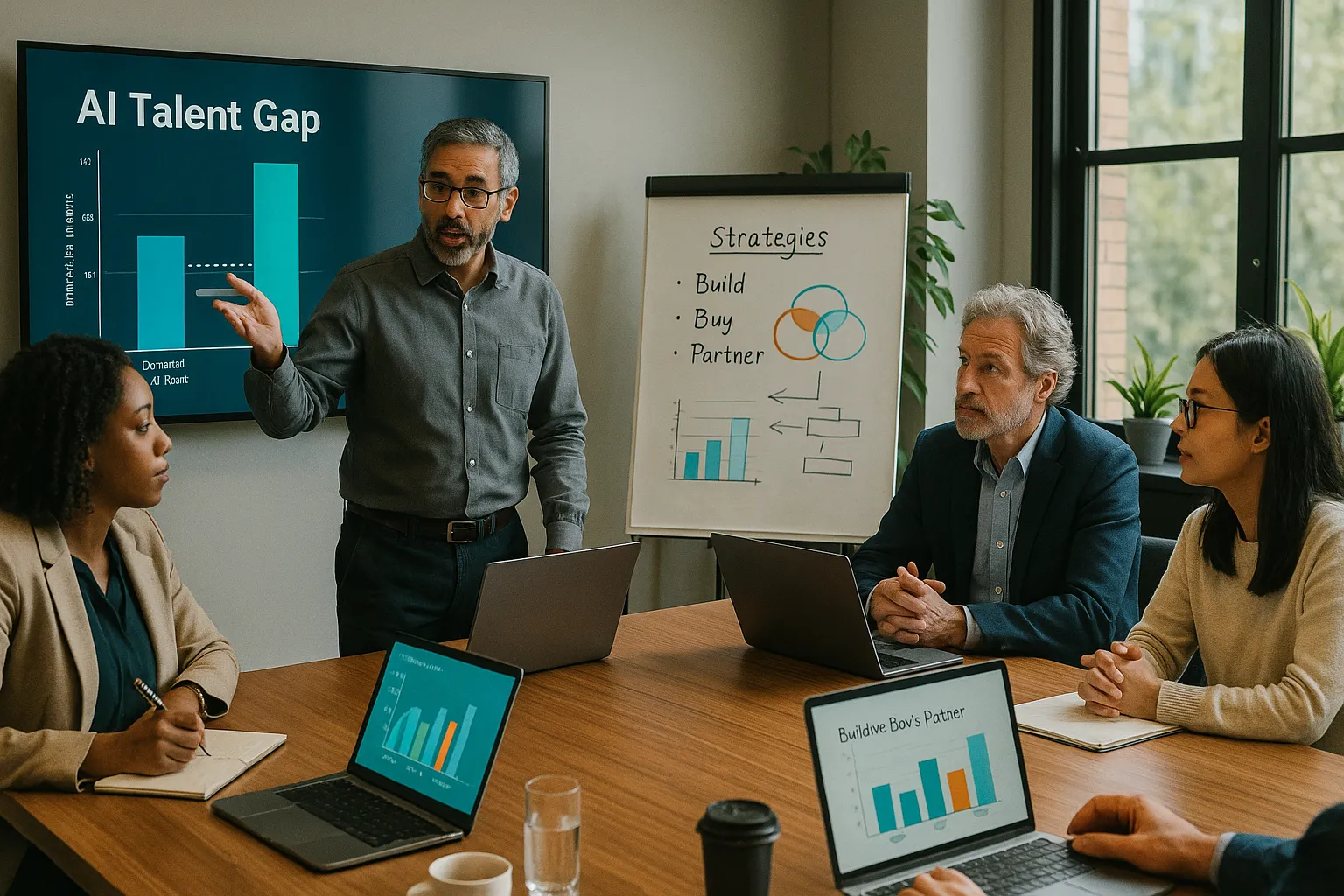
The job posting has been open for six months. Senior AI Engineer. Competitive salary (meaning: whatever it takes). Great benefits, meaningful work, all the perks. And still, the candidate pipeline is a trickle of underqualified applicants, overconfident juniors, and the occasional recruiter trying to poach your existing team.
Welcome to the AI talent gap of 2026.
LinkedIn’s 2026 Jobs on the Rise report shows AI-related roles growing at 5x the rate of overall job postings, while the supply of qualified candidates grows at barely 1.5x. The math doesn’t work. Organizations pursuing AI agent initiatives face a fundamental resource constraint that no amount of budget can fully solve.
This isn’t just a hiring problem—it’s a strategic decision point. How you address the AI talent gap determines not just your implementation timeline but your competitive position. Organizations that make the wrong choice waste years building capability they could have acquired, or become dependent on vendors who don’t understand their business. The stakes are high, and the options are nuanced.
Understanding the AI Agent Talent Landscape
The talent shortage isn’t uniform. Different AI capabilities face different supply-demand dynamics:
| Capability | Supply Level | Demand Level | Gap Severity |
|---|---|---|---|
| Prompt engineering | Moderate | Very High | Medium |
| LLM fine-tuning | Low | High | Severe |
| Agent architecture | Very Low | High | Critical |
| MLOps/AI Ops | Low | Very High | Severe |
| AI product management | Moderate | High | Medium |
| AI ethics/governance | Low | Moderate | Medium |
Agent architecture—the ability to design and build autonomous systems that reason, plan, and act—represents the most acute shortage. This skill requires deep understanding of LLM capabilities, system design expertise, and practical experience with production AI deployments. Universities aren’t producing graduates with this profile; it takes years to develop.
The Experience Premium
According to Levels.fyi data from 2026, AI engineers with 5+ years of relevant experience command 2-3x the salary of those with 2-3 years. But “relevant experience” in AI agents specifically is rare—the field barely existed five years ago. Organizations compete for a tiny pool of truly qualified candidates.
The Real Costs of AI Talent
When calculating the cost of building internal AI capability, most organizations drastically underestimate:
Direct Compensation
- Senior AI Engineer: $180-280K base salary
- AI Architect: $250-400K total compensation
- AI Engineering Manager: $300-450K total compensation
- Benefits, equity, bonuses: Add 30-50%
Recruiting Costs
- Agency fees: 20-30% of first-year salary
- Internal recruiting time: 100+ hours per hire
- Interview time: 20-40 hours of engineer time per hire
- Signing bonuses: Often required to close competitive candidates
Ramp-Up Time
- Average time to full productivity: 6-12 months
- Knowledge transfer burden on existing team: Significant
- Turnover risk during ramp: High (AI talent receives constant recruiting)
Retention Costs
- AI talent turnover rate: 15-25% annually
- Counter-offers: Increasingly expensive
- Retention bonuses: Now expected, not exceptional
A single senior AI engineer easily represents a $400-600K annual commitment when fully loaded costs are considered. And one engineer doesn’t build an AI capability—you need a team.
The Build Option: Internal AI Capability
Building internal AI agent capability means developing the skills, processes, and infrastructure to design, implement, and operate AI agents with your own team.
flowchart TD
    A[Build Decision] --> B{Strategic Differentiator?}
    B -->|Yes| C{Long-term Commitment?}
    B -->|No| D[Consider Buy/Partner]
    C -->|Yes| E{Resources Available?}
    C -->|No| D
    E -->|Yes| F{Talent Accessible?}
    E -->|No| D
    F -->|Yes| G[Build Makes Sense]
    F -->|No| H[Hybrid Approach]
When Building Makes Sense
Strategic differentiation: AI agents are core to your competitive advantage. What you build must be proprietary, deeply integrated with your business, and continuously evolving faster than competitors can copy.
Long-term commitment: You’re willing to invest over years, not quarters. Building capability takes time—rushing creates fragile systems and burned-out teams.
Resource availability: You have budget not just for people, but for infrastructure, tools, training, and the inevitable false starts that learning requires.
Talent accessibility: You can actually hire the people you need. Location, brand, compensation, and mission all influence your ability to attract AI talent.
The Build Roadmap
Year 1: Foundation
- Hire 2-3 senior AI engineers with complementary skills
- Establish infrastructure and tooling
- Complete 1-2 production deployments
- Document learnings and develop practices
Year 2: Scale
- Expand team to 5-8 engineers
- Formalize architecture patterns
- Deploy agents across multiple use cases
- Begin training and knowledge transfer
Year 3: Maturity
- Team of 8-15 depending on scope
- Established centers of excellence
- AI agents embedded in core processes
- Internal training programs producing new AI capability
Total investment: $3-8M over three years, plus ongoing operational costs of $2-5M annually.
Engineering Leadership
❌Before AI
- •Expect immediate results from AI hires
- •Underestimate infrastructure needs
- •Skip documentation and knowledge capture
- •Treat AI team as siloed specialists
✨With AI
- •Plan for 12+ month capability development
- •Invest in platforms alongside people
- •Build learning into team operations
- •Embed AI expertise across organization
📊 Metric Shift: Organizations that invest in AI platforms alongside talent see 40% faster time to value (Gartner 2025)
Build Risks
- Key person dependency: Small teams create single points of failure
- Skill obsolescence: AI moves fast; today’s expertise may be outdated tomorrow
- Opportunity cost: Resources invested in building could be deployed elsewhere
- Execution risk: Many internal AI initiatives fail to deliver
The Buy Option: AI Platforms and Products
Buying means acquiring AI agent capability through commercial platforms, tools, and products rather than building from scratch.
When Buying Makes Sense
Non-differentiating use cases: The AI capability you need is common across industries. Customer service agents, document processing, code assistance—these problems have commercial solutions.
Speed priority: You need capability now, not in two years. Markets don’t wait for internal development cycles.
Limited technical depth: Your organization lacks the engineering culture to build and operate complex AI systems long-term.
Clear requirements: You know exactly what you need, and commercial products meet those needs without significant customization.
The Buy Landscape
| Category | Example Products | Typical Cost | Sweet Spot |
|---|---|---|---|
| Agent platforms | Salesforce Einstein, ServiceNow AI | $50-500K/year | Enterprise workflow automation |
| Development tools | GitHub Copilot, Cursor | $20-50/user/month | Developer productivity |
| Vertical solutions | Harvey (legal), Abridge (healthcare) | $100K-1M/year | Industry-specific needs |
| Agent builders | AutoGen, LangGraph, CrewAI | $0-50K/year | Custom agent development |
| Infrastructure | AWS Bedrock, Azure AI, Google Vertex | Usage-based | LLM hosting and management |
Buy Risks
- Vendor lock-in: Switching costs grow over time; you become dependent on vendor roadmap
- Limited customization: Products designed for everyone fit no one perfectly
- Competitive parity: If everyone uses the same tool, no one gains advantage
- Data concerns: Your data may train vendor models or become accessible to others
- Cost unpredictability: Usage-based pricing can surprise as adoption grows
The Hidden Cost of Buying
License fees are just the beginning. Implementation, integration, customization, training, and ongoing management often exceed the product cost. Budget 2-3x the software cost for total cost of ownership. A $100K platform easily becomes a $300K annual commitment.
The Partner Option: Specialized Expertise
Partnering means engaging specialized firms to design, build, and potentially operate AI agent capabilities on your behalf.
When Partnering Makes Sense
Capability acceleration: You need to move faster than internal building allows but require more customization than buying provides.
Skill transfer: You want to develop internal capability while benefiting from external expertise during the learning curve.
Risk mitigation: Complex AI initiatives benefit from experienced guidance to avoid common pitfalls.
Capacity bridging: You have some internal capability but need to scale beyond current team capacity.
Partner Types
| Partner Type | What They Provide | When to Engage |
|---|---|---|
| Strategy consultants | AI strategy, roadmaps, governance | Early planning phases |
| Implementation partners | Architecture, development, deployment | Active build phases |
| Managed service providers | Ongoing operation, optimization | Post-deployment |
| Specialized agencies | Deep domain expertise | Complex, specialized needs |
| Fractional talent | Part-time senior expertise | Capability gaps |
The Partner Model That Works
The most effective partnerships combine external expertise with internal ownership:
-
Partner leads architecture and initial implementation: Their experience prevents common mistakes and accelerates timeline
-
Internal team works alongside partner: Your people learn by doing, not just watching
-
Knowledge transfer is explicit deliverable: Documentation, training, and capability building are contractual requirements
-
Ownership transitions systematically: Clear milestones for internal team to assume responsibility
-
Partner remains available for support: Ongoing advisory relationship for complex challenges
gantt
    title Partnership Timeline
    dateFormat  YYYY-MM
    section Strategy
    AI Strategy Development    :2026-01, 2M
    section Implementation
    Partner-Led Build          :2026-03, 4M
    Joint Development          :2026-07, 3M
    Internal-Led (Partner Support) :2026-10, 3M
    section Operations
    Internal Operations        :2027-01, 12M
Partner Risks
- Dependency: Over-reliance on partner for ongoing operation
- Knowledge gaps: Partner leaves and takes expertise with them
- Misalignment: Partner optimizes for their interests, not yours
- Cost creep: Scope expansion increases fees beyond original estimates
- Quality variance: Partner performance can vary significantly
The Decision Framework
Most organizations don’t face a pure build/buy/partner choice. The question is: what combination of approaches fits your situation?
Assessment Criteria
Score your organization on each dimension (1-5 scale):
Strategic Importance
- How central is AI agent capability to competitive advantage?
- 1 = Nice to have, 5 = Core differentiator
Time Pressure
- How urgently do you need capability deployed?
- 1 = Can wait 2+ years, 5 = Need it now
Internal Capability
- What AI expertise exists in your organization today?
- 1 = None, 5 = Strong AI team already
Budget Flexibility
- What resources can you commit to AI capability?
- 1 = Very limited, 5 = Significant investment available
Risk Tolerance
- How much execution risk can you absorb?
- 1 = Very risk-averse, 5 = High tolerance for failure
Decision Matrix
| Profile | Recommended Approach |
|---|---|
| High strategic importance + High capability + Low time pressure | Build |
| High strategic importance + Low capability + High time pressure | Partner then build |
| Low strategic importance + High time pressure | Buy |
| High strategic importance + High time pressure + High budget | Partner for acceleration + build for sustainability |
| Low budget + Low time pressure + Low strategic importance | Buy commodity solutions |
Hybrid Approaches
Most successful AI strategies combine approaches:
Build Core + Buy Commodity: Build proprietary agents for competitive differentiation; buy standard solutions for common needs.
Partner to Accelerate + Build to Sustain: Use partners to achieve quick wins and develop internal capability simultaneously.
Buy Platform + Build on Top: Acquire foundational infrastructure; build differentiated applications on top.
Start with Partner + Transition to Build: Partner-led implementation with explicit knowledge transfer and internal team ramp.
The Role of Enterprise Context Engineering
Enterprise Context Engineering offers a partnership model specifically designed to address the AI talent gap while building lasting capability.
Rather than providing generic AI consulting, ECE focuses on the unique context that makes your AI agents effective:
-
Autonomous Agents that understand your business because they’re built with your specific context, not generic patterns
-
Agentic Workflows designed around your actual processes, not templates that require endless customization
-
Continuous AI Operations that transfers operational knowledge to your team while ensuring agents improve over time
-
Executive Digital Twin capabilities that extend leadership capacity as AI scales across the organization
The ECE approach acknowledges that you can’t buy context and you can’t easily build it alone. The partnership accelerates capability development while ensuring you own the result.
The Context Advantage
Most AI talent knows how to build agents. Few understand how to build agents that truly understand a specific business. ECE bridges this gap—combining technical AI expertise with deep investment in understanding your context. The result is AI capability that works for your business specifically, not generic solutions that require constant correction.
Making the Decision
The build/buy/partner decision isn’t one-time—it’s ongoing. As your capability grows, your organization changes, and the market evolves, the right approach shifts.
Today’s decision: What approach gets you started effectively given current constraints?
Future optionality: What approach preserves flexibility as you learn more?
Long-term vision: What approach builds toward your ultimate capability goals?
The organizations that navigate the AI talent gap successfully don’t pick one approach and stick with it religiously. They combine approaches strategically, adjust as circumstances change, and focus relentlessly on building capability—whether through hiring, purchasing, or partnering.
The talent gap is real, but it’s not insurmountable. It just requires thinking beyond the traditional “hire the best people” playbook that worked when talent was abundant. In the AI age, strategy beats scarcity.
Navigate the AI Talent Gap
metacto helps organizations develop AI agent capabilities despite the talent shortage. Whether you need to accelerate internal teams, select the right platforms, or partner for implementation, we bring the expertise that makes AI initiatives succeed.
How do I decide between building, buying, or partnering for AI agents?
Assess strategic importance (is AI core to competitive advantage?), time pressure (how urgently do you need capability?), internal capability (what AI expertise exists?), budget flexibility (what resources are available?), and risk tolerance (how much execution risk can you absorb?). Build for strategic, long-term needs with adequate resources. Buy for commodity needs with time pressure. Partner to accelerate capability development while building internal expertise.
What is the true cost of hiring AI engineers?
Senior AI engineers cost $180-280K base salary, with total compensation often reaching $300-400K+ including equity and bonuses. Add 30-50% for benefits and overhead. Recruiting costs include agency fees (20-30% of salary), internal recruiting time (100+ hours), and signing bonuses. Expect 6-12 months to full productivity and 15-25% annual turnover. A single senior AI engineer represents $400-600K annual commitment fully loaded.
When should I buy AI platforms instead of building?
Buy when the capability is non-differentiating (common across industries), speed is critical, technical depth is limited, and requirements are clear with existing commercial solutions. Common buy scenarios include developer productivity tools, standard customer service automation, and document processing. Budget 2-3x the license cost for total cost of ownership including implementation and integration.
How do I choose an AI implementation partner?
Look for demonstrated experience in your industry, clear methodology for knowledge transfer, references from similar engagements, technical depth in agent architecture specifically (not just general AI), and willingness to transition ownership to your team. Avoid partners who create dependency rather than capability. The best partnerships include explicit deliverables for documentation, training, and capability building.
What skills are hardest to find in AI talent?
Agent architecture (designing autonomous systems that reason and act) represents the most critical shortage---it requires deep LLM understanding, system design expertise, and production AI experience. LLM fine-tuning and MLOps also face severe gaps. Prompt engineering and AI product management have moderate shortages. These skills take years to develop and universities aren't producing graduates with the required profile.
Can I start with a partner and transition to internal capability?
Yes, this hybrid approach works well when you need speed but want long-term internal capability. The key is structuring the engagement for knowledge transfer: have internal team members work alongside partners, make documentation and training explicit deliverables, establish clear milestones for transitioning responsibility, and maintain an advisory relationship for complex challenges after primary engagement ends.
How long does it take to build internal AI agent capability?
Plan for 3+ years to build mature internal capability. Year 1 focuses on hiring foundation team (2-3 senior engineers), establishing infrastructure, and completing initial deployments. Year 2 scales the team, formalizes patterns, and expands use cases. Year 3 achieves maturity with 8-15 engineers, established practices, and internal training programs. Total investment typically runs $3-8M over three years plus $2-5M ongoing annually.