

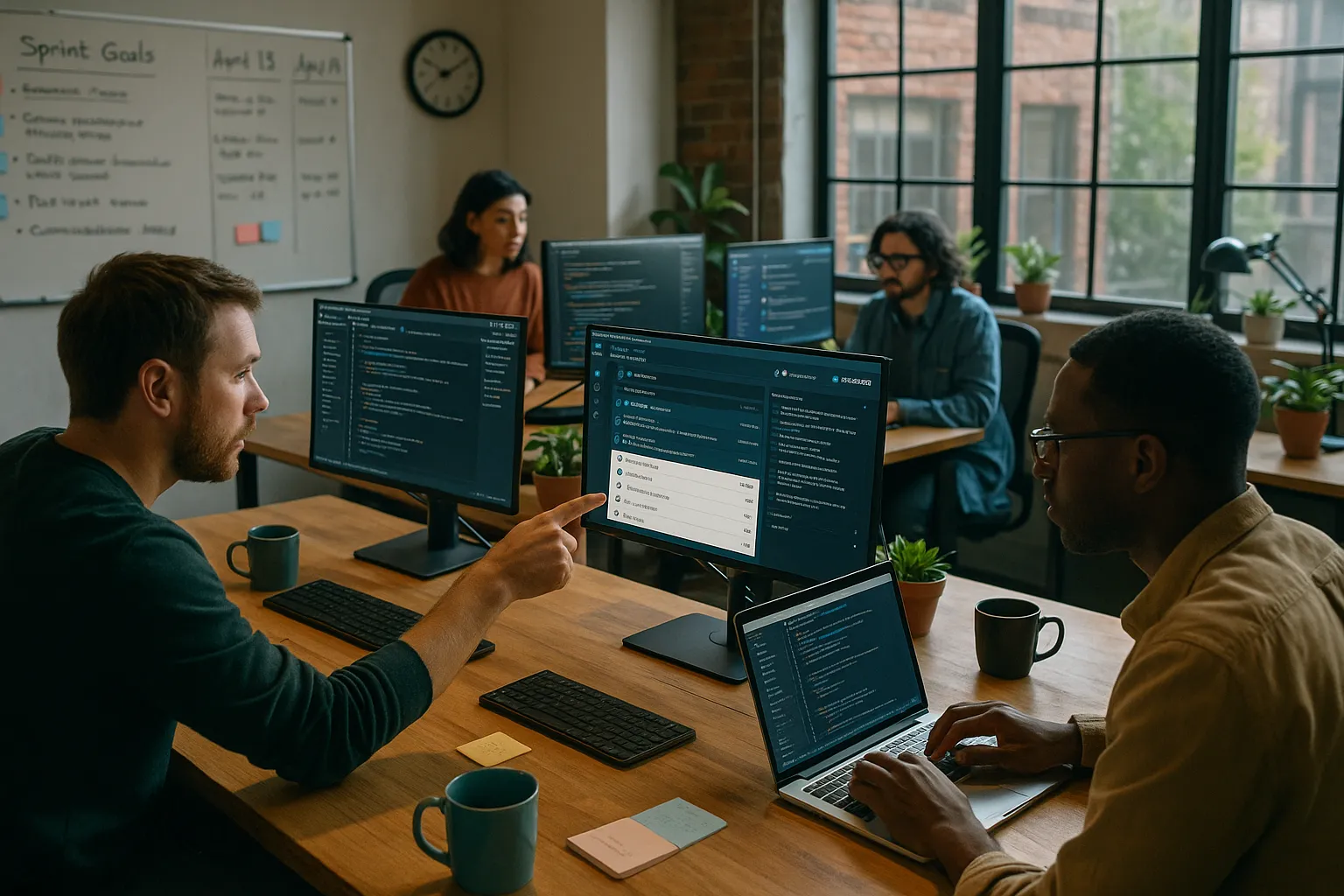
The Bottleneck Moved From Writing Code to Verifying It
AI coding assistants can make individual developers feel faster almost immediately. The problem appears one step later. More code reaches the pull request queue, more changes need verification, and the people trusted to review risky work still have the same number of hours in the week.
That is the AI code review bottleneck: PR inflow rises faster than review capacity. The team writes code faster, but delivery does not accelerate because review, testing, security validation, and architectural judgment become the new constraint.
This is not just a feeling. Faros AI’s research on AI software engineering reported a sharp increase in pull request volume alongside longer review times. The DORA research program has also connected AI adoption with larger PRs and more time spent in review. The exact numbers will vary by organization, but the operating pattern is consistent: AI reduces the cost of producing code before it reduces the cost of trusting code.
How to Spot a Code Review Bottleneck
To reduce a code review bottleneck, measure the queue before buying another tool. Track time to first review, median PR size, reviewer concentration, escaped defects, rework PRs, and lead time for change. Then shrink PRs, add AI first-pass review, review intent before code generation, and rebalance reviewer capacity. If those changes do not move lead time, the issue is no longer a review habit. It is an operating model problem.
For engineering leaders, that distinction matters. A tool can catch obvious issues. It cannot decide who owns review capacity, what level of risk requires senior approval, whether AI-generated code matches product intent, or how review metrics tie back to delivery economics. That is why this article treats the bottleneck as a measurement and operating-model problem first, and a tooling problem second.
What to Measure Before You Buy an AI Review Tool
If your team says “reviews are slow,” do not start with a vendor evaluation. Start with a baseline. The metrics below tell you whether the bottleneck is PR size, reviewer availability, review quality, or unclear intent.
| Metric | What it reveals | What to watch for |
|---|---|---|
| Time to first review | Queue wait before a human engages | PRs sitting untouched for a day or more |
| Median PR size | Cognitive load per review | AI-assisted changes drifting into large bundled diffs |
| Reviewer concentration | Whether a few senior engineers are the constraint | A small group handling most high-risk approvals |
| Review iteration count | How much rework happens after review starts | Repeated comments about requirements, tests, or architecture |
| AI fix-up PRs | Whether generated code is creating follow-on cleanup | Small corrective PRs that patch earlier AI-assisted changes |
| Escaped defects | Whether review quality is falling under load | More production issues tied to logic, edge cases, or security |
| Lead time for change | Whether AI is improving delivery, not just activity | Faster coding with flat or worse delivery timelines |
The important move is to connect review data to delivery data. DORA’s software delivery metrics frame lead time for change as an end-to-end measure, not a coding-speed measure. If your commit-to-production time is not improving, more AI-generated code may simply be filling the queue faster.
Do not measure AI by output alone
Generated lines, accepted completions, and PR count can all rise while delivery slows. Measure the handoff from generated code to trusted code. That is where the bottleneck usually shows up.
Why AI Makes Review Harder Before It Makes Review Faster
Code generation and code review scale differently.
Generation is parallel and cheap. A developer can prompt an assistant, get a working draft, revise it, and open a PR in minutes. Review is serial and expensive. A reviewer must understand the change, compare it to intent, inspect edge cases, evaluate test coverage, consider security implications, and decide whether the code belongs in the system.
That work becomes harder when AI changes the shape of PRs:
- More PRs arrive. Even if every PR is individually reasonable, the queue grows when review capacity stays fixed.
- PRs can get larger. AI makes it easy to bundle “while I am here” changes that would have been too tedious to write by hand.
- Intent becomes less visible. Reviewers may see generated implementation before they see the business rule, acceptance criteria, or tradeoff the code is supposed to satisfy.
- Trust is uneven. A human-authored change often carries context from the author. AI-generated code can look polished while hiding a wrong assumption.
- Security review spreads thinner. More generated code means more surface area for dependency, auth, data-handling, and injection risks.
flowchart LR
    A[AI-assisted coding] --> B[More and larger PRs]
    B --> C[Review queue]
    C --> D[Human verification]
    D --> E[Trusted code]
    C --> F[Longer wait time]
    F --> G[Context loss and rushed reviews]
    G --> C

    style C fill:#f97316,stroke:#c2410c,color:#fff
    style G fill:#fee2e2,stroke:#ef4444,color:#111827
This is why “add an AI reviewer” is not a complete answer. AI can absolutely help with the first pass. But the highest-value review work is still judgment: whether the change matches the spec, whether the architecture remains coherent, whether a shortcut will become an incident, and whether the team has enough tests to trust the merge.
Diagnose the Stage of the Bottleneck
The same symptom - slow reviews - can mean three different things. Treating all of them the same wastes time.
| Stage | Signals | Best first response |
|---|---|---|
| Early congestion | PRs wait longer than normal, but cycle time is still acceptable | Tighten PR size, add review SLAs, make aging PRs visible |
| Active bottleneck | Lead time worsens, reviewers rush approvals, fix-up PRs increase | Add AI first-pass review, review intent earlier, rebalance reviewer load |
| Structural capacity failure | A few senior engineers block most merges, quality risk rises, roadmap work stalls | Redesign ownership, risk tiers, staffing, and operating cadence |
Use a simple checklist to place yourself:
- PRs regularly wait more than 24 hours before first human review.
- Median PR size has climbed over the last two quarters.
- A small group of senior engineers handles most complex approvals.
- Large diffs receive fast “LGTM” approvals with little substantive feedback.
- Production issues increasingly trace back to missed logic, data, or security edge cases.
- Developers say they are moving faster, but change lead time is flat or worse.
- Review comments often uncover unclear requirements rather than code-level issues.
- You see multiple follow-on PRs correcting AI-assisted changes after merge.
If only one or two are true, you may have a workflow hygiene issue. If three or more are true, review is already constraining throughput. If the final four are true, the problem has moved beyond code review and into engineering operating model.
Decision Tree: Process Fix, Tool Fix, or Operating Model Fix
Use this sequence before you start comparing AI code review vendors.
flowchart TD
    A[Is lead time worse despite faster coding?] -->|No| B[Keep measuring and limit PR size]
    A -->|Yes| C[Are PRs too large or waiting too long?]
    C -->|Yes| D[Process fix: smaller PRs, review SLAs, visible queues]
    C -->|No| E[Are reviewers catching repetitive mechanical issues?]
    E -->|Yes| F[Tool fix: AI first-pass review, policy checks, test suggestions]
    E -->|No| G[Is senior review capacity the constraint?]
    G -->|Yes| H[Operating model fix: risk tiers, reviewer rotation, ownership changes]
    G -->|No| I[Review intent before code: specs, acceptance criteria, architecture notes]
Choose a Process Fix When the Queue Is Mostly Hygiene
Process fixes work when the team is fundamentally healthy but AI has increased throughput faster than habits have adapted.
Start here:
- Cap PR size and require authors to split unrelated changes.
- Use stacked PRs for features that cannot fit in one small diff.
- Add a first-response SLA so PRs do not disappear into the queue.
- Reserve a daily review block for the team instead of treating review as leftover time.
- Require a short PR summary: intent, risk, test evidence, and reviewer ask.
Jellyfish has reported that AI-assisted PRs can be larger than traditional ones, and research-backed practitioner guidance on review size consistently points in the same direction: smaller diffs are easier to understand, safer to review, and faster to merge.
Choose a Tool Fix When Humans Are Repeating Mechanical Work
AI-assisted review is most useful when it removes low-value repetition before a human enters the thread. That means catching missing tests, risky file changes, inconsistent patterns, dependency changes, obvious security issues, and unclear PR descriptions.
Useful tool categories include:
- GitHub-native review: GitHub Copilot code review for teams already standardized on GitHub.
- Dedicated AI PR review: tools such as CodeRabbit, Qodo, or Greptile for automated first-pass comments and repository-aware checks.
- Agentic review workflows: Claude Code or similar agent workflows for teams that want review prompts, repository context, and test execution tied into CI.
- Stacked PR workflow: Graphite or similar tooling when the main issue is large bundled changes.
The key is to make the tool a filter, not the final approver. Ask it to summarize intent, flag risky changes, propose missing tests, and point reviewers to the files that deserve attention. Do not ask it to replace architectural ownership.
Senior Reviewer
❌Before AI
- •Reads every changed file with little triage
- •Spends review time on style, naming, and obvious test gaps
- •Switches context repeatedly as the queue ages
- •Approves under pressure when PR volume spikes
✨With AI
- •Starts from an AI-generated risk summary
- •Lets automation handle repeatable policy checks
- •Focuses on architecture, product intent, and edge cases
- •Uses review time for judgment instead of cleanup
📊 Metric Shift: More comments are not the win. Faster trust in the right changes is.
Choose an Operating Model Fix When Review Ownership Is Broken
If the same senior engineers are always the only credible reviewers, you do not have a code review problem. You have a knowledge distribution problem.
Operating-model fixes include:
- Define risk tiers for PRs so low-risk work can move without senior escalation.
- Assign code ownership by system boundary, not by who happens to be available.
- Rotate reviewers intentionally so knowledge spreads beyond the same experts.
- Add review runbooks for auth, data handling, AI-generated code, and dependency changes.
- Connect review quality to incident review when escaped defects happen.
- Create explicit “review left” checkpoints for large or risky work before code is generated.
This is where AEMI becomes relevant. AEMI looks at whether AI is improving the full software delivery lifecycle, not just whether developers are using AI tools. If AI adoption raises activity but does not improve lead time, review quality, or release confidence, the maturity gap is measurable.
Five Fixes That Reduce Code Review Bottlenecks
1. Shrink PRs Before You Add More Review Automation
Large PRs are the easiest bottleneck to create and the hardest to review well. AI makes them seductive because the assistant can generate a complete implementation in one sitting. Reviewers still have to reconstruct the reasoning.
Set a default PR size target, then make exceptions explicit. A 900-line PR may be appropriate for generated snapshots, migrations, or mechanical refactors, but it should not be the norm for product logic. For feature work, ask authors to split the sequence into reviewable units: schema, internal API, business logic, UI, tests, cleanup.
The rule is simple: if a reviewer cannot explain the intent and risk of the change after one focused pass, the PR is too large or too poorly framed.
2. Put AI in Front of Human Reviewers, Not Instead of Them
AI first-pass review should answer the questions a human would otherwise burn time assembling:
- What changed?
- Which files carry the most risk?
- What tests were added or missing?
- Are there obvious security, dependency, or data-handling concerns?
- Does the implementation appear to match the stated acceptance criteria?
Then a human reviewer can spend attention where it matters. That is especially valuable for senior engineers, whose bottleneck is rarely syntax. Their bottleneck is judgment.
3. Review Intent Before Code Is Generated
Many review threads are slow because the reviewer discovers the real disagreement too late. The issue is not the code. It is the plan.
For AI-assisted work, shift review left:
- Review the ticket before implementation.
- Require acceptance criteria that can be tested.
- Ask for an implementation plan on risky work.
- Document architecture tradeoffs before the assistant writes code.
- Treat prompts and generated plans as reviewable artifacts when the change is complex.
When the plan is already agreed upon, the code review becomes verification: did the implementation do what we approved? That is faster than asking reviewers to reverse-engineer intent from the diff.
4. Rebalance Review Capacity Deliberately
Review load should not be a tax that silently accumulates on the most experienced people. If review quality depends on three people, AI will make those three people busier.
Create review rotations by system area. Pair junior reviewers with senior owners on medium-risk work. Publish an aging PR dashboard. Give reviewers protected time. Most importantly, separate “must be reviewed by a domain owner” from “can be reviewed by any trained engineer using the runbook.”
This is how you increase throughput without pretending every engineer has the same context.
5. Turn Review Signals Into Continuous AI Operations
Once AI-generated code is part of the delivery system, review metrics should become operating metrics. They belong in the same conversation as test health, deployment frequency, incident rate, and escaped defects.
Continuous AI Operations is the discipline of keeping AI-enabled workflows reliable after launch. In the engineering workflow, that means monitoring review load, eval failures, CI failures, risky dependency changes, model/tool drift, and incident patterns. It also means updating runbooks as the codebase and AI tooling change.
Do not freeze the process. Create a feedback loop that keeps the review system healthy as AI usage grows.
Is AI Improving the SDLC or Just Moving Work Around?
The most common AI measurement mistake is stopping at adoption. “Most engineers use Copilot” or “we opened twice as many PRs” is activity, not maturity.
An AI-mature engineering organization can answer harder questions:
- Did AI reduce lead time for change?
- Did review wait time improve or worsen?
- Did escaped defects fall, stay flat, or rise?
- Which SDLC phase became the new constraint after code generation improved?
- Which review decisions can be automated, and which require human judgment?
- Which teams need better context, tests, ownership, or runbooks before more AI is useful?
That is the purpose of an AEMI Assessment: measure AI’s effect across the delivery system, find the constraint, and connect the technical bottleneck to business outcomes. For this article’s problem, AEMI would not ask only “Which AI review tool should we buy?” It would ask “Where did AI move the constraint, and what operating change restores throughput without lowering quality?”
If the answer is workflow automation, AI Agents & Workflows can help build the review assistant, PR triage flow, test-generation loop, or escalation workflow. If the answer is sustained reliability, Continuous AI Operations keeps the metrics and runbooks alive. If the answer is a delivery bottleneck that needs focused senior execution, Lightning Pods can supply a compact team to remove the constraint without turning it into a broad transformation program.
When to Get Outside Help
You can usually fix early congestion internally. If the issue is oversized PRs, missing SLAs, or unclear PR descriptions, start with process. You do not need a transformation project to ask engineers to split diffs and write better acceptance criteria.
Outside help becomes useful when the bottleneck is structural:
- Leadership cannot tell whether AI is improving delivery economics.
- Review data is missing, incomplete, or disconnected from DORA metrics.
- Senior engineers are permanently stuck approving work instead of designing systems.
- AI-generated code is increasing security, reliability, or maintenance risk.
- Teams disagree about whether the fix is tooling, process, staffing, or architecture.
- The organization needs a board-ready answer on AI engineering ROI.
In those cases, the fastest path is not another isolated tool trial. It is a short assessment that identifies the constraint, sizes the business impact, and turns the fix into an operating plan.
What You Can Do This Week
Start with one repository and one month of data.
-
Measure the queue. Pull time to first review, time to merge, median PR size, reviewer distribution, and escaped defects.
-
Tag AI-assisted PRs. Do not debate vibes. Create a lightweight label so you can compare AI-assisted work against the rest of the queue.
-
Split the largest PRs. Pick the top 10% by size and inspect whether they could have been stacked or staged.
-
Add AI first-pass review where it removes repetition. Use it for summaries, policy checks, risky-file flags, missing-test suggestions, and dependency review.
-
Review intent earlier. For risky work, require a plan and acceptance criteria before implementation.
-
Rebalance review ownership. Make aging PRs visible and rotate review responsibility by system area.
-
Escalate the operating problem if metrics do not move. If review wait, lead time, or escaped defects stay high after process and tooling changes, treat the bottleneck as a maturity issue.
The teams that win with AI will not be the teams that generate the most code. They will be the teams that build the fastest path from generated code to trusted, tested, production-ready software.
Assess your AI engineering bottleneck
Metacto's AEMI Assessment helps engineering leaders find where AI moved the constraint, measure the impact on delivery, and build a practical plan to restore throughput without lowering quality.
FAQ: AI Code Review Bottlenecks
What is the AI code review bottleneck?
The AI code review bottleneck is the gap between faster AI-assisted code generation and slower human verification. Developers can open more pull requests, but reviewers still need to inspect intent, architecture, tests, security, and business logic. When PR inflow grows faster than review capacity, delivery slows even though coding feels faster.
How do we reduce code review bottlenecks?
Start by measuring time to first review, median PR size, reviewer concentration, rework, escaped defects, and lead time for change. Then reduce PR size, add review SLAs, use AI for first-pass triage, review requirements before code generation, and rebalance review ownership so the same senior engineers are not the permanent constraint.
Which metrics should we track before buying an AI PR review tool?
Track time to first review, time from first review to merge, median PR size, review comments per PR, reviewer distribution, CI failure rate, escaped defects, AI fix-up PRs, and lead time for change. These metrics show whether the issue is queue wait, PR size, quality, unclear intent, or reviewer capacity.
Can AI code review replace manual PR review?
No. AI review tools are useful for first-pass checks, summaries, missing-test suggestions, risky-file flags, and common policy issues. Human reviewers are still needed for architectural judgment, business logic, security accountability, and mentorship. The strongest pattern is AI first, human judgment second.
What AI tools help reduce code review bottlenecks?
Common options include GitHub Copilot code review for GitHub-native teams, CodeRabbit or Qodo for dedicated AI PR review, Greptile for repository-aware analysis, Claude Code workflows for agentic review tasks, and Graphite for stacked PR workflows. The right tool depends on whether your bottleneck is mechanical review work, large PRs, missing tests, or senior-reviewer capacity.
How can we improve code review throughput without adding headcount?
Improve throughput by shrinking PRs, making aging PRs visible, creating review rotations, using AI first-pass review for repeatable checks, and reviewing specs before implementation. This reduces cognitive load and context switching without pretending review quality is free.
When is a code review bottleneck an operating model problem?
It becomes an operating model problem when review quality depends on a few senior engineers, lead time worsens despite process fixes, escaped defects rise, or no one owns the metrics. At that point, the fix is not just tooling. You need clearer ownership, risk tiers, runbooks, and a recurring operating cadence.
How do we reduce security review bottlenecks from AI-generated code?
Create risk tiers for security-sensitive changes, add automated checks for dependencies and data-handling patterns, require explicit acceptance criteria for auth and privacy work, and route high-risk PRs to qualified reviewers early. AI can triage security signals, but accountability for security decisions should remain human.
Sources:
- Faros AI: The AI Productivity Paradox Research Report
- Google DORA Research
- DORA: Software Delivery Performance Metrics
- InfoQ: AI Coding Assistants Haven’t Sped up Delivery Because Coding Was Never the Bottleneck
- LogRocket: Why AI Coding Tools Shift the Real Bottleneck to Review
- Jellyfish: AI-Assisted Pull Requests Are 18% Larger
- Mathieu Lamiot: Code Reviews Are Killing Your Team’s Velocity
- GitHub Docs: Using GitHub Copilot Code Review
- Claude Code: GitHub Actions Documentation
- Graphite: Stacked Diffs and Code Review