

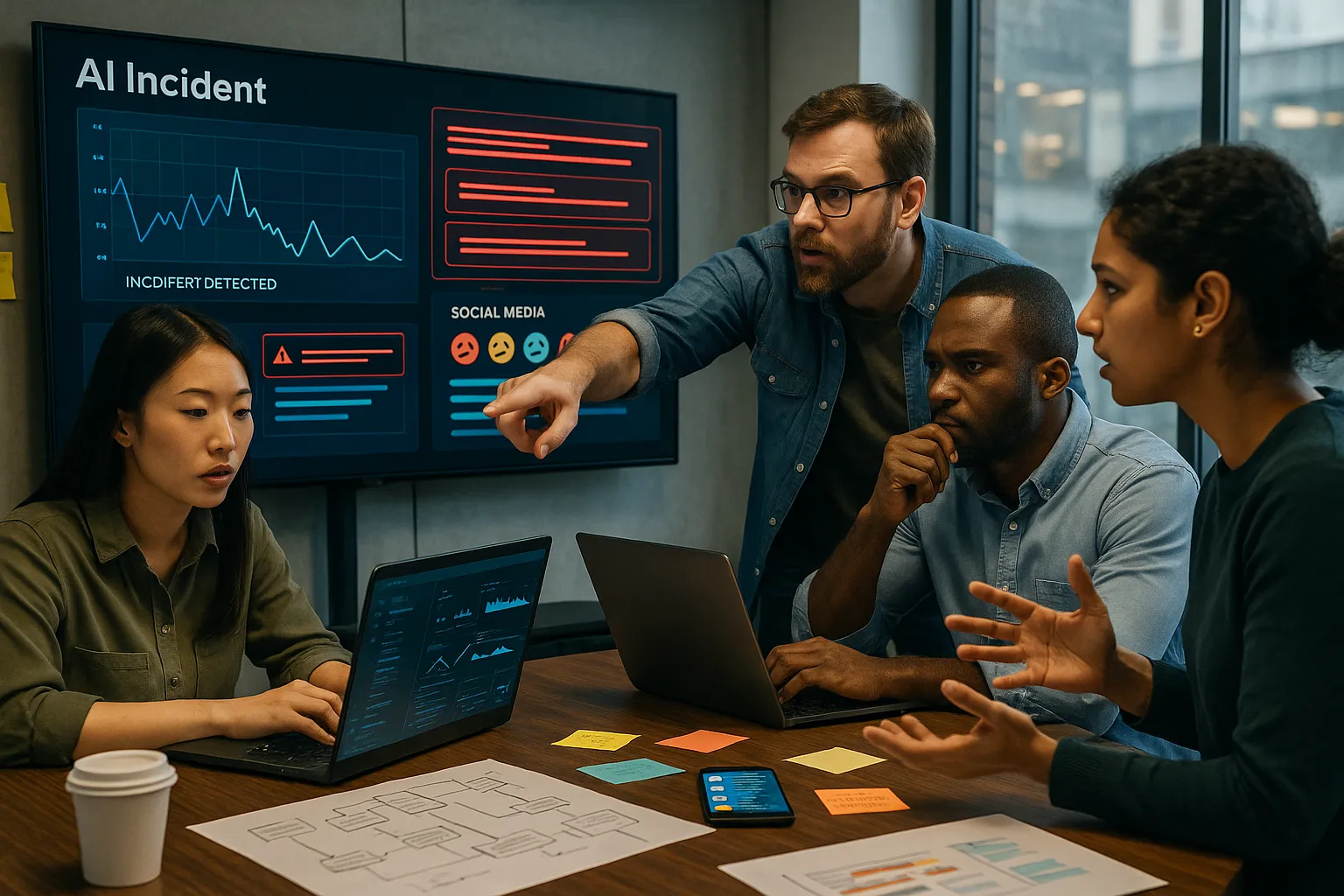
At 2:47 PM on a Tuesday, the AI-powered customer service system started telling customers that the company was going out of business. The AI was not hallucinating—it had found a six-year-old news article about a competitor with a similar name and integrated that information into its responses. By the time the team noticed, 347 customers had received alarming messages. Social media lit up. The CEO’s phone rang.
This is what an AI incident looks like. Not a crash. Not an error message. An AI system confidently producing harmful outputs while every monitoring dashboard showed green lights. The team had incident response procedures for service outages but nothing for “the AI is saying true-sounding things that are wrong.”
AI incidents are inevitable. The question is not whether your AI systems will produce problematic outputs but how quickly you will detect them, how effectively you will respond, and how reliably you will prevent recurrence. This guide provides a framework for AI incident response that addresses the unique challenges of production AI systems.
How AI Incidents Differ from Traditional Incidents
Traditional software incident response assumes certain things: failures are visible, the system either works or does not, and fixing the code fixes the problem. AI incidents violate all these assumptions.
The Invisible Failure Problem
Traditional software fails visibly—error messages, crashes, timeouts. AI systems can fail silently while appearing to work perfectly. An AI producing confident, well-formatted, completely wrong outputs looks healthy to conventional monitoring. This invisible failure mode is the defining challenge of AI incident response.
The AI Incident Taxonomy
Type 1: Availability Failures The system is down or returning errors. Traditional incident response applies. These are actually the easy ones.
Type 2: Quality Failures The system is up and returning outputs, but outputs are wrong, harmful, or inappropriate. Quality monitoring must detect these.
Type 3: Safety Failures The system produces outputs that could cause harm—security breaches, privacy violations, legal exposure, or physical safety risks.
Type 4: Reputation Failures Outputs are technically correct but inappropriate—tone-deaf responses, off-brand communications, or outputs that reflect poorly on the organization.
Type 5: Economic Failures The system is functioning but costs have spiraled—runaway token usage, resource consumption spikes, or efficiency collapse.
| Type | Detection Challenge | Response Priority |
|---|---|---|
| Availability | Easy (system is down) | High |
| Quality | Medium (requires quality monitoring) | High |
| Safety | Hard (may require human recognition) | Critical |
| Reputation | Medium (user feedback or monitoring) | Medium-High |
| Economic | Medium (cost monitoring) | Medium |
Traditional incident response focuses almost exclusively on Type 1. AI incident response must address all five.
The AI Incident Response Framework
Effective AI incident response follows a structured process adapted for AI-specific challenges.
graph TD
    A[Incident Detected] --> B[Severity Assessment]
    B --> C{Severity Level}
    C -->|Critical| D[Immediate Containment]
    C -->|High| E[Rapid Containment]
    C -->|Medium| F[Controlled Response]
    C -->|Low| G[Scheduled Response]
    D --> H[Stakeholder Notification]
    E --> H
    H --> I[Root Cause Investigation]
    I --> J[Remediation Planning]
    J --> K[Fix Implementation]
    K --> L[Verification]
    L --> M[Gradual Restoration]
    M --> N[Post-Incident Review]
    N --> O[Prevention Measures]
Phase 1: Detection
Detection is where most organizations fail. They discover incidents through user complaints or, worse, social media escalation rather than proactive monitoring.
Detection Sources
| Source | Typical Detection Time | Coverage |
|---|---|---|
| Automated monitoring | Seconds to minutes | Quantitative issues |
| User feedback | Minutes to hours | Quality and UX issues |
| Support tickets | Hours to days | Serious user impact |
| Social media | Hours to days | Reputation issues |
| Internal discovery | Variable | Random catch |
| External report | Days to weeks | Security/compliance |
Organizations should invest in faster detection sources. Every hour of delay in detection multiplies incident impact.
Building Detection Capability
The monitoring discussed in our AI monitoring guide provides the foundation for detection:
- Quality metrics that surface accuracy degradation
- User behavior signals (regeneration rate, edit distance) that indicate problems
- Drift detection that catches distribution shifts
- Cost monitoring that identifies economic anomalies
- Safety classifiers that flag potentially harmful outputs
Detection is an investment that pays off in reduced incident impact.
Phase 2: Severity Assessment
Rapid severity assessment enables appropriate response allocation. Not every issue warrants waking someone at 3 AM, but some issues cannot wait until morning.
Severity Criteria
| Severity | User Impact | Business Impact | Response Time |
|---|---|---|---|
| Critical | Safety risk or widespread harm | Significant liability or reputation damage | Immediate (minutes) |
| High | Major feature degraded | Material business impact | Within 1 hour |
| Medium | Feature impaired but usable | Limited business impact | Within 4 hours |
| Low | Minor degradation | Minimal business impact | Next business day |
AI-Specific Severity Factors
Standard severity assessment does not capture AI-specific risks. Add these factors:
- Blast radius: How many users/requests affected?
- Output persistence: Are bad outputs stored, cached, or sent externally?
- Reversibility: Can affected outputs be corrected or recalled?
- Amplification risk: Could the issue get worse over time?
- Detection delay: How long was the issue active before detection?
An issue with small current impact but large blast radius or amplification risk should be treated as higher severity.
Phase 3: Containment
Containment limits damage while investigation proceeds. AI containment differs from traditional containment because you often cannot simply “turn off” the AI without significant business impact.
Incident Containment
❌Before AI
- •Only option is complete system shutdown
- •Containment decisions made ad-hoc under pressure
- •No visibility into blast radius during incident
- •Manual identification of affected users/requests
- •No ability to selectively disable problematic features
✨With AI
- •Graduated containment options from feature flags to shutdown
- •Pre-defined containment playbooks for common scenarios
- •Real-time blast radius tracking during incidents
- •Automated identification and flagging of affected outputs
- •Feature-level circuit breakers enable selective disabling
📊 Metric Shift: Organizations with structured containment options reduce incident impact duration by 70%
Containment Options
Level 1: Monitor and Warn Add warnings to outputs, increase monitoring, alert users. Use when impact is uncertain or limited.
Level 2: Human Review Gate Route all outputs through human review before delivery. Use when quality is questionable but the system should continue operating.
Level 3: Fallback Mode Switch to degraded functionality—simpler prompts, smaller models, rule-based alternatives. Use when full functionality is unsafe but basic capability is needed.
Level 4: Feature Disable Disable specific features or use cases while leaving others operational. Use when problems are isolated to specific functionality.
Level 5: Full Shutdown Complete system disable. Use only when other options are insufficient to contain damage.
The goal is minimum viable containment—limiting damage with minimum business disruption.
Containment Decisions
Make containment decisions using explicit criteria:
IF safety_risk == true THEN Level_5
ELIF reputation_damage_active THEN Level_4
ELIF quality_below_threshold AND user_facing THEN Level_3
ELIF quality_below_threshold AND internal THEN Level_2
ELSE Level_1
Pre-define these decision trees so containment happens quickly during incidents.
Phase 4: Communication
Incidents require communication to multiple audiences. Each has different information needs.
Stakeholder Communication Matrix
| Audience | What They Need to Know | When | Channel |
|---|---|---|---|
| On-call team | Technical details, containment status | Immediately | Incident channel |
| Leadership | Business impact, ETA, resource needs | Within 30 min | Direct message |
| Affected users | What happened, what to do, when fixed | As soon as possible | In-app, email |
| All users | System status | If widespread | Status page |
| External parties | Depends on contractual/regulatory requirements | As required | Per requirements |
Communication Principles
- Be honest: Do not minimize or obscure what happened
- Be specific: Vague updates erode trust
- Provide ETAs: Even uncertain ones, with caveats
- Update regularly: Silence breeds anxiety
- Own mistakes: Attempting to deflect blame makes things worse
Phase 5: Investigation
Investigation identifies root cause so remediation addresses the actual problem rather than symptoms.
AI Root Cause Categories
| Category | Example | Investigation Focus |
|---|---|---|
| Data issues | Training data problems, context retrieval failures | Data pipelines, retrieval logs |
| Model issues | Capability gaps, failure modes | Model behavior analysis |
| Prompt issues | Ambiguity, missing constraints | Prompt audit |
| Integration issues | API changes, system interactions | Integration logs |
| Configuration issues | Parameters, thresholds, limits | Configuration audit |
| Capacity issues | Overload, resource exhaustion | Performance metrics |
| External factors | Upstream service changes, API provider issues | External dependencies |
Investigation Process
- Gather evidence: Logs, metrics, affected requests, user reports
- Establish timeline: When did behavior change? What changed around that time?
- Identify patterns: What do affected requests have in common?
- Form hypotheses: What could explain the pattern?
- Test hypotheses: Reproduce the issue, verify the cause
- Confirm root cause: Ensure fix addresses actual cause, not symptom
The Five Whys for AI
Traditional root cause analysis asks “why?” repeatedly until reaching fundamental cause. For AI incidents, also ask: “Why didn’t we detect this sooner?” and “Why wasn’t this prevented by guardrails?” These questions often reveal systematic gaps.
Phase 6: Remediation
Remediation fixes the immediate issue. For AI systems, this often involves changes that require careful validation before deployment.
Remediation Options
| Issue Type | Remediation Approach | Validation Required |
|---|---|---|
| Data quality | Fix data pipeline, rebuild context | Regression testing |
| Model behavior | Prompt changes, model updates | Quality evaluation |
| Missing guardrail | Add constraint, validation | Test new guardrail |
| Capacity | Scale resources, rate limiting | Load testing |
| Integration | Fix interface, update dependencies | Integration testing |
Remediation Principles
- Fix forward, not back: Do not just revert if the underlying issue remains
- Validate before deploy: AI fixes can introduce new problems
- Incremental rollout: Deploy to subset before full deployment
- Monitor closely: Enhanced monitoring during and after remediation
Phase 7: Restoration
Restoration returns the system to normal operation. For AI systems, this should be gradual rather than binary.
graph LR
    A[Contained State] --> B[Fix Deployed]
    B --> C[5% Traffic]
    C --> D{Quality OK?}
    D -->|Yes| E[25% Traffic]
    D -->|No| F[Rollback]
    E --> G{Quality OK?}
    G -->|Yes| H[50% Traffic]
    G -->|No| F
    H --> I{Quality OK?}
    I -->|Yes| J[100% Traffic]
    I -->|No| F
    J --> K[Normal Operations]
Restoration Checkpoints
At each checkpoint, verify:
- Quality metrics meet baseline thresholds
- Error rates remain acceptable
- User feedback is not negative
- No new anomalies detected
Do not rush restoration. The incident is not over until normal operation is verified at full scale.
Phase 8: Post-Incident Review
Post-incident review (PIR) transforms incidents into improvements. This is where long-term reliability is built.
PIR Structure
- Timeline reconstruction: What happened when?
- Impact assessment: What was the actual damage?
- Root cause analysis: Why did it happen?
- Detection analysis: Why didn’t we catch it sooner?
- Response evaluation: What worked, what didn’t?
- Action items: What will we change?
Action Item Categories
| Category | Example Actions |
|---|---|
| Detection | Add monitoring for this failure mode |
| Prevention | Add guardrail to prevent recurrence |
| Response | Update runbook for similar incidents |
| Documentation | Document new failure mode |
| Training | Train team on new procedures |
Blameless Culture
Effective PIRs require blameless culture. Focus on system improvements, not individual fault. People who fear blame hide information, making future incidents worse.
Building Incident Response Capability
Incident response capability is built before incidents occur.
Runbooks
Runbooks provide step-by-step guidance for common scenarios. For AI systems, create runbooks for:
- Quality degradation detected
- Harmful output reported
- Cost anomaly detected
- Model provider outage
- Data pipeline failure
- Capacity exhaustion
Each runbook should include:
- Detection criteria
- Severity assessment guidelines
- Containment steps
- Investigation procedures
- Remediation options
- Communication templates
On-Call Rotation
AI systems require on-call coverage with appropriate expertise:
- Understanding of AI system architecture
- Access to monitoring and diagnostic tools
- Authority to make containment decisions
- Escalation paths to AI/ML experts
Traditional DevOps on-call may not have AI-specific skills. Consider dedicated AI operations rotation or cross-training.
Incident Tooling
Effective incident response requires tooling:
| Tool Category | Purpose | Examples |
|---|---|---|
| Incident management | Coordination, communication, tracking | PagerDuty, Incident.io, Opsgenie |
| Monitoring | Detection, diagnostics | Datadog, Grafana, custom dashboards |
| Logging | Investigation, evidence | Elasticsearch, Splunk, CloudWatch |
| Communication | Stakeholder updates | Slack, Teams, status pages |
| Documentation | Runbooks, PIRs | Notion, Confluence, wiki |
Integrate these tools so incident responders have a unified view.
Regular Drills
Practice makes response automatic. Conduct regular incident drills:
- Tabletop exercises: Walk through scenarios without actual system impact
- Game days: Inject faults and practice real response
- Chaos engineering: Automated fault injection to verify resilience
Drills reveal gaps in runbooks, tooling, and team knowledge before real incidents expose them.
Common AI Incident Patterns
Certain incident patterns recur across AI deployments. Recognizing these patterns accelerates diagnosis.
Pattern 1: Context Poisoning
Bad information enters the AI’s context through retrieval or data pipelines, leading to wrong outputs.
Detection: Outputs reference incorrect information, factual errors cluster around specific topics.
Response: Identify and remove problematic context sources, add validation to data pipelines.
Pattern 2: Prompt Injection
Malicious or unexpected inputs cause the AI to ignore instructions or behave unexpectedly.
Detection: Outputs deviate from expected format/behavior, suspicious input patterns detected.
Response: Strengthen input validation, add output filtering, update prompts with injection resistance.
Pattern 3: Distribution Shift
Input patterns change in ways the system was not designed to handle.
Detection: Drift metrics trigger, quality degrades on new input types while remaining stable on familiar inputs.
Response: Update system to handle new distributions, add monitoring for emerging patterns.
Pattern 4: Cascade Failure
Failure in one component triggers failures in dependent components.
Detection: Multiple systems alert simultaneously, failure spreads over time.
Response: Implement circuit breakers, add fallback modes, reduce tight coupling.
Pattern 5: Cost Spiral
Costs escalate rapidly due to runaway usage, inefficient patterns, or attack.
Detection: Cost monitoring alerts, token usage spikes.
Response: Implement rate limiting, add cost circuit breakers, investigate root cause.
Incident Response Maturity
❌Before AI
- •Incidents discovered through user complaints
- •Ad-hoc response depending on who is available
- •No runbooks or documented procedures
- •Same incidents recur repeatedly
- •Post-incident reviews are blame-focused or skipped
✨With AI
- •Automated detection catches issues before user impact
- •Structured on-call with clear escalation paths
- •Comprehensive runbooks for common scenarios
- •Systematic prevention based on incident learnings
- •Blameless PIRs drive continuous improvement
📊 Metric Shift: Mature incident response reduces mean time to recovery by 65% and incident recurrence by 80%
The Role of Continuous AI Operations
Incident response is one component of Continuous AI Operations. The broader discipline includes:
- Monitoring: Detection foundation for incident response
- Incident response: Handling failures when they occur
- Optimization: Preventing incidents through proactive improvement
- Governance: Ensuring AI systems remain compliant and safe
Organizations that invest in comprehensive CAO have fewer incidents, detect them faster, and resolve them more effectively. Incident response without the broader CAO context is firefighting without fire prevention.
Conclusion: Incidents Are Inevitable, Chaos Is Optional
AI systems will produce problematic outputs. Components will fail. Unexpected scenarios will arise. This is inherent to operating complex systems.
What is not inevitable is chaotic response. Organizations that build structured incident response capability handle failures as routine operations rather than crises. They detect faster, contain effectively, resolve quickly, and prevent recurrence.
The investment in incident response capability pays off not just in reduced incident impact but in confidence. Teams that know they can handle failures are teams that can deploy AI systems with appropriate boldness. Teams that fear incidents are teams that either avoid AI or deploy it carelessly.
Build the capability before you need it. When the AI tells customers the company is going out of business, you want to be reaching for a runbook, not making it up as you go.
Build AI Incident Response Capability
Stop treating AI incidents as unexpected crises. Our Continuous AI Operations approach builds structured incident response capability so your team can handle failures confidently and systematically.
Frequently Asked Questions
How are AI incidents different from traditional software incidents?
AI systems can fail while appearing to work perfectly—producing confident, well-formatted outputs that are completely wrong. Traditional monitoring shows green lights while the system causes harm. AI incident response must include quality monitoring and respond to failures that are invisible to conventional observability.
What is the most common type of AI incident?
Quality failures—where the system produces outputs that are wrong, inappropriate, or harmful while appearing to function normally. These are harder to detect than availability failures and often have larger impact because they continue until someone notices the quality problem.
How quickly should you detect AI incidents?
As fast as possible. Every hour of delay multiplies impact. Automated monitoring should detect quantitative issues in seconds to minutes. Quality issues may take longer but should be detected in minutes to hours through user feedback proxies, not days to weeks through complaints or social media.
What containment options exist for AI incidents?
Options range from monitoring with warnings (Level 1) through human review gates (Level 2), fallback modes (Level 3), feature disabling (Level 4), to full shutdown (Level 5). The goal is minimum viable containment—limiting damage with minimum business disruption. Pre-define which option applies to which scenario.
What should a post-incident review cover?
Timeline reconstruction, impact assessment, root cause analysis, detection analysis (why didn't we catch it sooner?), response evaluation, and action items. Action items should address detection, prevention, response, documentation, and training. Focus on system improvements, not individual blame.
How do you prevent AI incidents from recurring?
Every incident should produce prevention measures: new monitoring for similar failure modes, guardrails to prevent recurrence, updated runbooks, documentation of the failure pattern, and team training. Track action item completion and verify effectiveness. Without systematic prevention, the same incidents recur.
What skills do AI incident responders need?
Understanding of AI system architecture, access to monitoring and diagnostic tools, ability to interpret AI-specific metrics (quality scores, drift indicators), authority to make containment decisions, and knowledge of AI failure modes. Traditional DevOps skills are necessary but not sufficient for AI incident response.