

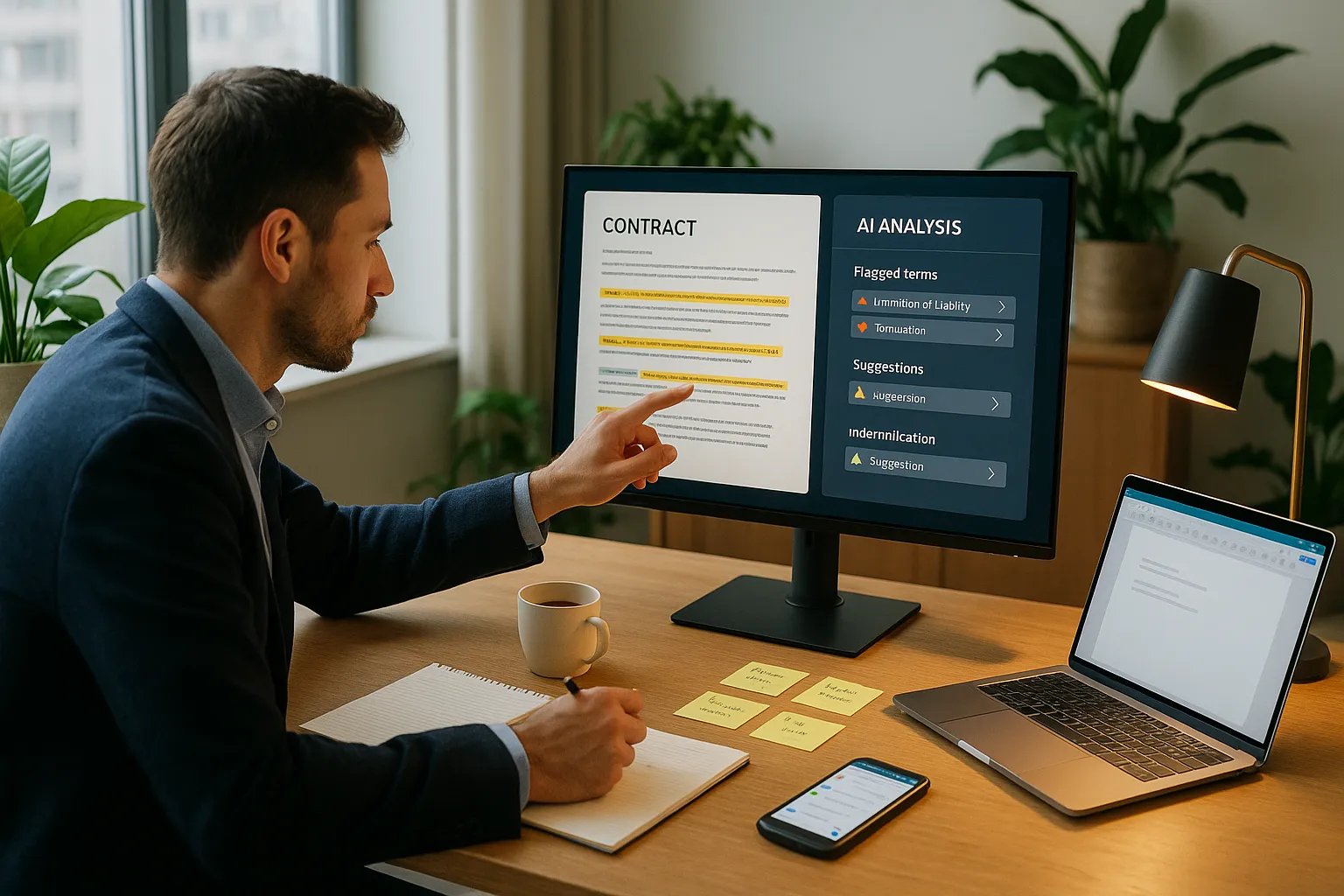
The deal was perfect. Six months of relationship building, multiple demos, and a champion inside the account who was pushing hard for your solution. Then the prospect sent over their standard vendor agreement, and everything stalled.
Your legal team has a three-week backlog. The prospect’s procurement deadline is in ten days. Every day that passes, your champion loses internal momentum, and the competition is circling.
This scenario plays out thousands of times daily across B2B sales organizations. According to research from the International Association for Contract and Commercial Management, contract negotiation adds an average of 3.4 weeks to the sales cycle, with some complex deals taking months to get through redlining and approval processes.
The frustrating part? Most of that time is spent on routine review tasks that follow predictable patterns. Identifying liability caps, flagging unusual indemnification clauses, checking payment terms against company policy. These are exactly the kinds of structured analysis tasks that AI excels at.
AI contract analysis is not about replacing legal counsel. It is about giving sales teams the intelligence to understand what they are looking at, flag obvious issues early, and accelerate the path to signature. When sales reps can identify problematic clauses before sending agreements to legal, the entire process compresses.
The Hidden Cost of Contract Delays in Sales
Before examining how AI transforms contract analysis, it is worth understanding the true impact of contract delays on sales performance.
The direct cost is obvious: delayed revenue recognition. If a deal slips from Q4 to Q1 because of contract negotiations, that affects quota attainment, commission payouts, and company financials. But the indirect costs are often larger.
Deal decay is real. Every additional day in the sales cycle increases the probability that something changes. Budget freezes happen. Champions leave companies. Competitors make moves. A study by Gong found that deals that close quickly have significantly higher win rates than deals that drag on.
There is also the opportunity cost of sales rep attention. When a rep is managing a stalled contract negotiation, they are not prospecting, not running demos, not advancing other opportunities. The best salespeople are ruthlessly efficient with their time, and contract delays force them to context-switch constantly.
The Contract Bottleneck
In a survey of B2B sales organizations, 67% of sales leaders identified contract review and approval as one of their top three deal velocity bottlenecks. Legal teams are not the problem; they are simply overwhelmed by volume that could be pre-filtered with better tools.
Finally, there is the customer experience impact. Prospects who go through painful contract negotiations start their relationship with your company frustrated. That frustration affects implementation engagement, renewal conversations, and referral likelihood. The contract process is often the last major touchpoint before becoming a customer, and it shapes perception disproportionately.
How AI Contract Analysis Works for Sales Teams
AI contract analysis for sales is not the same as AI contract management for legal. The use cases, interfaces, and outputs are fundamentally different. Sales teams need quick answers to specific questions, not comprehensive legal analysis.
The most effective AI contract analysis systems for sales work through several key mechanisms:
Intelligent Document Parsing
Modern AI systems can ingest contracts in virtually any format, including PDFs, Word documents, and even scanned images with OCR. The AI breaks down the document into its component sections, identifying clause types, party definitions, and structural elements.
This parsing goes beyond simple text extraction. The AI understands that a liability limitation clause in Section 8.3 relates to the indemnification provisions in Section 7.2. It can trace defined terms back to their definitions and identify when those definitions differ from industry standard usage.
Risk Pattern Recognition
Every organization develops patterns around what contract terms they can accept, what requires negotiation, and what represents a deal-breaker. AI systems learn these patterns from historical data: which clauses triggered legal escalation in past deals, which terms were successfully negotiated, and which positions the company has consistently maintained.
When the AI analyzes a new contract, it compares against these learned patterns. A liability cap at 12 months of fees might be flagged as “within standard range” while a cap at 3 months triggers an alert. An indemnification clause covering third-party IP claims might be marked as routine, while one extending to consequential damages gets highlighted for review.
Natural Language Explanation
The most valuable aspect of AI contract analysis for sales is translation. Legal documents are written in legal language for good reason, but sales reps should not need a law degree to understand what they are agreeing to.
Good AI contract analysis tools provide plain-language summaries of key provisions. Instead of reading three paragraphs of dense legalese about limitation of liability, the rep sees: “This contract caps our liability at the amount paid in the last 12 months. This is standard for our deals. The customer’s liability is uncapped, which is also standard.”
Sales Rep with Contract for Review
❌Before AI
- •Wait 2-3 weeks for legal review queue
- •Cannot answer prospect questions about terms
- •Deals stall during back-and-forth redlining
- •Legal team reviews routine clauses repeatedly
- •Reps send contracts without understanding risks
✨With AI
- •Get AI analysis within minutes of receiving contract
- •Understand key terms and standard vs. non-standard provisions
- •Pre-identify issues before legal escalation
- •Legal focuses on truly complex or unusual situations
- •Reps have informed conversations about contract terms
📊 Metric Shift: AI contract analysis reduces average legal review requests by 40-60%
Key Contract Elements AI Can Analyze
Not every contract clause requires the same level of attention. AI contract analysis tools are particularly effective at identifying and explaining several categories of provisions that directly impact sales deals.
Payment and Financial Terms
Payment terms directly affect revenue recognition and cash flow. AI can quickly identify:
- Payment timing: Net 30, Net 60, or longer payment windows
- Payment triggers: Whether payment is due on signature, delivery, or acceptance
- Invoicing requirements: Specific formats, PO requirements, or documentation needed
- Currency and exchange: Which currency applies and who bears exchange risk
- Late payment provisions: Interest rates, grace periods, and remedies
For sales reps, understanding these terms helps set appropriate expectations with finance and prevents surprises during implementation.
Liability and Risk Allocation
These provisions determine what happens when things go wrong. Key elements include:
- Limitation of liability: Caps on total damages, exclusions for certain damage types
- Indemnification: Who protects whom from third-party claims and under what circumstances
- Insurance requirements: Minimum coverage levels and certificate requirements
- Warranty provisions: What the seller promises about the product and for how long
AI can compare these provisions against company standards and flag deviations that require negotiation or approval.
Term and Termination
Understanding how and when a contract can end is crucial for sales planning:
- Initial term: Contract duration and relationship to pricing
- Renewal provisions: Auto-renewal, notice requirements, price escalation
- Termination rights: For cause, for convenience, and associated penalties
- Wind-down obligations: Data return, transition assistance, survival clauses
These provisions affect customer lifetime value calculations and churn risk assessment.
The 80/20 Rule of Contract Review
Approximately 80% of contract review time is spent on provisions that follow standard patterns. AI excels at handling this routine analysis, freeing legal professionals to focus on the 20% that requires genuine expertise and judgment.
Data and Intellectual Property
In technology sales, IP and data provisions are often the most contentious:
- Data ownership: Who owns data created through use of the product
- Data processing: Location, security requirements, privacy compliance
- IP assignment: Whether custom work becomes customer property
- License grants: Scope of usage rights, restrictions, and transferability
AI can identify when these provisions deviate from standard templates and highlight potential issues for legal review.
Implementing AI Contract Analysis in Your Sales Process
Deploying AI contract analysis effectively requires thoughtful integration with existing sales workflows. The goal is to augment human judgment, not replace it.
Integration Points in the Sales Process
The most effective implementations insert AI analysis at specific moments in the deal cycle:
Pre-negotiation review: When a prospect sends their paper (their standard contract), AI provides an immediate analysis highlighting key differences from your standard terms. This helps the rep have an informed conversation about which terms are negotiable.
Redline comparison: As contracts go through negotiation, AI tracks changes between versions and summarizes what shifted. This prevents important changes from being buried in dense documents.
Final review checkpoint: Before signing, AI provides a summary of all key terms as agreed, serving as a sanity check before commitment.
Training the AI on Your Standards
Generic contract analysis is useful, but organization-specific analysis is transformative. The AI needs to learn your company’s:
- Standard positions: What terms you typically accept without negotiation
- Negotiable ranges: Where you have flexibility and what alternatives are acceptable
- Hard limits: Provisions that require executive approval or represent deal-breakers
- Historical patterns: How similar situations were resolved in past deals
This training happens through a combination of explicit rule definition and machine learning from historical contract data.
Human-in-the-Loop Design
AI contract analysis should never be the final word. The most effective systems are designed with clear escalation paths:
- Green light provisions: AI confirms these match standards; no review needed
- Yellow flags: These deviate from standards but may be acceptable; rep should review
- Red flags: These require legal review before proceeding
Sales reps learn to trust the green lights while understanding that yellow and red items need human attention.
The Role of Context Engineering in Contract AI
Generic AI tools can analyze contracts, but they lack the context that makes analysis truly valuable. This is where Enterprise Context Engineering transforms the capability.
Connecting Contracts to Deal Context
A standalone contract analysis tells you what the document says. A context-aware analysis tells you what it means for this specific deal. When the AI has access to:
- CRM data: Deal size, strategic importance, customer history
- Historical contracts: How similar customers were handled
- Competitive intelligence: Whether the prospect is considering alternatives
- Internal communications: Relevant discussions about the account
The analysis becomes dramatically more useful. A liability cap that would be acceptable for a small deal might be flagged for a strategic account. Payment terms that are standard for established customers might warrant scrutiny for a new prospect with unknown creditworthiness.
Autonomous Agents for Contract Workflows
Beyond analysis, AI agents with full company context can take action on contracts:
- Automatically routing contracts to appropriate reviewers based on complexity and deal importance
- Generating redline suggestions based on company positions and negotiation patterns
- Scheduling follow-ups when contracts have been pending too long
- Notifying stakeholders when specific clause types appear that require their input
These agents operate continuously, ensuring contracts do not languish in queues and that the right people are engaged at the right time.
Maintaining Contract Intelligence Over Time
Contracts are not one-time documents. They govern ongoing relationships and need to be referenced throughout the customer lifecycle. Continuous AI Operations ensures that:
- Contract terms are surfaced during relevant customer interactions
- Renewal dates trigger proactive outreach with appropriate lead time
- Changes in customer behavior are evaluated against contract provisions
- Compliance with contract terms is monitored automatically
This ongoing intelligence turns contracts from filing cabinet documents into active business assets.
Measuring the Impact of AI Contract Analysis
Organizations implementing AI contract analysis should track metrics that demonstrate both efficiency gains and business impact.
Efficiency Metrics
Time to first analysis: How quickly can sales reps get an initial read on a contract? Best-in-class implementations deliver analysis within minutes of document upload.
Legal escalation rate: What percentage of contracts require human legal review? AI should reduce this by handling routine reviews automatically.
Review cycle time: How long from contract receipt to signature-ready status? This measures end-to-end process improvement.
Analyst productivity: How many contracts can legal reviewers process per day with AI assistance versus without?
Business Impact Metrics
Deal velocity: Has average sales cycle length decreased since implementing AI analysis?
Win rate on stalled deals: Are deals that previously would have died in contract review now closing?
Customer satisfaction: Are prospects reporting better experiences during the contracting process?
Risk incidents: Has the rate of problematic contract terms slipping through decreased?
Real-World Results
Organizations implementing AI contract analysis report 40-60% reductions in legal review requests, 50%+ faster time to contract signature, and significant improvements in sales rep confidence when discussing terms with prospects.
Common Concerns and How to Address Them
Implementing AI contract analysis often raises concerns from multiple stakeholders. Addressing these proactively smooths adoption.
Legal Team Concerns
“AI will miss important issues”: Position AI as a filter, not a replacement. Legal still reviews flagged items and complex situations. The AI handles routine review so legal can focus on what matters.
“We need to validate AI accuracy”: Start with a shadow period where AI analysis runs parallel to human review. Compare results and tune the system before relying on it.
“This could create liability”: Work with legal to define appropriate disclaimers and ensure human sign-off on final contract acceptance. The AI advises; humans decide.
Sales Team Concerns
“This is just another tool to learn”: Integrate analysis into existing workflows (CRM, email) rather than requiring reps to use a separate system.
“I do not trust AI for important deals”: Allow reps to request full legal review for any deal. As they see AI accuracy on smaller deals, trust builds naturally.
“Legal will still take forever”: Show legal teams how AI reduces their workload on routine items, freeing capacity for the reviews that matter to sales.
IT and Security Concerns
“Contract data is sensitive”: Use enterprise-grade solutions with appropriate data handling. Many AI contract tools offer on-premise deployment or SOC 2 certified cloud options.
“Integration will be complex”: Start with simple implementations (email forwarding or web upload) before pursuing deep integrations.
Getting Started with AI Contract Analysis
Implementing AI contract analysis does not require a massive transformation. Start small, prove value, and expand.
Phase 1: Pilot with High-Volume Contract Types
Identify the contract types that consume the most review time. Often these are standard vendor agreements from prospects or routine renewals. Deploy AI analysis for these specific document types and measure impact.
Phase 2: Expand to Complex Scenarios
Once the pilot proves value, extend to more complex situations: custom agreements, enterprise deals, international contracts. Each expansion should include training the AI on relevant patterns and rules.
Phase 3: Integrate Across the Sales Stack
Connect contract analysis to CRM, proposal tools, and communication platforms. Enable analysis to flow seamlessly through the deal process without manual intervention.
Phase 4: Build Continuous Intelligence
Move from one-time analysis to ongoing contract intelligence. Surface relevant terms during customer interactions, automate renewal notifications, and monitor compliance.
At metacto, we help organizations implement AI contract analysis as part of comprehensive Enterprise Context Engineering initiatives. Our approach ensures that contract AI has the context it needs to deliver truly valuable insights, not just generic document analysis.
Accelerate Your Contract Process
Talk with our team about implementing AI contract analysis that connects to your sales process, legal standards, and business context for faster deals and reduced risk.
Frequently Asked Questions
Can AI contract analysis replace legal review entirely?
No, and it should not. AI contract analysis is designed to handle routine review tasks and flag items that need human attention. Complex negotiations, unusual provisions, and final sign-off should always involve qualified legal counsel. The goal is to reduce legal workload on routine items so they can focus on what matters.
How accurate is AI contract analysis?
Accuracy depends heavily on training and configuration. Well-implemented systems achieve 90%+ accuracy on routine clause identification and risk flagging. However, accuracy should be measured not just on what AI catches but also on false positive rates. An overly conservative system that flags everything is not useful.
What types of contracts work best with AI analysis?
AI excels at analyzing structured documents that follow recognizable patterns: SaaS agreements, vendor contracts, NDAs, and standard procurement documents. Highly customized agreements or those in specialized domains may require more training before AI analysis is reliable.
How long does it take to implement AI contract analysis?
Basic implementations can be deployed in weeks. Simply uploading contracts to an AI tool for generic analysis requires minimal setup. However, organization-specific implementations that incorporate your standards, historical patterns, and workflow integration typically take 2-4 months to fully deploy and tune.
What happens to contract data used for AI analysis?
This varies by vendor and deployment model. Enterprise solutions typically offer options ranging from cloud processing with strict data handling policies to on-premise deployment where data never leaves your infrastructure. Evaluate vendors carefully on data security, retention policies, and compliance certifications.
How do we train the AI on our specific contract standards?
Training typically involves providing examples of your standard contracts, defining rules for acceptable and unacceptable terms, and feeding historical data about negotiation outcomes. Some systems learn passively from human reviewer decisions over time. The best implementations combine explicit rules with learned patterns.
Will sales reps actually use this?
Adoption depends entirely on implementation. If AI analysis requires reps to leave their normal workflow and use a separate tool, adoption will be low. If analysis is embedded in email, CRM, or document management systems they already use, adoption increases dramatically. Make the path of least resistance also the path through AI analysis.