

The first time Sarah handed a customer complaint to her AI teammate, she felt like she was shirking. She was a senior customer success manager, and the complaint deserved care. Asking an agent to help felt too casual for work that involved a real relationship.
Then the agent returned a structured account brief: recent support history, relevant contract terms, similar past escalations, open risks, and a draft response that Sarah could edit in her own voice. It did not replace her judgment. It gave her the context to use that judgment faster.
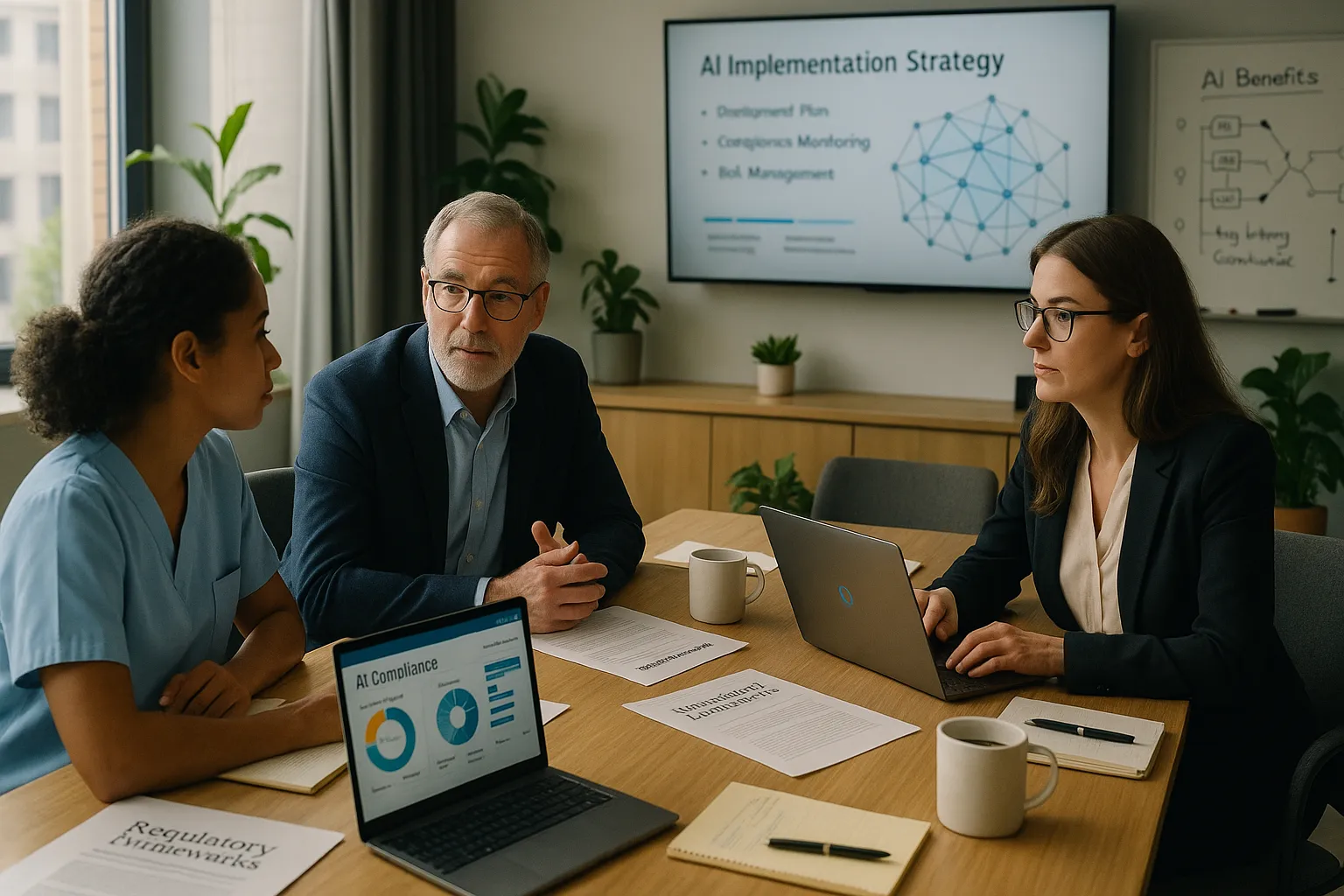
That is the point of a human-AI team operating model. It is not a slogan about people and machines collaborating. It is the set of rules that defines which work goes to humans, which work goes to AI agents, when agents need approval, what evidence reviewers see, where decisions are recorded, and how the team improves the workflow after launch.
For operators, executives, and team leads, the question is not “Can AI help this team?” The sharper question is: what AI agent team structure lets people and agents share work without losing ownership, quality, or accountability?
The operating model is the product
A useful AI agent does more than answer prompts. In production, it needs a job, context, permissions, review paths, write-backs, metrics, and an owner. Without that operating model, the team gets isolated AI usage instead of a dependable workflow.
Human-AI Team Operating Model Blueprint
Start with the work, not the org chart. A human-AI team should be designed around repeatable workflows where agents can prepare, draft, route, monitor, or execute bounded steps while humans keep judgment, relationship ownership, policy authority, and exception handling.
| Work type | Human role | Agent role | Autonomy level | Approval path | Success metric |
|---|---|---|---|---|---|
| Customer or account prep | Relationship lead interprets the situation and chooses the response | Agent gathers history, summarizes evidence, flags risks, and drafts options | Assisted or collaborative | Human reviews before customer-facing action | Prep time, response quality, customer risk visibility |
| Research and synthesis | Subject expert frames the question and validates implications | Agent searches approved sources, compares patterns, and cites source material | Collaborative | Human approves findings used in decisions | Source coverage, reviewer edit rate, time to insight |
| Drafting and communication | Human owns tone, judgment, and final message | Agent drafts emails, briefs, proposals, tickets, or documentation | Collaborative | Human edits and approves external or sensitive output | Cycle time, brand consistency, rework rate |
| System updates and write-backs | Process owner defines rules and high-risk fields | Agent prepares CRM, ERP, ticketing, or knowledge-base changes | Conditional autonomy | Low-risk updates can be queued or auto-applied; high-risk updates require approval | Update accuracy, exception rate, audit completeness |
| Monitoring and routing | Operations owner decides escalation policy | Agent watches queues, anomalies, thresholds, and missing inputs | Semi-autonomous | Agent escalates when confidence, policy, or business impact crosses a threshold | SLA adherence, false escalation rate, missed escalation rate |
| Process improvement | Team lead decides which changes become standard | Agent spots bottlenecks, recurring corrections, and prompt or context gaps | Advisory | Human approves process, policy, or workflow changes | Bottleneck reduction, incident trend, adoption quality |
This is where AI Agents & Workflows becomes practical. The production asset is not a generic assistant. It is a mapped workflow with role-based agents, human review, write-backs, monitoring, dashboards, and runbooks.
How Teams Assign Work to AI Agents Alongside Humans
Good work assignment is not “give the agent everything repetitive.” Some repetitive work is high risk. Some ambiguous work is safe if the agent is only preparing evidence. The assignment rule should combine four factors.
1. Is the work bounded? Agents perform better when the job has a clear start, finish, input set, and expected output. “Prepare a renewal risk brief from CRM, support tickets, contract notes, and last-quarter usage” is a job. “Help account management” is not.
2. Can the agent show its work? If a reviewer needs to trust the output, the agent should surface source evidence, assumptions, missing information, and confidence boundaries. This is especially important for customer-facing decisions, financial changes, compliance-sensitive workflows, and operations that update a system of record.
3. What happens if the agent is wrong? Low-impact mistakes can often be handled with sampling, monitoring, and rollback. High-impact mistakes need human review, stricter permissions, and clear escalation triggers.
4. Does the human reviewer have enough context to approve quickly? A workflow that saves the agent time but forces the reviewer to reopen five systems is not finished. The review surface should include the exact context needed to approve, reject, edit, or escalate.
Team Operating Model
❌Before AI
- •Humans gather context manually before every decision
- •AI usage depends on individual habits and prompts
- •Review happens in scattered chats, docs, and inboxes
- •System updates are copied manually after approval
- •Performance is judged by anecdotes about saved time
✨With AI
- •Agents prepare evidence, drafts, and next-step options
- •AI roles are tied to specific workflow responsibilities
- •Review happens in a controlled approval path
- •Approved actions write back to the right systems
- •Performance is measured by speed, quality, risk, cost, and adoption
📊 Metric Shift: The shift: preparation and routine execution move to agents; accountability, exceptions, and relationship decisions stay with humans.
The Collaboration Spectrum
Human-AI collaboration is not one model. A healthy team may use several modes at the same time.
| Mode | What the agent does | What the human owns | Best fit |
|---|---|---|---|
| Tool | Executes a specific prompt or command | All direction, interpretation, and follow-up | One-off tasks with low workflow dependency |
| Assistant | Suggests next steps and prepares partial work | Prioritization, acceptance, and quality control | Personal productivity and low-risk support |
| Collaborator | Contributes evidence, drafts, and analysis inside a shared task | Judgment, edits, and final decision | Knowledge work with meaningful review |
| Teammate | Owns a defined workflow responsibility and escalates exceptions | Oversight, policy, and operating outcomes | Repeatable workflows with clear inputs and review paths |
| Autonomous agent | Acts independently inside strict boundaries | Goals, constraints, monitoring, and exception response | Low-risk, well-instrumented work with strong rollback paths |
Most production teams should spend their design energy in the collaborator and teammate modes. Full autonomy is useful only when the boundaries, metrics, permissions, and incident paths are mature enough to support it.
flowchart LR
    A[Work intake] --> B[Agent prepares context]
    B --> C[Agent drafts or recommends action]
    C --> D{Review required?}
    D -->|Yes| E[Human approves, edits, or escalates]
    D -->|No| F[Bounded action executes]
    E --> F
    F --> G[System of record updates]
    G --> H[Metrics and feedback review]
    H --> B
AI Agent Team Structures
Traditional org charts show reporting lines. Human-AI teams need a second map: how work flows across people, agents, systems, approvals, and records. These four structures cover most operating patterns.
1. The Workflow Pod
A pod is organized around one outcome, such as renewals, proposal generation, claims triage, invoice exception handling, or engineering incident response.
| Pod member | Human or agent | Responsibility |
|---|---|---|
| Workflow owner | Human | Owns the business outcome, risk level, and operating review |
| Domain expert | Human | Defines judgment calls, source-of-truth rules, and edge cases |
| Context agent | AI | Retrieves records, policies, history, examples, and source evidence |
| Drafting agent | AI | Produces briefs, messages, tickets, proposals, or documentation |
| Operations agent | AI | Monitors queues, prepares updates, and routes exceptions |
| Reviewer | Human | Approves, rejects, edits, or escalates agent output |
The pod model works when one workflow crosses several systems but still has a clear business owner.
2. The Human Hub With Specialist Agents
In this structure, one human hub coordinates several agents with narrow jobs. A sales operations lead might use one agent for lead research, one for CRM hygiene, one for follow-up drafting, and one for pipeline risk monitoring.
The hub does not manage agents as direct reports. The hub manages workflow quality: whether the right context is available, whether approvals are fast enough, whether exceptions are routed correctly, and whether the system is producing business value.
3. The Layered Operations Model
Layered models separate strategic, tactical, operational, and exception work.
| Layer | Primary owner | Work examples |
|---|---|---|
| Strategic | Humans | Priorities, resource tradeoffs, policy, relationship decisions |
| Tactical | Humans and agents | Planning, analysis, recommendations, review queues |
| Operational | Agents | Intake, monitoring, drafting, routing, bounded updates |
| Exception | Humans with agent support | Novel cases, conflicts, high-risk decisions, incidents |
This model is useful when leaders want a clear answer to where human judgment stays in the process.
4. The Agent System Of Record Model
Teams using both humans and AI agents need a place where the workflow state is visible. The agent system of record does not have to be a new database. It can be a controlled layer across CRM, ticketing, project management, document systems, and workflow logs.
At minimum, it should show:
- What work the agent accepted or declined
- Which sources the agent used
- What output it produced
- Whether a human approved, edited, rejected, or escalated it
- What system updates were made
- Which incidents, corrections, and feedback items should change future behavior
Without this record, managers cannot tell whether the team has a real operating model or just a pile of disconnected agent interactions.
Decision Authority and Escalation
Human-AI teams become fragile when authority is implied instead of documented. Write down what each agent can do alone, what it can recommend, and what only a human can decide.
| Workflow | Agent can do | Human must approve | Escalation trigger |
|---|---|---|---|
| Customer support | Draft response, summarize history, suggest refund or escalation route | Refund above policy, legal-sensitive language, high-value account response | Angry sentiment, missing source data, policy conflict, account risk |
| Revenue operations | Research account, score inbound demand, prepare CRM update | Qualification rule changes, territory exceptions, outbound messaging to strategic accounts | Conflicting firmographic data, low confidence, executive account |
| Finance operations | Match invoice to purchase order, flag variance, draft exception note | Payment release, vendor dispute, accounting policy exception | Amount above threshold, missing approval, vendor mismatch |
| HR or people operations | Prepare policy summary, route request, identify missing documents | Employment decision, sensitive employee response, policy exception | Protected category risk, manager conflict, incomplete record |
| Engineering operations | Summarize incident, draft postmortem, identify similar past issues | Production change, customer communication, severity change | Unclear root cause, customer impact, security concern |
The rule of thumb is simple: agents can prepare and execute bounded work when the risk is understood. Humans own decisions that change relationships, money, policy, legal exposure, security posture, or strategic direction.
Trust should be earned in the workflow
Do not set autonomy based on enthusiasm for the model. Set it based on observed reliability, visible evidence, clear rollback paths, and the cost of being wrong. Start with tighter review and relax controls only where the workflow proves it can support more autonomy.
What Is a Healthy Human-to-Agent Ratio?
There is no universal healthy human-to-AI-agent ratio for an engineering team, operations team, or revenue team. A ratio is only meaningful after you know the workflow.
A team with one high-risk agent that prepares regulatory responses may need several human reviewers and strict approval gates. A team with five narrow monitoring agents may need one operations owner who reviews dashboards and exceptions. The right ratio depends on review capacity, risk, source quality, incident rate, and the number of decisions the workflow asks humans to make.
Use these questions instead of a fixed ratio:
- How many agent outputs can a reviewer approve without rubber-stamping?
- What percentage of outputs require edits, rejection, or escalation?
- Which agent actions can be sampled instead of reviewed one by one?
- Which decisions are too sensitive for autonomous action?
- Does the workflow owner have enough visibility to spot drift or misuse?
If the human side becomes a bottleneck, do not automatically add more agents. First improve the review surface, narrow the agent job, remove low-value approvals, or change which tasks are eligible for autonomy.
Managing AI Agents as Team Members
It is tempting to say managers should treat AI agents like employees. That analogy breaks down quickly. Agents do not have judgment, motivation, accountability, or workplace context in the human sense. They do have assigned work, permissions, performance, failure modes, and operating costs.
Manage agents as workflow members, not people.
| Management practice | For humans | For AI agents |
|---|---|---|
| Role definition | Responsibilities, goals, collaboration norms | Job scope, inputs, outputs, tools, permissions |
| Performance review | Judgment, communication, growth, outcomes | Accuracy, completion rate, escalation quality, cost, latency |
| Coaching | Feedback, skill development, context sharing | Prompt updates, examples, evals, context fixes, tool changes |
| Supervision | Manager check-ins and peer collaboration | Monitoring, sampling, approval queues, incident review |
| Accountability | Human owns decisions and conduct | Human owner owns agent behavior and workflow results |
The most important management habit is closing the loop. When reviewers repeatedly correct the same issue, that correction should become an improvement item: better context, clearer instructions, a narrower permission, a stronger eval, or a different handoff.
Metrics for a Human-AI Operating Model
Do not measure a hybrid team only by hours saved. Time savings matter, but they do not prove the workflow is better. A stronger scorecard connects agent performance to business outcomes and operating risk.
| Metric category | What to track | Why it matters |
|---|---|---|
| Revenue | Conversion quality, renewal risk visibility, proposal cycle time, customer response readiness | Shows whether the workflow helps the business capture or protect value |
| Cost | Manual prep time, review load, compute cost, vendor spend, rework | Shows whether the operating model is efficient after review and exceptions |
| Quality | Reviewer edit rate, rejection rate, source citation quality, customer-visible error classes | Shows whether output is good enough to trust |
| Speed | Intake-to-decision time, queue aging, SLA adherence, handoff delay | Shows whether agents remove bottlenecks or create new ones |
| Risk | Escalation accuracy, incident count, policy violations, rollback frequency | Shows whether autonomy is controlled |
| Adoption | Active users, approved outputs, override reasons, repeat usage by workflow | Shows whether teams are actually working in the model |
For production workflows, these metrics belong in Continuous AI Operations, not in a one-time launch report. The operating review is where teams decide whether to widen autonomy, tighten controls, improve context, or retire a workflow that is not earning its complexity.
Context Engineering for Human-AI Teams
Most failed human-AI collaboration is really failed context design. The agent may be fast, but it does not know which source is authoritative, which customer facts matter, which policy applies, what the reviewer needs to see, or what it is allowed to update.
Context Engineering is the discipline of preparing the business context an AI workflow needs at the moment of work. For human-AI teams, that means:
- Source-of-truth rules for records, documents, messages, tickets, and policies
- Permission boundaries that match the human role and agent job
- Evidence packages that reviewers can inspect quickly
- Freshness rules for data that changes often
- Examples of approved and rejected outputs
- Handoff context that follows the work from intake to review to write-back
Context is what lets the agent feel less like a generic tool and more like a useful teammate inside a specific workflow. It also protects the human reviewer from becoming a detective every time the agent produces an answer.
When to Redesign a Team Around AI Agents
Not every team needs a new operating model. A redesign is worth considering when the current workflow has clear friction and enough repetition to justify the operating work.
Common triggers include:
- Knowledge workers spend more time gathering context than making decisions
- AI pilots produce useful drafts but no one owns review, approval, or measurement
- Agent output varies because context, prompts, and examples are inconsistent
- Humans and agents duplicate work because handoffs are unclear
- Managers cannot see what agents did, what humans approved, or what changed in systems
- Escalations are ad hoc, causing either over-review or risky autonomy
- Teams want AI to update systems, not just summarize them
These are operating symptoms. The fix is rarely another prompt library by itself. The fix is a workflow design that connects Operational AI, context, agents, controls, and continuous improvement.
Implementation Roadmap
Build the operating model in phases. Prove one workflow can run with clear ownership, useful context, controlled autonomy, and measurable outcomes before expanding agents everywhere.
Phase 1: Map the workflow Name the workflow, owner, inputs, outputs, source systems, human decisions, current bottlenecks, and risk level. Decide which outcome the workflow should improve: revenue, cost, quality, speed, or risk.
Phase 2: Define roles and authority Write down the agent jobs, human roles, approval rules, escalation triggers, and write-back permissions. If a team cannot explain who owns a decision, the workflow is not ready for autonomy.
Phase 3: Build the context and review surface Connect the sources, prepare the evidence package, define source-of-truth rules, and design the review screen so a human can approve or reject quickly without rebuilding the agent’s work manually.
Phase 4: Pilot with tight controls Start with more review than you expect to need. Track edit rates, rejection reasons, escalations, latency, and user feedback. Use the pilot to discover missing context and unclear handoffs.
Phase 5: Operate and tune Move the workflow into a recurring review cadence. Decide where to widen autonomy, where to narrow scope, where to improve prompts or evals, and where business rules need to change.
The Future of Work Is a Designed Workflow
Human-AI teams do not become effective because people are open-minded about AI. They become effective when the work is designed well.
Humans should not spend their best hours collecting background information, formatting routine updates, or copying approved changes between systems. AI agents should not make sensitive decisions without context, oversight, or accountability. The operating model is how those two truths fit together.
The best human-AI teams will feel less like a person using a chatbot and more like a well-run workflow: context arrives before the decision, drafts arrive with evidence, approvals happen in the right place, updates are recorded, and improvement is part of the cadence.
That is the new operating model. Human judgment stays central. AI agents become responsible workflow participants. The team gets faster because the handoffs are designed, not improvised.
Map Your Human-AI Operating Model
Design AI agent workflows with role clarity, business context, approval paths, write-backs, operating metrics, and continuous improvement built in from the start.
What is a human-AI team operating model?
A human-AI team operating model defines how people and AI agents share work. It covers agent roles, human responsibilities, handoffs, autonomy levels, approval paths, system updates, metrics, and operating reviews so the team can use AI without losing quality or accountability.
How do teams assign work to AI agents alongside human team members?
Teams should assign agents bounded, evidence-based work such as research, summarization, drafting, monitoring, routing, and prepared system updates. Humans should own judgment, relationships, policy exceptions, high-risk approvals, and accountability for the workflow.
Should managers treat AI agents the same way they manage human team members?
No. AI agents should be managed as workflow members, not people. They need clear jobs, inputs, outputs, tools, permissions, monitoring, evals, and human owners. Humans remain accountable for decisions and for the operating results of the agent workflow.
What is a healthy human-to-AI-agent ratio?
There is no universal ratio. The right balance depends on workflow risk, review capacity, source quality, autonomy level, incident rate, and how many agent outputs require human decisions. A high-risk workflow may need more reviewers, while narrow monitoring agents may need only one clear operations owner.
What is an agent system of record?
An agent system of record is the place where the team can see what work the agent handled, which sources it used, what output it produced, who approved or edited it, what systems were updated, and what feedback should improve future behavior. It may be a dedicated workflow layer or a controlled record across existing business systems.
How much autonomy should AI agents have?
AI autonomy should increase only where the workflow has clear boundaries, reliable source context, visible evidence, strong monitoring, and a rollback or escalation path. Start with tighter human review, then relax controls where observed reliability supports it.
Which metrics matter for human-AI teams?
Measure more than hours saved. Track revenue impact, cost, quality, speed, risk, and adoption. Useful operating metrics include review edit rate, rejection rate, escalation quality, cycle time, incident count, write-back accuracy, and whether the workflow improves a real business outcome.