Introduction
The demand for convenience has permeated every aspect of modern life, and healthcare is no exception. On-demand medicine delivery has shifted from a niche service to a critical component of the digital health ecosystem, offering patients unparalleled access to prescriptions and essential medical supplies from the safety of their homes. However, building an application for this sensitive market is a formidable challenge. It involves much more than creating a simple e-commerce platform; it requires navigating a labyrinth of regulatory compliance, implementing ironclad security protocols to protect patient data, and designing an impeccably intuitive user experience for a diverse audience.
Venturing into this space requires a deep understanding of both technology and the stringent demands of the healthcare industry. Many organizations underestimate the complexity, encountering significant hurdles in ensuring HIPAA compliance, managing sensitive data, and building a scalable, reliable platform. This article serves as a comprehensive guide to developing a custom on-demand medicine delivery application. We will explore the core concepts, dissect the challenges of in-house development, and articulate the compelling case for a custom-built solution.
Furthermore, we will provide an overview of the top development companies specializing in healthcare solutions that can transform your vision into a reality. At the forefront is metacto, a top-tier, US-based AI-powered app development firm. With over two decades of experience and more than 100 successful app launches, we specialize in building, growing, and monetizing complex mobile applications. Throughout this guide, we will illustrate how partnering with an expert agency like us can help you navigate the intricate process of creating a secure, compliant, and market-leading on-demand medicine delivery app.
What is an On-Demand Medicine Delivery App?
At its core, an on-demand medicine delivery app is a specialized mobile platform designed to bridge the gap between patients, pharmacies, and healthcare providers. These applications are a crucial part of the broader category of healthcare apps, which are created by specialized developers to improve the delivery of healthcare services, streamline medical processes, and provide patients with easy access to vital health information. More than just a logistical tool, a medicine delivery app is a digital health solution that facilitates the timely and secure delivery of prescription and over-the-counter medications directly to a user’s doorstep.
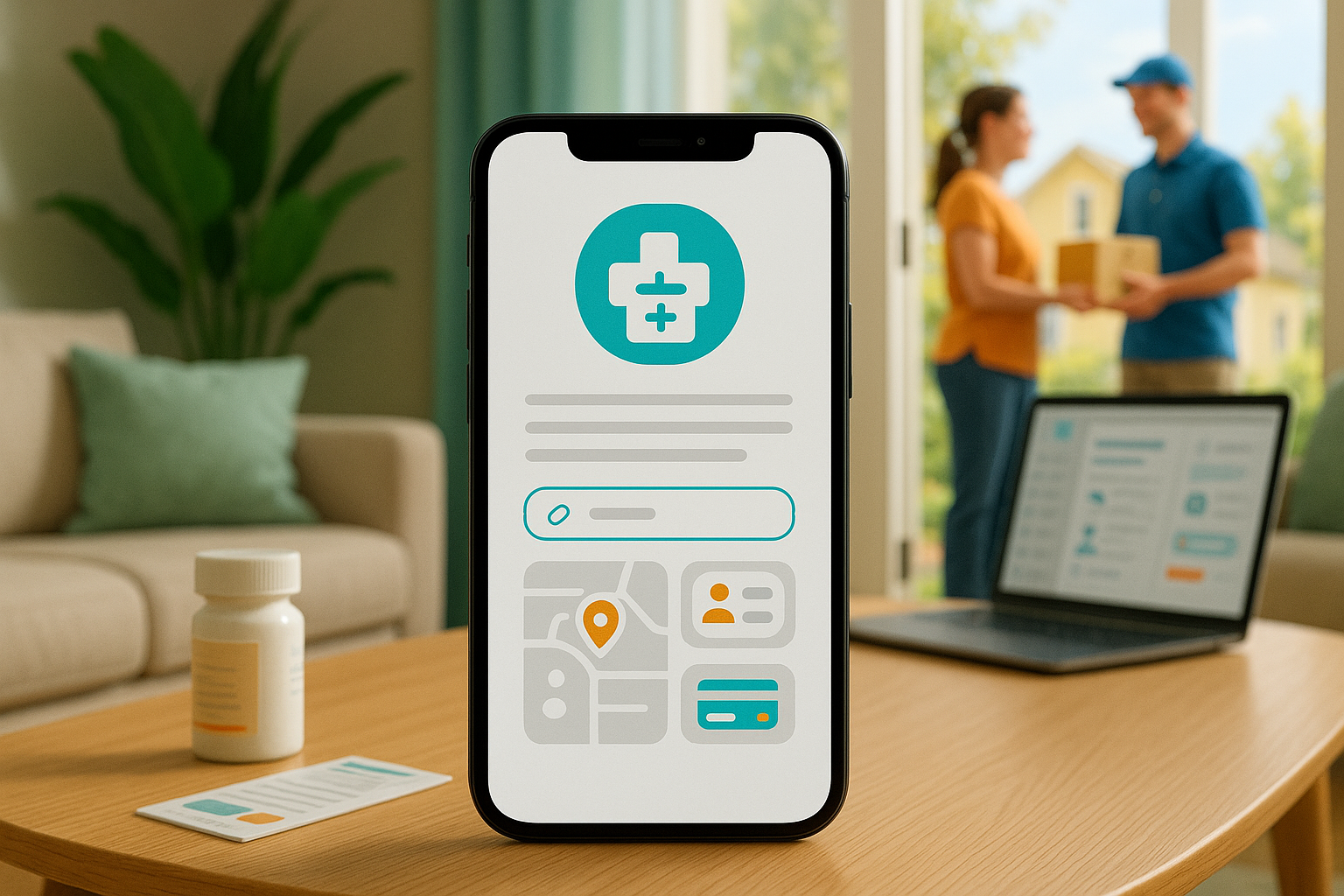
The fundamental workflow of these applications involves a few key steps. A user, typically a patient or caregiver, uploads a valid prescription from their doctor. The app then connects them with a licensed pharmacy that can verify and fill the order. Once the order is prepared, a delivery agent is dispatched to transport the medicine to the user’s specified location. This entire process is managed within the app, which provides features for order tracking, secure payment, and communication.
Effective on-demand medicine delivery apps offer a robust set of features tailored to the needs of all stakeholders:
- For Patients: Features include creating a secure profile, uploading prescriptions via photo or file, browsing a catalog of medications, placing orders, making secure online payments, and tracking deliveries in real time. Advanced features often include refill reminders, medication management logs, and the ability to schedule appointments or consult with pharmacists through secure messaging or video calls.
- For Pharmacies: The platform provides a dashboard to manage incoming orders, verify prescriptions, update inventory, process payments, and coordinate with delivery personnel. This helps streamline their operations and expand their customer reach beyond their physical location.
- For Delivery Agents: A dedicated interface allows drivers to view assigned deliveries, access optimized routes, confirm pickups and drop-offs, and communicate with pharmacies and customers when necessary.
By seamlessly integrating these functions, on-demand medicine delivery apps not only provide immense convenience but also enhance medication adherence, improve access for patients with mobility issues, and create a more efficient workflow for pharmacies. They represent a significant step forward in making healthcare more accessible and patient-centric.
Reasons It Is Difficult to Develop an On-Demand Medicine Delivery App In-House
While the concept of an on-demand medicine delivery app may seem straightforward, the execution is fraught with complexities that make in-house development a challenging and often unadvisable path for many organizations. The unique intersection of technology, logistics, and stringent healthcare regulations creates a high barrier to entry. Attempting to build such a platform without a dedicated, experienced team can lead to compliance failures, security breaches, budget overruns, and ultimately, a product that fails to earn user trust.
Navigating Regulatory and Compliance Hurdles
The single most significant challenge is adhering to the strict regulatory landscape governing healthcare data. In the United States, the Health Insurance Portability and Accountability Act (HIPAA) sets the standard for protecting sensitive patient data, known as Protected Health Information (PHI). Building a HIPAA-compliant application is a non-trivial task. It requires a deep, specialized knowledge of the law’s technical, physical, and administrative safeguards.
For example, development teams must implement robust security measures like end-to-end encryption for all data in transit and at rest, and two-layered access controls when handling PHI, as NMG Technologies did for its SynApp project. An in-house team without specific, proven experience in healthcare compliance is at high risk of making critical errors that could result in severe penalties, including fines reaching millions of dollars, and irreparable damage to the company’s reputation.
Ensuring Ironclad Data Security
Beyond regulatory compliance, the ethical and business imperative to protect patient data is paramount. Healthcare apps are prime targets for cyberattacks due to the value of the information they contain. An in-house team must possess advanced cybersecurity expertise to build a multi-layered defense system. This includes secure coding practices, regular vulnerability assessments, penetration testing, and secure cloud infrastructure management. As specialized app development companies know, building healthcare apps requires using the latest encryption technology and providing better data management solutions to protect patient information from ever-evolving threats.
Mastering a Complex Feature Set and User Experience
An on-demand medicine delivery app requires a sophisticated architecture to support its diverse user base and complex functionalities. The platform must cater to patients, pharmacists, administrators, and delivery drivers, each with a unique interface and set of tools. Key features like real-time prescription verification, inventory management integration, dynamic pricing, secure payment gateways, and GPS-based delivery tracking all require significant development effort.
Furthermore, the user experience (UX) and user interface (UI) must be exceptionally clear, intuitive, and accessible. The target audience may include elderly individuals or users with health conditions who may not be tech-savvy. Specialized firms like ELEKS and Light IT Global focus on creating visually appealing and intuitive healthcare interfaces that enhance user engagement. An in-house team may lack the dedicated UI/UX design expertise needed to create an application that is not only functional but also trustworthy and easy to use for everyone.
Achieving Scalability and High Performance
A successful medicine delivery app must be prepared to scale rapidly. As the user base grows, the platform must handle an increasing volume of orders, data, and concurrent users without any degradation in performance. This requires a robust back-end architecture, efficient database management, and a scalable cloud infrastructure. Companies like Orangesoft specialize in building robust back-end systems with technologies like Node.js and Python, while firms like Trango Tech offer cloud-based solutions for data storage and scalability. Building such a system from scratch requires a team of experienced back-end and DevOps engineers, a resource that can be difficult and expensive to assemble in-house.
Prohibitive Costs and Extended Time-to-Market
Assembling an in-house team with the requisite skills—including project managers, UI/UX designers, iOS developers, Android developers, back-end engineers, QA testers, and compliance experts—is a major financial and logistical undertaking. The recruitment process is long, and the salaries for such specialized talent are high.
In contrast, partnering with a development agency provides immediate access to a complete, experienced team. This dramatically reduces development and maintenance costs. The efficiency of a seasoned team also accelerates the development timeline. ELEKS, for instance, helped a client develop a market-ready product in four weeks instead of four months, saving up to 80% of the development cost. For a business looking to enter the market quickly and efficiently, this speed and cost-effectiveness is a decisive advantage that in-house development simply cannot match.
Why Custom App Development for On-Demand Medicine Delivery
When launching an on-demand medicine delivery service, one of the first major decisions is whether to use an off-the-shelf, white-label solution or invest in custom app development. While white-label products promise a faster and cheaper entry into the market, they often come with critical limitations in functionality, security, and scalability that are particularly detrimental in the healthcare sector. Custom development, on the other hand, offers a tailored, secure, and future-proof solution that is essential for long-term success.
Tailored to Your Unique Business Model
Every business has a unique operational model, target audience, and value proposition. A custom-developed application can be built from the ground up to perfectly align with these specific needs. Whether your model is a direct-to-consumer online pharmacy, an aggregator platform connecting users to local pharmacies, or an extension of an existing healthcare provider’s services, a custom app can be designed to support your exact workflow. Development partners like NMG Technologies focus on creating user-friendly, scalable healthcare apps tailored to the client’s specific needs, ensuring the final product is a perfect fit for the business, not a generic compromise.
Uncompromising Security and Compliance
Security and compliance are not features that can be bolted on as an afterthought; they must be woven into the fabric of the application from the very first line of code. Custom development allows for a security-first approach, where every component is designed and built to meet and exceed the stringent requirements of regulations like HIPAA. This includes implementing advanced encryption, secure data storage protocols, multi-factor authentication, and detailed audit trails. By building a custom solution, you have complete control over the security architecture, ensuring that patient data is protected with the highest level of diligence and helping your business stay compliant.
A Superior and Differentiated User Experience
In a competitive market, user experience is a key differentiator. A custom app allows you to design a unique, intuitive, and engaging journey for your users. You can conduct thorough user research to understand the specific pain points and needs of your target audience and craft an interface that is both visually appealing and highly functional. Professional design services from firms like Designli can help craft intuitive UIs that set your app apart from generic, template-based solutions. This focus on a superior user experience builds trust, encourages adoption, and fosters long-term customer loyalty.
Seamless Integration with Your Ecosystem
A medicine delivery app does not operate in a vacuum. It often needs to integrate with a variety of other systems, such as a pharmacy’s existing Pharmacy Management System (PMS), Electronic Health Records (EHR), inventory management software, and third-party payment gateways. Custom development provides the flexibility to build robust, reliable integrations with any necessary external system. As Trango Tech’s work demonstrates, custom software can be developed to enhance enterprise-level systems and facilitate seamless integration and data management, creating an efficient, automated workflow that off-the-shelf solutions can rarely achieve.
Scalability to Support Future Growth
A successful business grows, and its technology must be able to grow with it. Custom-built applications are designed with scalability in mind. The architecture can be engineered to handle increasing traffic, users, and data without compromising performance. As your business expands into new markets, adds new services, or onboards more pharmacy partners, a custom platform can be adapted and scaled accordingly. App development companies specialize in building highly-scalable apps, ensuring your initial investment continues to pay dividends as your business evolves.
Different Types of On-Demand Medicine Delivery Apps
The on-demand medicine delivery market is not monolithic. Several distinct business models have emerged, each catering to different market needs and operational strategies. Understanding these models is crucial when planning a custom app, as the required features and workflows can vary significantly.
1. The Pharmacy-to-Patient Model
This is a direct model where an existing pharmacy or a chain of pharmacies develops an app to serve its own customer base. The app functions as a digital extension of the brick-and-mortar store, allowing loyal customers to order prescriptions and other products directly for delivery.
- Key Features: User profiles with prescription history, direct prescription uploads, integration with the pharmacy’s internal inventory and management system, a digital product catalog, and a localized delivery management module.
- Advantages: This model strengthens customer relationships, increases loyalty, and provides a new revenue stream. The pharmacy maintains full control over product quality, pricing, and the customer experience.
2. The Aggregator (Marketplace) Model
This model positions the app as a third-party intermediary that connects users with a network of local, independent pharmacies. The app itself does not hold any inventory; it is a marketplace where users can browse and order from various pharmacies in their area.
- Key Features: Advanced search and filter functions to find pharmacies, comparison of drug prices and availability, a unified cart system, separate dashboards for users, pharmacies, and delivery agents, and a commission-based payment processing system.
- Advantages: This model is highly scalable and can expand its geographic reach quickly by onboarding new pharmacy partners. It offers users greater choice and competitive pricing.
3. The Direct-to-Consumer (DTC) / Online Pharmacy Model
In this model, the company operates as a fully licensed online pharmacy with its own centralized inventory. They manage the entire process in-house, from receiving and verifying prescriptions to packaging and shipping the medication, often using national courier services for delivery.
- Key Features: A large-scale inventory management system, a robust e-commerce platform, integrations with prescribing doctors or telehealth platforms for new prescriptions, and a sophisticated logistics and shipping management system.
- Advantages: This model allows for greater control over the entire supply chain, potentially leading to better pricing and operational efficiency at scale. It can serve a wide geographic area without needing a physical retail presence.
Choosing the right model depends on your business goals, available capital, and regulatory environment. A custom app development partner can help you design and build a platform that is perfectly tailored to your chosen strategy.
Cost Estimate for Developing an On-Demand Medicine Delivery App
Estimating the cost of developing a custom on-demand medicine delivery app is complex, as it depends on a multitude of factors. There is no one-size-fits-all price tag. However, by understanding the key variables and the different phases of development, you can get a clearer picture of the potential investment required.
The final cost is primarily influenced by:
- Feature Complexity: A basic app with core features (user registration, prescription upload, order placement) will cost significantly less than a complex platform with advanced functionalities like real-time video consultations, EHR integration, AI-powered medication reminders, and multi-language support.
- Platform Choice: Developing for a single platform (either iOS or Android) is less expensive than building for both. Cross-platform development using frameworks like React Native or Flutter can be a cost-effective option for reaching both audiences, though native development often provides the best performance and user experience. A web-based application for pharmacies and administrators will also be a separate cost component.
- UI/UX Design: A highly customized, polished, and extensively tested user interface will require more design hours than a more basic, template-driven design. Given the importance of user trust and accessibility in healthcare, this is not an area to cut corners.
- Development Team: The geographic location, size, and experience of the development team are major cost drivers. A top-tier US-based agency will have higher rates than an offshore team, but often provides advantages in communication, quality, and expertise in navigating US regulations like HIPAA.
A typical app development project can be broken down into the following phases, each contributing to the overall cost:
- Discovery and Design (10-15% of total cost): This phase includes market research, requirements gathering, creating user flows, wireframing, and creating the final UI/UX design. It’s a critical step that lays the foundation for the entire project.
- Back-End Development (30-40% of total cost): This is the engine of the app. It involves building the server-side logic, databases, APIs, and all the administrative functions for managing users, orders, and pharmacies.
- Front-End (Mobile App) Development (25-35% of total cost): This is the development of the user-facing application for iOS and/or Android.
- Testing and Quality Assurance (15-20% of total cost): Rigorous testing is essential to find and fix bugs, ensure the app is secure and performant, and verify that it meets all functional requirements.
- Deployment and Maintenance (Ongoing): This includes the initial setup on app stores and servers, as well as ongoing costs for hosting, monitoring, updates, and bug fixes after launch.
Considering these factors, a very rough ballpark estimate for a custom on-demand medicine delivery app can range from $75,000 to $300,000+. A Minimum Viable Product (MVP) with core functionalities could fall on the lower end of this spectrum, while a full-featured, multi-platform application with advanced integrations would be at the higher end or beyond.
Partnering with an agency like us can provide a more predictable and cost-effective path. Our 90-day MVP service is designed to get your core product to market quickly, allowing you to validate your idea and start generating revenue before investing in a more extensive feature set.
Top On-Demand Medicine Delivery App Development Companies
Choosing the right development partner is the most critical decision you will make. You need a team with proven experience in healthcare, a deep understanding of compliance and security, and the technical prowess to build a scalable, high-quality product. Below are some of the top companies in this specialized field.
1. metacto
As a premier US-based AI-powered mobile app development agency, we at metacto bring over 20 years of experience and a track record of launching over 100 successful applications. We don’t just build apps; we build businesses. Our end-to-end services cover everything from initial product strategy and design to development, growth, and monetization.
Our approach is built on a foundation of strategic technology leadership. We understand that an on-demand medicine delivery app is a mission-critical tool that must be secure, reliable, and user-friendly. We excel at translating complex business requirements into clean, scalable technical solutions. Our expertise in AI development can be leveraged to create intelligent features like AI-powered prescription scanning, personalized health recommendations, and predictive analytics for inventory management, giving your platform a competitive edge.
We recognize the need to get to market efficiently. Our 90-day MVP service is designed to take your idea from concept to a fully functional, market-ready application in record time, without compromising on quality. We believe in building the right way from day one, ensuring your platform is built on a solid foundation that can support future growth and evolution. Our focus is on delivering tangible results, from driving user acquisition to building robust monetization strategies that ensure long-term profitability.
2. NMG Technologies
NMG Technologies is a healthcare app development company that offers web and mobile app development, eCommerce solutions, and custom software development. They focus on building high-performance healthcare apps that improve patient outcomes and streamline operations while meeting the highest compliance standards. Their work on the SynApp project involved implementing critical security features like end-to-end encryption and two-layered access for handling PHI. NMG serves a global client base of startups, SMEs, and large enterprises, with a strong emphasis on quality and timely delivery.
3. Orangesoft
Orangesoft is a mobile app and web development company that creates custom software solutions for various industries, including healthcare. They have experience building a HIPAA and FDA-compliant MVP for a virtual hospital platform, which enabled patients to receive specialist support 24/7. Orangesoft utilizes modern cross-platform frameworks like React Native and Flutter to build health apps that work on both iOS and Android, supported by robust back-end systems built with technologies like Node.js and Python.
4. Designli
Based in Greenville, South Carolina, Designli is a software development firm specializing in UX/UI design and custom mobile and web apps. Their approach focuses on delivering high-quality, user-friendly solutions tailored to client needs. A notable project is AskIris, a healthcare application that allows professionals to manage medical supply inventory via voice or text search, receive low-stock alerts, and manage inventory via CSV. This demonstrates their ability to build practical, innovative tools for the healthcare sector.
5. Trango Tech
Trango Tech is a tech service and healthcare app development company focused on helping businesses innovate and streamline operations. They were the technology provider behind Shifaam, a telemedicine platform, providing the critical machine learning, AI, and cloud technology for the service. Trango Tech offers customized healthcare platforms and cloud-based solutions for data storage and scalability, developing software that enhances enterprise-level systems through automation, integration, and data management.
6. Light IT Global
With over 18 years of experience and more than 500 completed projects, Light IT Global is a healthcare app development company that delivers innovative web and mobile solutions. Their extensive collaboration with Pfizer is a testament to their capabilities. The software they created for Pfizer resulted in an automation rate three times higher than before and dramatically increased productivity by cutting the time for most tasks from 8 hours to 30 minutes. They specialize in building robust, secure, and scalable healthcare platforms for a global clientele.
7. ELEKS
ELEKS is a global technology partner that helps businesses innovate and drive digital growth across industries like finance, healthcare, and retail. They demonstrated their efficiency by helping their client Fleming-AOD develop a market-ready patient assessment product in just four weeks instead of four months, saving up to 80% on development costs. ELEKS takes a strategic approach, analyzing target audiences and business goals to develop a plan, and then creates visually appealing and intuitive interfaces to enhance user engagement.
8. App Maisters
App Maisters specializes in healthcare mobile app development and digital solutions, particularly for larger organizations. Their team successfully developed an innovative solution centered on a UWP-based Windows Tablet app that interfaces with a mechanical circulatory support system for patients with heart failure. This collaboration transformed a complex concept into a polished, user-centric healthcare mobile app, showcasing their ability to handle specialized and critical healthcare technology projects.
Company Comparison
| Company | Key Strengths & Specializations | Notable Projects/Experience |
|---|---|---|
| metacto | AI-powered development, end-to-end services (build, grow, monetize), 90-day MVP, US-based | 100+ successful apps launched across various industries |
| NMG Technologies | High-performance, compliant healthcare apps, end-to-end encryption | SynApp (secure healthcare communication) |
| Orangesoft | HIPAA/FDA-compliant MVP development, cross-platform (React Native/Flutter) | Virtual hospital platform MVP |
| Designli | UX/UI design, custom mobile/web apps for specific workflows | AskIris (voice-powered medical inventory management) |
| Trango Tech | AI/ML and cloud technology for healthcare, telemedicine platforms | Shifaam telemedicine platform |
| Light IT Global | Large-scale enterprise solutions, process automation, 18+ years experience | Pfizer (dramatic productivity increase via automation) |
| ELEKS | Rapid development and cost savings, strategic planning, user engagement | Fleming-AOD (market-ready product in 4 weeks) |
| App Maisters | Solutions for large organizations, specialized medical device integration | Windows Tablet app for heart failure patient support system |
Conclusion
The journey to launching a successful on-demand medicine delivery app is both promising and perilous. The immense potential to improve healthcare access is matched by the significant challenges of navigating regulatory compliance, ensuring data security, and creating a flawless user experience. As we have explored, attempting to build such a complex platform in-house is often impractical due to the specialized expertise, time, and resources required.
Custom app development emerges as the superior path, offering a solution that is tailored to your business model, built for scalability, and designed with security and compliance at its core. By choosing a custom approach, you can create a unique and trusted platform that stands out in a competitive marketplace.
The key to success lies in selecting the right development partner—a team that not only possesses deep technical skills but also understands the nuances of the healthcare industry. We have highlighted several capable firms, each with unique strengths in this domain.
At metacto, we combine two decades of app development experience with cutting-edge AI capabilities to build sophisticated, market-leading solutions. We are more than just developers; we are strategic partners dedicated to helping you build, launch, and grow a successful digital health business.
Ready to build your custom on-demand medicine delivery app? Talk with an expert at metacto today to discuss your vision and get a clear roadmap for turning your idea into a compliant, secure, and market-ready solution.