

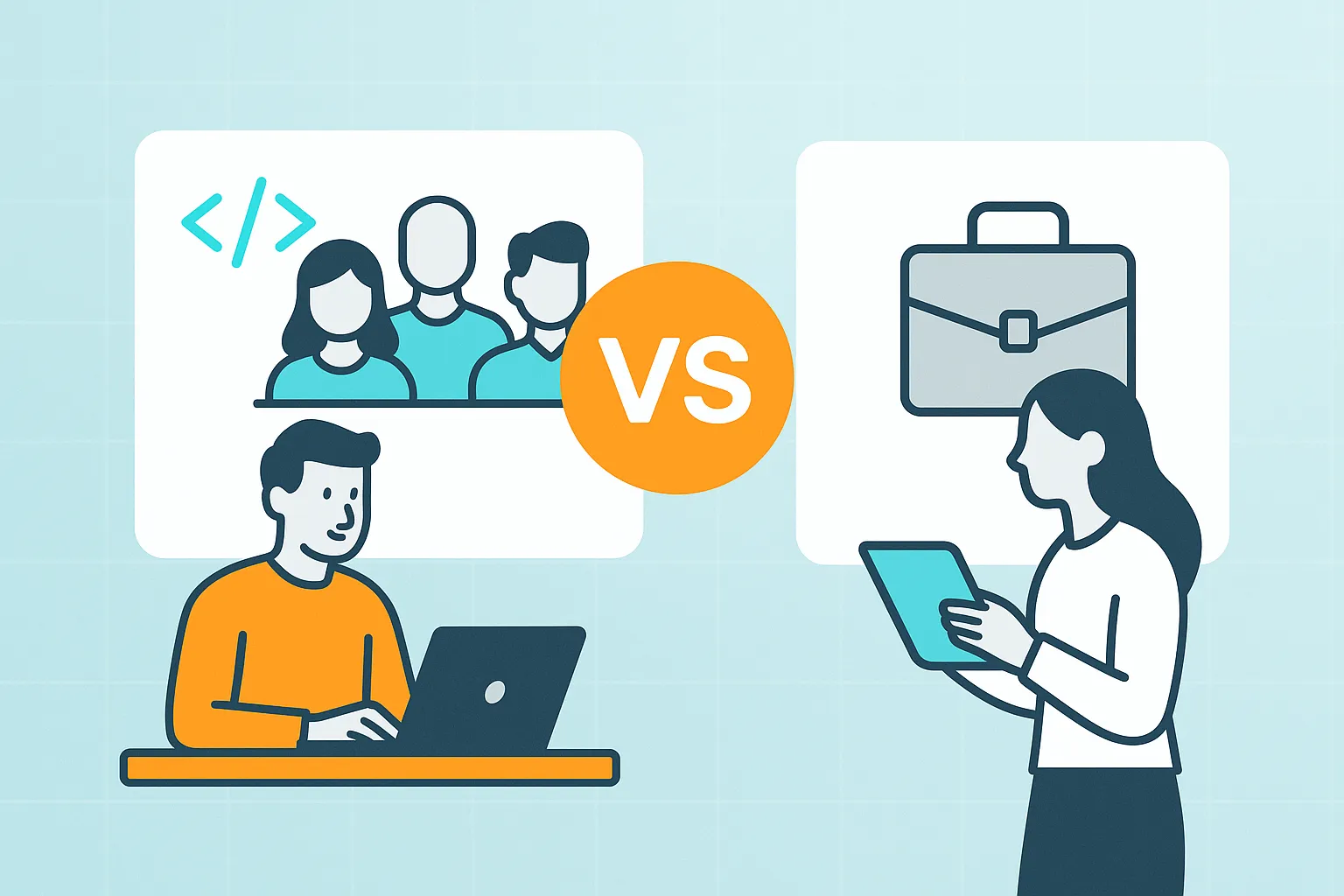
In the complex landscape of modern software development, business leaders often face a polarized marketplace. On one end of the spectrum, there are massive global entities offering scale and cost-efficiency through offshore labor. On the other, there are boutique design studios that prioritize high-end strategy and user experience but often come with a premium price tag and lower capacity. This dichotomy represents the fundamental choice between Chetu and Sidebench.
Selecting the right partner is not merely about comparing hourly rates; it is about aligning your company’s trajectory with a development model that can sustain it. A mismatch here can lead to ballooning budgets, missed deadlines, or a product that functions technically but fails commercially. Whether you are an enterprise seeking staff augmentation or a startup looking for a strategic product launch, understanding the operational DNA of these two firms is critical.
In this article, we will dissect the offerings, strengths, and weaknesses of Chetu and Sidebench. We will explore Chetu’s “global delivery model” grounded in Indian development centers and contrast it with Sidebench’s Los Angeles-based innovation studio approach. Finally, we will introduce metacto, a U.S.-based firm founded by experienced CTOs, which bridges the gap by offering rapid, high-quality app development, deep AI integration, and a unique focus on growth and monetization.
What is Chetu?
Chetu, Inc. is a veteran in the software development space, having been founded in 2000 by Atal Bansal. Headquartered in Sunrise, Florida, Chetu has established itself as a massive provider of backend technology and software solutions. Their model is distinctively industrial in scale. While they maintain a physical presence in the United States—with offices in Florida, Nevada, Arizona, Texas, and other states—the engine of their operation lies overseas.
The Global Delivery Model
Chetu operates under what they term a “Captive Outsourced Development Center” model. Unlike many agencies that rely on freelancers or varied subcontractors, Chetu emphasizes that their developers are full-time, in-house employees. However, “in-house” in this context largely refers to their three massive campuses in Noida, India, which house over 2,800 developers across approximately 280,000 square feet of office space. This infrastructure allows them to offer significant cost savings compared to purely onshore firms, leveraging the labor arbitrage between the U.S. and India.
Services and Industry Breadth
Chetu functions primarily as a “backend technology partner.” They do not limit themselves to a niche; rather, they claim expertise in over 40 industries, ranging from hospitality and gaming to supply chain and healthcare. Their service list is exhaustive, covering:
- Custom Application Development: Native and cross-platform mobile apps (iOS, Android, Windows) and enterprise web applications.
- Staff Augmentation: Providing on-demand developers and dedicated offshore teams to supplement client workforces.
- Emerging Technologies: They market specialized solutions in AI/ML integration, blockchain, IoT, and AR/VR.
- Compliance: They maintain standards for HIPAA, PCI, GDPR, and SSAE to serve regulated sectors like finance and healthcare.
Reputation and Performance
While Chetu’s scale is impressive, their reputation is mixed. Independent reviews paint a picture of a company that is cost-effective but inconsistent. On Trustpilot, they average a 3.1 out of 5 stars. While some clients praise their technical skills and responsiveness, others report significant issues with project management. For instance, one reviewer noted a project estimated at 500 hours ballooning to over 1,000 hours without completion. Clutch reviews similarly highlight that while Chetu offers good value for cost, the quality of deliverables and adherence to timelines can vary.
In summary, Chetu is a volume player. They are well-suited for companies looking to augment their staff with specific technical resources at a lower cost, provided the client has strong internal management to oversee the offshore output.
What is Sidebench?
Sidebench represents the opposite end of the development spectrum. Founded in 2012 and based in Santa Monica, California, Sidebench markets itself as a premier design and development consultancy. They are not just a “coding shop”; they position themselves as strategic partners who help define the product before a single line of code is written.
The Boutique Studio Model
Sidebench is a U.S.-based consultancy with a team size estimated between 50 and 249 employees. Unlike Chetu’s massive offshore campuses, Sidebench’s operations appear centralized in their Los Angeles headquarters. Their approach is “UX-first,” heavily emphasizing product strategy, discovery, and design architecture. They often act as a “CTO for hire” or innovation consultant for their clients, which range from enterprise giants like Red Bull and Sony to high-growth startups.
Services and Strategic Focus
Sidebench’s service offerings go beyond mere implementation. They focus on digital transformation and user-centric design. Their core capabilities include:
- Strategy & Discovery: Consulting on innovation, user research, and product roadmapping.
- UX/UI Design: Visual design, prototyping, and user journey mapping.
- Engineering: Mobile and web development, including backend systems and systems integration.
- Emerging Tech: They explicitly market AI and Machine Learning services, including “GenAI accelerators” and personalization strategies.
Their portfolio reflects this high-touch approach. They have developed a Ghostbusters VR mobile game for Sony, a fan-engagement platform for Pabst Blue Ribbon, and complex healthcare solutions for Inland Empire Health Plan (IEHP).
Reputation and Client Satisfaction
Sidebench enjoys a stellar reputation among its clientele. They hold a perfect 5.0 rating on GoodFirms and highly positive feedback on Clutch. Clients consistently praise their professionalism, communication, and ability to deliver exactly what was envisioned. Reviews highlight their “creativity” and the fact that they have a “really good pulse of current markets.”
Sidebench is the choice for organizations that prioritize product quality, user experience, and strategic alignment over raw cost savings. They are a “quality-first” firm, ideal for complex, consumer-facing applications where design and brand perception are paramount.
Chetu vs Sidebench: A Comparative Analysis
When choosing between Chetu and Sidebench, you are essentially choosing between two different philosophies of software development: the “Factory” model versus the “Studio” model.
Comparison Matrix
| Feature | Chetu | Sidebench |
|---|---|---|
| Headquarters | Sunrise, FL (USA) | Santa Monica, CA (USA) |
| Primary Development Location | Noida, India (Offshore) | Los Angeles, CA (Onshore) |
| Team Size | 2,800+ Developers | ~50–249 Employees |
| Core Value Proposition | Cost-effectiveness & Scale | Strategy, UX Design & Innovation |
| Model | Staff Augmentation & Dedicated Teams | Consultancy & Product Studio |
| Key Clients | Wild Birds Unlimited, PathVu, Startups | Red Bull, Sony, Pabst Blue Ribbon |
| Review Ratings | Mixed (~3.1/5 on Trustpilot) | Excellent (5.0/5 on GoodFirms) |
Scale vs. Strategy
Chetu’s primary advantage is scale. With nearly 3,000 developers, they can ramp up large teams quickly to handle bulk coding tasks, maintenance, or legacy system updates. However, this scale comes with the friction of offshore management. Clients must often bridge time zones and cultural gaps, and as reviews suggest, project management can sometimes falter.
Sidebench, conversely, offers strategy. They are smaller and likely more expensive per hour, but they provide a higher level of consultative service. They are better suited for “0 to 1” product builds where the market fit and user experience are unknown and need to be discovered.
Execution vs. Innovation
Chetu executes requirements. If you have a strict technical specification and need bodies to build it, their model works. Sidebench helps define requirements. They thrive in ambiguity, using design thinking to solve business problems. For example, while Chetu might build a standard loyalty app based on a spec sheet, Sidebench might workshop with a client to invent a novel VR experience like they did for Sony.
Why Use metacto Instead?
While Chetu offers scale and Sidebench offers design, many businesses find themselves needing a partner that bridges the gap—a firm that offers the strategic leadership of a consultancy with the rapid execution of a dedicated development team. This is where metacto excels.
We are not just a dev shop; we are a team founded by experienced CTOs who have launched over 100 apps and helped clients raise over $40 million in funding. We combine the high-touch strategic guidance of a U.S.-based firm with a rigorous focus on business results, not just code.
1. Strategic Leadership via Fractional CTOs
One of the biggest risks in app development is a lack of technical leadership. Chetu provides developers, but not necessarily technical vision. Sidebench acts as a consultant, but often at a high premium. We offer Fractional CTO services to provide you with strategic technology leadership without the $400K+ salary of a full-time executive. Our founders have successfully exited companies and built high-performing teams, meaning we don’t just build your app; we ensure it makes business sense.
2. Rapid 90-Day MVP Delivery
In today’s market, speed is survival. Long development cycles kill startups. Unlike firms that may let projects drag on—as seen in some Chetu reviews where hours doubled—we specialize in Rapid MVP Development. We are structured to take a product from idea to market-ready launch in 90 days. This agility allows you to validate your market, gather user data, and iterate quickly.
3. Deep AI and Machine Learning Integration
Both Chetu and Sidebench list AI as a service, but at metacto, AI Development is core to our engineering philosophy. We don’t just add AI as a buzzword; we build it into the fabric of the application to drive revenue and retention.
- Case Study - Bond: We helped users achieve 3x more second dates by building a voice-to-insight AI pipeline and a proprietary relationship scoring algorithm.
- Case Study - MamaZen: We built an AI-powered content recommendation engine that matched parent stress patterns to mindfulness sessions, contributing to an 85% monthly retention rate.
- Case Study - Kommu: We implemented an AI chatbot for personalized onboarding, which increased completion rates by 73%.
4. Focus on Growth and Monetization
Perhaps the most distinct difference between metacto and traditional development shops is our focus on what happens after launch. Most agencies hand over the code and walk away. We believe that 95% of apps fail because they lack a monetization strategy. We offer dedicated App Growth and Monetization services. We help clients implement proven strategies—from subscriptions to in-app purchases—that users actually appreciate. For example, with Parrot Club, we helped launch a 2-sided marketplace that converted 10% of customers to annual subscriptions.
5. Unmatched Client Satisfaction
Like Sidebench, we pride ourselves on quality, but we pair it with the pragmatic efficiency of a startup partner. We hold a 5.0 out of 5 rating on Clutch, with 13 verified reviews. Clients like the CEO of iWorkflow note that we were “responsive to changing needs and delivered key milestones on schedule,” while the Founder of MyAtlas praised our “remarkable turnaround time.” We are entirely U.S.-based, ensuring that communication is seamless and aligned with your business hours and culture.
Conclusion
Choosing a development partner is a strategic decision that dictates the velocity and quality of your digital product.
- Choose Chetu if you have a massive, well-defined backlog of tasks, strong internal project management, and a primary goal of reducing hourly development costs through offshore staffing.
- Choose Sidebench if you are a funded enterprise or brand looking for a high-gloss, design-forward product and have the budget to pay for premium, U.S.-based consultancy rates.
- Choose metacto if you want the best of both worlds: high-quality U.S.-based engineering and strategic CTO leadership, combined with a focus on speed and revenue.
At metacto, we do not just build software; we build businesses. Our track record of helping clients raise millions and achieve successful exits proves that our model works. If you are ready to build a mobile app that generates real value, we are the partner you have been looking for.
Stop guessing with your technology. Talk to an expert at metacto today and let’s build your app the right way, from day one.