

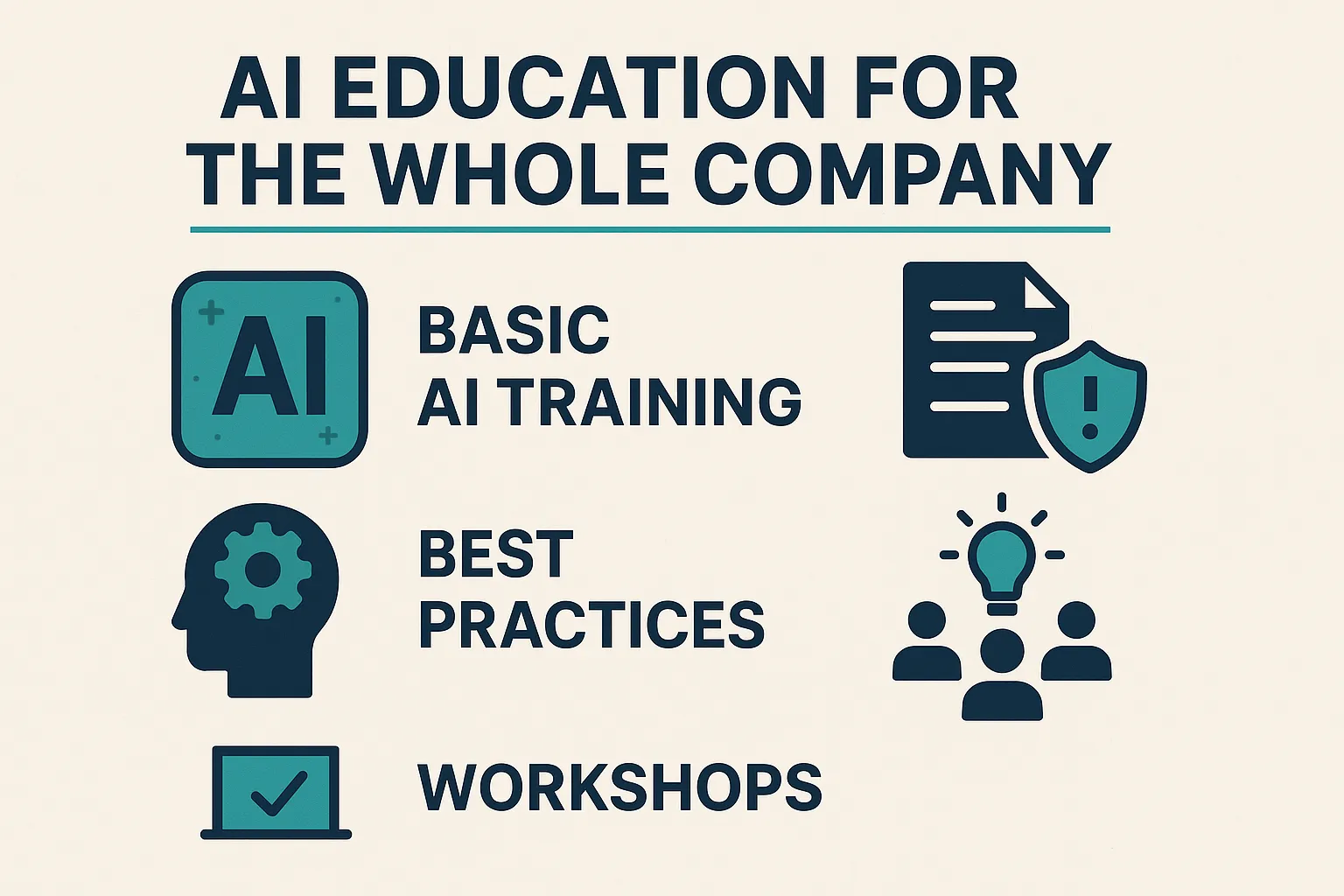
An AI awareness program for engineering teams is not a slide deck about artificial intelligence. It is the operating baseline that tells developers where AI belongs in the software delivery lifecycle, which tools are approved, how sensitive data can move, which outputs need human review, and how leadership will know whether adoption is improving the system.
Most engineering organizations need that baseline after AI has already entered the workflow. Developers are using coding assistants. Product managers are drafting requirements with LLMs. QA is experimenting with test generation. Architects are comparing vendor demos. Security is trying to understand what has touched customer data, source code, credentials, or regulated information.
That is the real problem behind AI literacy for engineering teams: not “what is AI?” but “how do we raise enough shared understanding that AI use becomes safer, more consistent, and worth funding?”
The practical answer is to treat awareness as the first maturity gate. Metacto’s AI-Enabled Engineering Maturity Index gives engineering leaders a way to score current behavior across the SDLC, identify readiness gaps, and turn AI training into an adoption roadmap instead of a one-time learning event.
Awareness is an operating control
If engineers do not share the same rules for tools, data, review, and measurement, AI adoption becomes a collection of private experiments. A strong awareness program makes good experimentation repeatable and risky experimentation visible without slowing useful adoption.
What an AI awareness program must answer
A useful AI awareness program gives engineering teams clear answers to six operating questions:
- Which AI tools are approved for code, documentation, analysis, testing, and customer-facing work?
- Which data classes can be used with each tool, and which data classes are never allowed?
- Where can AI help in the SDLC today, and where would it create review burden or delivery risk?
- What does a good AI-assisted output look like for code, tests, architecture notes, tickets, runbooks, and production workflows?
- Which metrics will show whether AI is improving delivery rather than creating downstream rework?
- Who owns policy updates, training, exceptions, incidents, and expansion decisions after the first wave of adoption?
If those answers are missing, AI enablement for software developers stays informal. A few people move faster, a few people opt out, and leaders cannot tell whether the organization is becoming more capable or simply more uneven.
AI awareness maturity checklist
Use this as a first-pass maturity screen. If a pillar has no owner or no observable signal, the awareness program is still training content rather than an operating model.
Awareness pillar: Shared AI vocabulary
- Owner and SDLC touchpoint
- Engineering leadership, developer experience, and architecture reviews.
- Risk reduced
- Teams stop using the same words to mean different things: model, agent, workflow, context, retrieval, evaluation, and automation.
- AEMI maturity signal
- Engineers can describe where AI is assisting, where it is acting, and where human judgment remains required.
Awareness pillar: Approved tool and data rules
- Owner and SDLC touchpoint
- Security, platform, legal, and team leads across coding, docs, tickets, and support workflows.
- Risk reduced
- Sensitive source code, customer records, credentials, and regulated data are not copied into unmanaged tools.
- AEMI maturity signal
- Policy is specific enough that developers know which tool to use, what data is allowed, and how to request an exception.
Awareness pillar: SDLC use-case map
- Owner and SDLC touchpoint
- Engineering managers and product owners across requirements, build, review, QA, release, and operations.
- Risk reduced
- AI energy does not scatter across demos that have no owner, metric, context, or production path.
- AEMI maturity signal
- The team can name the first workflows worth funding and the foundation gaps that must be fixed first.
Awareness pillar: Review and quality habits
- Owner and SDLC touchpoint
- Tech leads, reviewers, QA, and release owners.
- Risk reduced
- AI-generated output does not bypass the same quality, security, and maintainability expectations as human-written work.
- AEMI maturity signal
- Reviewers know what evidence to inspect before accepting AI-assisted code, tests, specs, or operational recommendations.
Awareness pillar: Measurement discipline
- Owner and SDLC touchpoint
- Engineering operations, finance partners, and the accountable workflow owner.
- Risk reduced
- Leadership avoids judging adoption by anecdotes, novelty, or raw tool usage alone.
- AEMI maturity signal
- Metrics connect AI use to delivery flow, review burden, defect patterns, risk, and business outcomes.
Awareness pillar: Continuous ownership
- Owner and SDLC touchpoint
- The operating owner for each AI-assisted workflow after launch.
- Risk reduced
- Training does not decay after the initial rollout, and incidents or model/tool changes feed back into practice.
- AEMI maturity signal
- The organization has a cadence for policy updates, enablement refreshes, monitoring, and expansion decisions.
The cost of low AI awareness
Low AI awareness is expensive because it hides itself inside normal engineering activity. The team is still shipping tickets, reviewing pull requests, answering incidents, and writing documentation. The difference is that no one can see which parts of the system now depend on unmanaged AI behavior.
Tool sprawl becomes process sprawl
When every engineer chooses their own AI workflow, the organization gets more than tool sprawl. It gets process sprawl.
One developer uses an AI coding assistant to draft implementation. Another uses a separate model to explain legacy code. A third uses a browser tool to summarize a customer issue. A fourth avoids AI because the rules feel unclear. Each choice may be reasonable in isolation, but the team no longer has a shared standard for inputs, review, output quality, or recordkeeping.
That makes it hard to train new engineers, compare results, enforce security expectations, or decide whether a use case deserves investment. The organization stays in a reactive or experimental AI maturity stage because adoption is visible only as isolated behavior.
Security and compliance risk moves closer to daily work
AI awareness matters most when the work touches data. Developers need practical rules for source code, logs, credentials, customer records, health information, payment data, contracts, personnel data, and proprietary strategy.
Generic warnings are not enough. A developer needs to know whether they can paste a stack trace into a tool, upload a failing test fixture, summarize a support thread, ask for a vulnerability explanation, or use an AI agent to write into a ticketing system. Each scenario has different data exposure, audit, and review implications.
This is where awareness becomes governance. It translates policy into decisions developers make during ordinary work.
AI output shifts the bottleneck
Teams often adopt AI to move faster, then discover that the bottleneck moved downstream. Code is drafted faster, but senior engineers spend more time reviewing suspicious diffs. Test ideas are generated faster, but QA inherits brittle cases. Documentation appears faster, but nobody knows whether it reflects the current system.
An awareness program should make this visible early. Developers should learn not only how to use AI tools, but how to verify their output, limit scope, preserve context, and identify when the output is not trustworthy enough for the next step.
Leadership cannot measure readiness
Tool adoption is not the same as engineering AI readiness. A team can have high usage and low maturity if it lacks approved workflows, data rules, quality checks, and operating ownership.
That is why the AEMI assessment is a useful next step after basic training. It moves the conversation from “are people using AI?” to “which SDLC phases are ready, which controls are missing, and which workflows should be funded first?”
Build AI literacy in layers
AI literacy for engineering teams should be role-specific and workflow-specific. Engineers do not need to become machine learning specialists. They do need enough shared judgment to use AI safely, challenge weak outputs, and spot practical opportunities.
Layer 1: Shared concepts
Start with the concepts developers will actually use:
- the difference between model, product, agent, workflow, and automation
- how prompts, context, retrieval, tools, and permissions change output quality
- why generated code, generated tests, and generated summaries require different review habits
- what hallucination, data leakage, prompt injection, overbroad permissions, and stale context look like in engineering work
- how evaluation differs from ad hoc “the answer looks good” checking
This layer gives the organization a shared language. It also prevents a common failure mode: one team discussing “AI agents” as autonomous production actors while another uses the same phrase for a chat assistant that drafts text.
Layer 2: Tool and data boundaries
Next, turn policy into everyday engineering rules. The output should be concrete enough that a developer can make a decision without hunting through a legal memo.
Define:
- approved tools by use case
- prohibited data classes
- allowed data classes by tool and environment
- rules for source code, logs, secrets, customer records, and regulated information
- exception paths and approval owners
- expectations for storing prompts, outputs, decisions, and audit evidence when the work affects production
This is also where AI training for development teams should include realistic examples. Use the same kinds of tickets, logs, pull requests, architecture notes, and incident records your teams handle every week.
Layer 3: SDLC playbooks
AI awareness becomes useful when it lands in the software delivery lifecycle.
For requirements, teach teams how to use AI to clarify ambiguity without inventing business rules. For architecture, teach them to compare options while preserving constraints and tradeoffs. For coding, teach them to scope prompts, inspect generated diffs, and protect maintainability. For review, teach reviewers where AI-assisted work tends to hide risk. For QA, teach teams to generate useful test ideas without mistaking volume for coverage. For operations, teach them to use AI summaries without losing incident accountability.
The point is not that AI belongs everywhere. The point is that each SDLC phase needs its own readiness standard.
Layer 4: Opportunity selection
Once teams understand the basics, the next question is where AI should be applied first.
This should be a governed selection process, not a brainstorming contest. A promising workflow usually has a named owner, repeated volume, accessible context, reviewable output, a measurable baseline, and an expansion path if the first version works.
Metacto’s Opportunity Mapping exists for that stage. It helps teams turn scattered ideas into a ranked map of workflows, foundation gaps, risks, and first-build recommendations.
Layer 5: Review, evaluation, and operating cadence
The final layer is the habit that keeps awareness alive. As tools change, models change, and workflows move closer to production, the organization needs a cadence for updating rules and measuring behavior.
For AI-assisted engineering work, that cadence should inspect:
- approved-tool adoption by team and use case
- policy exceptions and data-handling questions
- PR review burden and rework on AI-assisted changes
- defect patterns, test coverage changes, and release confidence
- cycle time for selected workflows, not just individual task speed
- the number of workflow ideas that become assessment-ready
- incidents, near misses, and control gaps discovered after rollout
These measures do not have to be perfect on day one. They just have to be specific enough that the team can learn.
A 90-day rollout model
Engineering leaders do not need to boil the ocean. A practical AI awareness program can start with a 90-day rollout.
Days 1-15: Baseline current behavior
Start by observing how AI is already being used. Inventory approved and unapproved tools, interview team leads, review representative workflows, and identify where AI touches code, documentation, tickets, incidents, tests, customer data, and internal knowledge.
Do not frame this as a compliance hunt. Frame it as a maturity baseline. The purpose is to see the real system before writing rules for an imaginary one.
Days 16-30: Publish the working agreement
Turn the baseline into a practical working agreement:
- what is approved
- what is prohibited
- what requires review
- what requires an exception
- who owns decisions
- how policy changes are communicated
Keep the first version short enough that developers will actually use it. A policy no one can remember will not change behavior.
Days 31-60: Run role-based workshops
Train by role and SDLC phase. Developers, reviewers, QA, platform, security, product, and engineering managers need overlapping awareness, but they do not need identical sessions.
Use live examples from your engineering environment when possible. Rewrite a ticket. Review an AI-generated diff. Evaluate a generated test. Inspect a risky prompt. Compare a safe workflow candidate with a tempting but premature one.
Days 61-90: Select first workflows and measure the loop
By the end of the first rollout, the organization should know which workflows are ready for controlled pilots and which foundation gaps need work first.
This is the bridge from awareness to Operational AI. Training has done its job when it produces better workflow selection, safer boundaries, clearer ownership, and enough measurement to decide what should scale.
When an AI development partner helps
AI development services should not replace internal awareness. They should accelerate it.
A good partner helps when the organization needs a neutral maturity assessment, a practical use-case map, production-grade architecture, or a faster path from training to controlled workflow adoption. The partner should be able to translate AI concepts into engineering operating decisions: data access, permissions, context, evaluation, human review, deployment, monitoring, and continuous improvement.
For engineering leaders, the important distinction is this: a partner who only delivers demos may increase enthusiasm without improving readiness. A partner who helps build the operating model can leave the team more capable after the first engagement.
Choose the next step based on the decision in front of the team: use AEMI when the question is engineering maturity, Opportunity Mapping when the question is workflow selection, and Continuous AI Operations when AI workflows need ownership after launch.
From awareness to maturity
The first goal of an AI awareness program is not to make every engineer use AI every day. It is to make the organization honest about readiness.
Can developers explain the rules? Can reviewers inspect AI-assisted work with confidence? Can security see where sensitive data might move? Can engineering managers name the workflows worth piloting? Can leadership measure whether adoption is reducing friction or creating it somewhere else?
When the answer is yes, AI awareness has become more than training. It has become a maturity baseline.
That is the point where the next step is no longer another generic workshop. It is a structured assessment of the SDLC, the controls, the use cases, and the operating model. Assess your engineering team’s AI readiness with AEMI, then use the result to decide which training gaps to close, which workflows to fund, and which AI practices are ready to move from experiment to production.
AI Awareness for Engineering Teams: FAQ
What is AI awareness for engineering teams?
AI awareness for engineering teams is the shared understanding developers, reviewers, managers, security teams, and product owners need to use AI safely in the SDLC. It covers approved tools, data rules, review expectations, workflow fit, measurement, and ownership.
How do you build AI literacy in a development organization?
Build AI literacy in layers: establish shared vocabulary, define tool and data boundaries, train by SDLC phase, practice on real engineering artifacts, select a small number of workflow candidates, and measure whether adoption improves delivery without adding hidden review or risk burden.
How do you measure AI readiness in software teams?
Measure AI readiness by looking beyond tool usage. Useful signals include policy clarity, approved-tool adoption, review quality, data-handling discipline, workflow selection maturity, PR review burden, defect patterns, operational ownership, and whether the team has metrics for the workflows it wants to scale.
When should an engineering team move from AI training to production workflows?
Move from training to production workflows when the team has a named workflow owner, accessible context, clear data boundaries, review and rollback paths, baseline metrics, and a cadence for monitoring after launch. Without those conditions, the next step is usually readiness work or opportunity mapping, not production automation.