Introduction: Entering the Virtual Frontier
metacto is an app development company that develops custom apps in many industries and for many use cases including virtual reality (VR) applications. With over 20 years of experience and more than 100 successful app launches, we bring deep expertise in mobile development and AI integration to create immersive VR experiences for Meta Quest, Vision Pro, and enterprise platforms. As one of the best custom VR app developers in the US, we specialize in custom AR VR app development that transforms business operations and user experiences.
Virtual Reality (VR) is no longer a futuristic fantasy; it is a powerful, accessible technology transforming industries from healthcare and education to manufacturing and entertainment. The allure of creating fully immersive digital experiences through custom VR app development is immense. However, the path from a groundbreaking idea to a polished, functional VR application is fraught with unique and formidable challenges. Companies often underestimate the specialized skills, intricate hardware considerations, and novel design principles required to build bespoke VR apps for this new medium. Attempting to develop in-house without working with the best custom VR app developers can lead to costly delays, a subpar user experience plagued by issues like motion sickness, and ultimately, a failed project.
This article serves as a comprehensive guide to navigating the world of custom VR app development. We will demystify the process, exploring what defines a VR app, why in-house development is so difficult, and the distinct advantages of a custom-built solution. We will also delve into the different types of VR applications, provide realistic cost estimates, and introduce you to top custom AR VR app development companies that can turn your vision into a virtual reality.
As a top US AI-powered app development firm with over 20 years of experience launching successful digital products, we at metacto understand what it takes to build cutting-edge bespoke VR apps. While VR presents a new frontier, the foundational principles of robust engineering, user-centric design, and strategic product management remain the same. We will show you how our deep expertise in mobile app development and AI integration makes us among the best custom VR app developers to help you build a transformative VR experience that achieves your business goals.
What is a VR App?
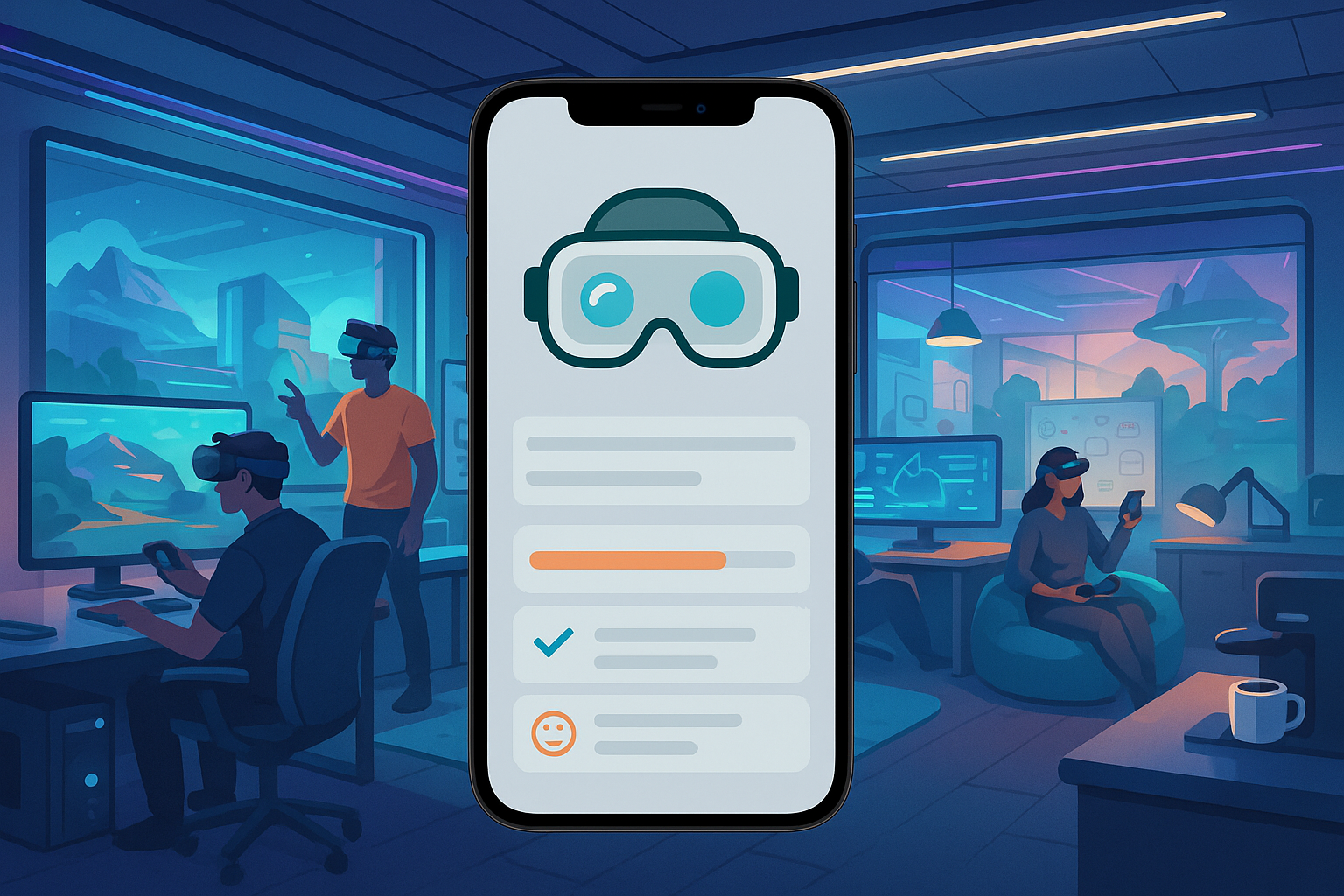
A Virtual Reality (VR) application is a software program designed to create a simulated, three-dimensional environment that a user can explore and interact with in a seemingly real or physical way. Unlike traditional applications that are viewed on a 2D screen, a VR app completely replaces the user’s real-world surroundings with a computer-generated world. This is achieved through the use of a specialized VR headset, such as a Meta Quest or HTC Vive, which uses stereoscopic displays to present a slightly different image to each eye, creating a convincing illusion of depth and presence.
The core of the VR experience is immersion. A well-designed VR app engages multiple senses to make the user feel truly present within the virtual environment. This goes beyond just visual and auditory stimuli. Advanced VR systems incorporate haptic feedback through specialized controllers or suits, allowing users to “feel” virtual objects and interactions. The application tracks the user’s head and body movements, updating the virtual world in real-time to match their perspective and actions. This seamless tracking is critical; any lag or disconnect between a user’s movement and the visual feedback can break the immersion and cause physical discomfort, commonly known as motion sickness.
It is important to distinguish VR from its cousins, Augmented Reality (AR) and Mixed Reality (MR). While VR creates a completely artificial world, AR overlays digital information or virtual objects onto the user’s real-world view, typically through a smartphone camera or smart glasses. MR is a step further, allowing virtual objects to not only be overlaid but also to interact with the real world in a spatially aware context. A VR app, by contrast, is a complete transportation to another place. This total immersion is what makes VR uniquely powerful for applications like realistic training simulations, architectural visualizations, and deeply engaging entertainment.
Reasons It Is Difficult to Develop a VR App In-House
While the potential of VR is exciting, the practical realities of development are sobering. Many organizations with strong traditional software engineering teams find themselves unprepared for the unique hurdles of the VR landscape. Here are the primary reasons why in-house VR development is so challenging.
Highly Specialized Skillsets
Standard web or mobile development skills do not translate directly to VR. A competent VR team requires a multidisciplinary blend of expertise that is rare to find and expensive to hire. This includes:
- 3D Artists and Modelers: To create the virtual environments, characters, and objects that populate the world.
- Game Engine Experts: Deep proficiency in engines like Unity or Unreal Engine is non-negotiable. These platforms provide the core rendering, physics, and interaction frameworks for VR.
- C++/C# Programmers: These are the primary languages used within Unity and Unreal Engine to script the application’s logic, interactions, and unique features.
- Spatial Computing Specialists: Developers who understand the mathematical and logical principles of working in a 3D space, including vector math, quaternions for rotation, and collision detection.
- Performance Optimization Engineers: Perhaps the most critical role. VR apps demand unwavering, high frame rates (typically 90 frames per second or higher) on two separate screens (one for each eye). Dropping frames can instantly cause motion sickness and ruin the experience. This requires a deep understanding of how to manage polygon counts, optimize shaders, reduce draw calls, and profile performance at a granular level.
Hardware Fragmentation and Platform Complexity
The VR market is not standardized. Developing an app means targeting a specific ecosystem of headsets, controllers, and tracking systems, each with its own Software Development Kit (SDK), performance characteristics, and input paradigms. An app built for the standalone Meta Quest 3, with its mobile processor, will have different constraints and optimization needs than one built for the PC-tethered Valve Index, which can leverage a powerful desktop GPU. Supporting multiple platforms multiplies the development, testing, and maintenance workload exponentially.
The Unforgiving Nature of VR UI/UX
Designing a user interface for a 3D, immersive world is a completely different discipline from 2D screen design. Menus, buttons, and text must be placed thoughtfully within the 3D space to be legible, comfortable to view, and easy to interact with. Key considerations include:
- User Comfort: Placing UI elements too close to the user can cause eye strain, while placing them too far can make them difficult to read. Text size and contrast are critical.
- Interaction Models: How does a user select a button? Do they point with a controller, use a gaze-based cursor, or “touch” it with a virtual hand? Each method has pros and cons that must be weighed for the specific use case.
- Avoiding Disorientation: Poorly designed movement systems (locomotion) or interfaces that require excessive head movement can quickly lead to user discomfort and nausea. The user interface must be intuitive and grounded to prevent sensory conflict.
High Cost of Equipment and Licensing
An in-house VR team requires a significant upfront investment in hardware and software. This includes multiple high-end VR headsets for development and testing across different platforms, powerful workstations capable of handling complex 3D scenes and real-time rendering, and licenses for essential software like 3D modeling tools, game engines, and specialized plugins. These costs can quickly escalate, making it difficult to justify for a single project or an unproven initiative.
Why Custom App Development for VR?
Given the challenges, partnering with a specialized development agency is often the most strategic and efficient path to building a successful VR application. Off-the-shelf VR solutions exist, but they are often generic and cannot address the unique goals, workflows, and brand identity of a specific business. Custom VR app development unlocks the true potential of VR. Working with the best custom VR app developers ensures your bespoke VR apps are built to meet your exact specifications and business objectives.
Tailored to Your Specific Business Objectives
Whether you aim to create a hyper-realistic surgical training simulation, a virtual showroom for configurable products, or an immersive educational module, a custom application is built from the ground up to meet your exact requirements. A development partner works with you to understand your specific problem and designs a solution that directly addresses it, ensuring the final product delivers tangible ROI instead of being a novelty.
A Unique and Branded User Experience
Custom development gives you complete control over the user experience. You can create a distinct virtual environment that reflects your brand’s aesthetic, values, and messaging. This allows you to differentiate your application in a crowded market and create a memorable, impactful experience for your users, whether they are customers, employees, or students.
Seamless Integration with Existing Systems
For enterprise applications, the ability to integrate with existing business systems is crucial. A custom VR app can be designed to connect with your company’s CRM, Learning Management System (LMS), inventory database, or other backend infrastructure. This enables data to flow seamlessly, allowing, for instance, a VR training module to record employee performance directly into your HR system or a virtual sales tool to pull real-time product data.
Scalability and Future-Proofing
Technology in the VR space evolves rapidly. A custom-built application can be architected with future growth in mind. The codebase can be made modular and scalable, making it easier to add new features, support upcoming VR hardware, or expand the application’s capabilities as your business needs change. This long-term flexibility is a key advantage over rigid, off-the-shelf platforms. By owning the intellectual property, you create a valuable, competitive asset that can evolve with your company.
Why Choose metacto for VR Development?
While VR presents a new frontier, the foundational principles of robust engineering, user-centric design, and strategic product management remain the same. Our deep expertise in AI development powers intelligent virtual characters, while our award-winning UI/UX design skills ensure your VR experience is intuitive and comfortable.
Different Types of VR Apps
The applications of VR technology are incredibly diverse, spanning nearly every industry. Custom development allows businesses to create specialized tools that solve specific problems. Here are some of the most common types of VR apps:
Training and Simulation
This is one of the most powerful use cases for VR in the enterprise. VR allows employees to practice complex or dangerous tasks in a safe, controlled, and repeatable virtual environment.
- Healthcare: Surgeons practice complex procedures, and medical students learn anatomy on virtual bodies.
- Manufacturing & Automotive: Technicians learn to assemble or repair intricate machinery without risking damage to expensive equipment.
- Aviation & Military: Pilots and soldiers run through countless simulations to build muscle memory for high-stakes scenarios.
Design, Prototyping, and Architecture
VR allows designers, engineers, and architects to visualize and interact with their creations at a 1:1 scale before a single physical component is produced.
- Architecture: Clients can walk through a virtual model of a building, experiencing the space and making changes to the design in real-time.
- Automotive: Engineers can sit inside a virtual prototype of a car to evaluate ergonomics and interior design long before a physical model is built.
Marketing, Retail, and e-Commerce
Brands are using VR to create deeply engaging and memorable marketing experiences that go far beyond traditional advertising.
- Virtual Showrooms: Customers can explore and customize products like cars or furniture in a fully immersive virtual space.
- Immersive Brand Storytelling: Companies can transport customers inside the world of their brand, creating an emotional connection.
- Virtual Try-Ons: In fashion and retail, users can see how products might look in their own home or on a virtual avatar.
Education and Data Visualization
VR can make abstract concepts tangible and learning more engaging.
- Virtual Field Trips: Students can visit historical sites, explore the solar system, or dive to the bottom of the ocean.
- Complex Data Visualization: Financial analysts or scientists can walk through and interact with complex 3D data models, uncovering insights that would be invisible on a 2D chart.
Entertainment and Social Platforms
Beyond gaming, VR is becoming a new platform for social interaction and entertainment.
- Virtual Events: Users can attend concerts, conferences, and meetups with others from around the world in a shared virtual space.
- Immersive Storytelling: New forms of narrative are emerging that place the user at the center of the story, allowing them to participate rather than just watch.
Cost Estimate for Developing a VR App
Determining the cost of a custom VR application is complex, as it depends on a multitude of factors. There is no one-size-fits-all price. However, we can provide a general framework based on the project’s scope and complexity.
The primary factors that influence cost include:
- Complexity and Features: A simple 360-degree video viewing application is fundamentally different from a complex, interactive multiplayer simulation with AI-driven characters and physics-based interactions.
- Artistic and Visual Fidelity: The level of realism and detail in the 3D assets, environments, and animations is a major cost driver. Photorealistic visuals require significantly more time and skill from 3D artists than a more stylized or minimalist aesthetic.
- Target Platform(s): Developing for a single platform like the Meta Quest 3 is the most cost-effective. Adding support for other platforms like SteamVR or PlayStation VR introduces additional development, testing, and optimization work, increasing the budget.
- Backend and API Integration: If the VR app needs to connect to external databases, user authentication systems, or other enterprise software, this backend development work will add to the overall cost.
- Team Size and Experience: The project will be priced based on the number of developers, artists, designers, and project managers required, as well as their experience level and geographic location.
Here are some ballpark estimates to help frame your budget:
- Simple VR Application ($25,000 – $75,000): This could include applications like a 360-degree video tour, a basic architectural walkthrough with limited interactivity, or a simple product viewer. These apps typically use pre-made assets and have a straightforward feature set.
- Intermediate VR Application ($75,000 – $200,000): This range covers more interactive experiences, such as a corporate training module with specific learning objectives and performance tracking, an interactive product configurator, or a small-scale VR game with custom assets.
- Complex VR Application ($200,000 – $500,000+): This tier is for high-end, enterprise-grade solutions. Examples include large-scale, multiplayer training simulations, advanced medical or engineering tools with complex data integration, or premium, commercial VR games with high-fidelity graphics and extensive content.
It is essential to undertake a thorough Product Design & Discovery phase with a development partner to define the project’s scope, features, and technical requirements. This initial step is critical for obtaining an accurate and reliable cost estimate for your specific vision.
Top VR App Development Companies
Choosing the right development partner is the most critical decision you will make. You need a team with the technical prowess, strategic vision, and project management discipline to deliver. Here are some of the top companies in the US specializing in custom AR VR app development.
1. metacto
At metacto, we have spent over two decades building, growing, and monetizing complex digital applications. As one of the best custom VR app developers in the industry, our core philosophy is platform-agnostic. We are experts in translating complex business requirements into robust, scalable, and user-centric software. This foundational expertise is precisely what is needed to succeed in the demanding field of custom VR app development.
We approach VR not just as a new technology, but as a new frontier for user interaction and business solutions. Our seasoned team of strategists, designers, and engineers applies the same rigorous process that has launched over 100 successful apps to the world of virtual reality. Our custom AR VR app development capabilities are enhanced by deep experience in AI development, which powers intelligent, responsive virtual characters for training simulations. Our award-winning UI/UX design skills ensure that your bespoke VR apps are intuitive, comfortable, and free from the pitfalls of motion sickness. We believe in building smart and scaling fast, and our 90-day MVP service is designed to get a functional, core version of your VR application into your hands quickly, allowing for real-world testing and iterative improvement. We don’t just build apps; we build businesses.
| Core Specialization | Custom Mobile App Development, AI Development, Virtual Reality |
| Primary Services | VR App Development, AI Integration, Mobile App Development, Product Strategy |
| Industry Focus | Healthcare, Education, Fintech, Social, Entertainment |
2. HQSoftware
Embarking on its technological odyssey in 2001, HQSoftware is a US-based firm with an outpost in Estonia that has become a luminary in the VR space. With a flair for augmented and virtual reality, IoT, and AI, the company is positioned among the most productive VR companies. Their expansive know-how allows them to maintain a firm footing in the competitive XR landscape. HQSoftware takes pride in being spotlighted by Clutch and views each project as an opportunity to push the boundaries of virtual reality, creating immersive experiences and innovative solutions that resonate with clients’ unique needs.
| Core Specialization | Software Development and Virtual Reality |
| Primary Services | VR Software Creation and Prototyping, VR for Mobile |
| Industry Focus | Education, Fintech, Automotive |
3. CXR
Founded in 2020, CXR is a US-based trailblazer that has rapidly built an impressive repertoire in the virtual reality landscape. This award-winning VR solutions provider sets a high standard, delivering custom AR/VR services tailored for diverse industries, from healthcare to commerce and industrial applications. With sights set on revolutionizing businesses, CXR is not just a participant but a force that pushes the envelope, challenges the status quo, and sets new benchmarks among virtual reality companies worldwide.
| Core Specialization | Software Development and Virtual Reality |
| Primary Services | VR App Development, VR Content Creation |
| Industry Focus | Manufacturing, Healthcare, e-Commerce |
4. Groove Jones
Groove Jones is a dynamic US-based agency at the forefront of pioneering next-generation technologies. While their expertise spans AI and machine learning, their primary focus is on developing the future of virtual, augmented, and mixed reality. Recognized as one of the leading VR companies, Groove Jones has a reputation for creating award-winning AR/VR applications that serve as powerful tools for modern advertising, digital marketing, and enterprise-level training. Their innovative solutions transform traditional paradigms into immersive experiences, making them a versatile hub of digital innovation.
| Core Specialization | Software Development and Virtual Reality |
| Primary Services | Interactive VR App Development, Business VR |
| Industry Focus | Manufacturing, Marketing |
5. Fingent
A beacon of innovation in the United States since 2003, Fingent provides sophisticated technical solutions across a multitude of industries. Their exceptional expertise in software, AR/VR, and infrastructure development has secured their position among the top VR companies globally. With hundreds of completed projects worldwide, Fingent acts as a catalyst for digital transformation, helping enterprises venture beyond the bounds of virtual reality into extended reality, data visualization, and artificial intelligence. Their unwavering commitment to technological evolution upholds their stature as a symbol of relentless innovation.
| Core Specialization | Software Development and Virtual Reality |
| Primary Services | Interactive VR App Development, VR for Mobile Devices, VR Content Production |
| Industry Focus | Education, Retail, Manufacturing |
6. NEXT/NOW
Since stepping into the VR arena in 2011, NEXT/NOW has consistently stood out as one of the top VR companies from the United States. With a keen focus on marketing, retail, and entertainment, their dynamic team diligently crafts custom VR services and state-of-the-art digital and XR solutions. Renowned for their forays into multimedia and digital exhibition design, NEXT/NOW’s diverse portfolio demonstrates proficiency across a spectrum of technological domains. They have positioned themselves as a stalwart in the field, paving the path forward with all-in-one solutions.
| Core Specialization | Software Development and Virtual Reality |
| Primary Services | Multimedia VR Development, Exhibition VR Design, Generative Art, VR App Creation |
| Industry Focus | Marketing, Retail, Entertainment |
7. TSUKAT
Established in 2017, TSUKAT is a US-based powerhouse with an unwavering dedication to developing immersive virtual and augmented reality applications. Their laser-sharp focus is on equipping designers, architects, and diverse industrial entities with tools to elevate their businesses. With a rich legacy of experience in VR, manufacturing, and game development, TSUKAT confidently tackles graphics-intensive projects that call for unique VR-focused hardware. Their singular focus on providing cutting-edge virtual reality solutions sets them apart as a go-to partner for businesses seeking to harness the power of VR.
| Core Specialization | Software Development and Virtual Reality |
| Primary Services | VR Architecting, VR Software Development, VR for Mobile |
| Industry Focus | Architecture, Manufacturing |
8. ScienceSoft
Established in 1989, ScienceSoft is one of the oldest and most reputable VR companies in the software development market. This US-based firm leverages an impressive 33-year trajectory in software development, including 26 years mastering 3D modeling, to deliver a broad spectrum of AR/VR solutions across healthcare, automotive, and commerce. ScienceSoft prides itself on a unique blend of high-quality services and cost-efficiency, positioning itself as a one-stop shop for clients seeking to amplify their digital footprint. As a seasoned player, they stand ready to guide clients through the exciting world of virtual reality.
| Core Specialization | Software Development and Virtual Reality |
| Primary Services | VR App Development, VR Outsourcing, VR for Mobile Development |
| Industry Focus | Healthcare, Automotive, Retail |
9. Realworld One
A trailblazer since its inception in 2017, Realworld One specializes in creating cutting-edge augmented and virtual reality solutions with a primary focus on manufacturing, science, sales, and marketing. This US-based company is known for crafting state-of-the-art immersive technology, particularly in enterprise VR development. Realworld One stands out for its uncompromising commitment to quality, performance, and research-based decision-making. Their ability to deliver reliable and effective VR solutions in high-stakes fields like life sciences and pharmaceuticals attests to their prowess.
| Core Specialization | Software Development and Virtual Reality |
| Primary Services | VR Software Development, Enterprise VR, VR for Mobile Devices |
| Industry Focus | Manufacturing, Marketing |
10. AVRspot
Nestled in New York, AVRspot is a titan among virtual reality companies, bringing an expansive array of AR/VR solutions to industries as diverse as real estate, navigation, and computer vision. Their brilliance lies in the ability to blend technology and art seamlessly. From the precision of 3D scanning to the thrill of immersive VR bike tours, AVRspot has shown proficiency in handling a multitude of client needs with effortless expertise. This versatility has made it an award-winning entity and a go-to choice for those seeking innovative VR solutions.
| Core Specialization | Software Development and Virtual Reality |
| Primary Services | VR Solutions for Businesses, VR App Creation, VR Content Production |
| Industry Focus | Healthcare, Automotive, Real Estate |
11. SubVRsive
SubVRsive has been a beacon in the virtual reality industry since 2015. This US-based company, fueled by innovation and ambition, shines with a diverse portfolio of AR/VR applications. Their repertoire expands beyond conventional norms to include commercial and 360-degree video production. What truly differentiates SubVRsive is its dedication to putting the user experience at the core of its mission. They don’t just create VR content; they cultivate experiences that transform passive audiences into active participants, establishing themselves as one of the most customer-centric VR companies.
| Core Specialization | Software Development and Virtual Reality |
| Primary Services | VR Metaverse Building, VR App Development, Mobile VR |
| Industry Focus | Marketing, Retail, Education |
12. Exyte
A US-based name that has been making waves for over seven years, Exyte stands tall amongst top VR companies. Their proficiency spans a wide range of services, from mobile development on iOS and Android to engaging AR/VR experiences and blockchain. Exyte’s unique strength lies in its full-stack programmers and designers, who are adept at undertaking complex mobile, blockchain, and XR development projects. Their successful foray into these sectors has cemented their position as a go-to destination for businesses looking to transform their operations in VR.
| Core Specialization | Software Development and Virtual Reality |
| Primary Services | Mobile App Development, Blockchain, VR Game Building |
| Industry Focus | Healthcare, Fintech, Education |
13. Mutual Mobile
Since its inception in 2009, Mutual Mobile has become a key player among top VR companies in the US. With core competencies in design strategy, engineering, and product management, they leverage cutting-edge technology to shape a diverse range of virtual products. Their portfolio reflects a rich tapestry of over a thousand VR projects spanning more than 20 industries. This depth of expertise guarantees that clients can anticipate full-service software development that invariably leads to high-quality, functional VR products that don’t just serve, but also inspire.
| Core specialization | Software development and virtual reality |
| Primary services | VR for mobile devices, VR app development, and Web VR |
| Industry focus | Education, Healthcare, and Marketing |
14. Itransition
A well-established force since 1998, US-based Itransition has mastered the art of smart automation, technology advisory, and engineering services. With an impressive workforce of over 3000 seasoned developers, Itransition represents the epitome of excellence, especially within the finance, healthcare, and retail sectors. Their team of in-house virtual reality maestros is dedicated to AR and VR development, crafting purpose-driven applications that deliver genuine value to end-users and assert the company’s position as a dominant player in the industry.
| Core specialization | Software development and virtual reality |
| Primary services | VR content creation, VR app development, and VR services |
| Industry focus | Fintech, Healthcare, and Retail |
15. Spire Digital
Ranked among the top echelons of global virtual reality companies, Denver-based Spire Digital commands expansive expertise across a wide spectrum of development fields. For over two decades, this product development tour de force has proven its mettle, from spearheading digital transformations and crafting mobile/web applications to innovating in AI, IoT, and VR development. Their mastery has been instrumental in assisting clients across healthcare, entertainment, and retail to achieve their business objectives and scale new heights.
| Core specialization | Software development and virtual reality |
| Primary services | VR content production, VR software creation, and VR software development |
| Industry focus | Automotive, Education, and Fintech |
Conclusion: Building Your Virtual Reality
We have journeyed through the exciting but complex landscape of custom VR app development. We have defined what makes a VR app, explored the significant challenges that make in-house development a risky proposition, and highlighted the strategic advantages of a bespoke solution tailored to your unique business goals. We’ve also surveyed the diverse types of VR applications transforming industries and provided a realistic framework for understanding development costs.
The key takeaway is that success in VR requires more than just a great idea; it demands a fusion of specialized technical skill, creative design thinking, and disciplined project execution. The difference between a captivating, effective VR experience and a disorienting, failed project often comes down to the expertise of the development partner you choose. The companies listed represent the best in the field, each with its own strengths and specializations.
At metacto, we bring over 20 years of experience in building successful digital products to this new frontier. Our expertise in mobile, AI, and robust backend engineering provides the strong foundation needed to build truly transformative VR applications. We are ready to help you navigate the complexities, avoid the common pitfalls, and turn your vision into a powerful virtual reality.
Your journey into the virtual world starts with a conversation. Talk with a VR app development expert at metacto today to explore how we can build your app the right way, from day one.
Ready to Build Your VR Application?
Get a free consultation with our VR and immersive technology experts. We'll discuss your vision, platform requirements, and create a roadmap to launch your virtual reality experience.
Frequently Asked Questions About Custom VR App Development
How much does custom VR app development cost?
Custom VR app development costs range from $50,000 to $500,000+ depending on complexity. Simple bespoke VR apps for training or visualization start around $50,000-$80,000. Complex custom AR VR app development with advanced interactions, multiplayer features, and enterprise integrations can exceed $300,000. Platform choice (Quest, Vision Pro, PC VR) significantly impacts costs.
How long does it take to build bespoke VR apps?
Basic bespoke VR apps take 4-6 months. Mid-complexity custom VR app development with custom 3D assets, interactions, and optimization requires 6-9 months. Enterprise custom AR VR app development projects with multi-platform support, multiplayer, and advanced features may take 12-18 months.
What platforms can you build custom VR apps for?
The best custom VR app developers build for all major platforms including Meta Quest 2/3/Pro, Apple Vision Pro, HTC Vive, Valve Index, PlayStation VR2, and PC VR systems. Each platform has different capabilities and optimization requirements that experienced custom VR app development teams handle.
What types of bespoke VR apps can you build?
We build all types of bespoke VR apps including enterprise training simulations, architectural visualization, healthcare and therapy applications, educational experiences, entertainment and gaming, virtual showrooms, remote collaboration tools, and marketing/brand experiences. Custom AR VR app development can also combine both technologies.
Why should I hire the best custom VR app developers?
VR development requires specialized skills in 3D modeling, game engines (Unity/Unreal), spatial computing, performance optimization (90fps is critical), and comfort-focused UX design. The best custom VR app developers prevent costly issues like motion sickness, poor performance, and hardware fragmentation problems that plague inexperienced teams.