Introduction
In an age of instant connectivity, the demand for seamless, realtime messaging applications has never been higher. Users expect the polish and reliability of giants like WhatsApp and Slack, creating a formidable standard for any new entrant. However, the path to building a custom instant messaging or realtime chat app can be fraught with challenges. It requires far more than a sleek user interface; it demands a deep understanding of complex infrastructure, data integrity, security protocols, and scalability. The time developers spend battling code, uprooting issues, and juggling protocols can add up quickly, turning a promising project into a resource-draining endeavor.
This article serves as a comprehensive guide to navigating the intricate world of custom Messenger app development. We will explore the fundamental nature of these applications, dissect the significant technical and financial hurdles of in-house development, and outline the compelling reasons for choosing a custom solution. We will also provide a detailed cost breakdown and introduce the top development companies that can turn your vision into a reality.
As a top US AI-powered app development firm with over two decades of experience and more than 100 successful app launches, we at metacto understand these challenges intimately. We specialize in transforming complex ideas into market-ready applications. This guide will leverage our expertise to show you how to build a robust, scalable, and secure Messenger app the right way, from day one.
What is a Messenger App?
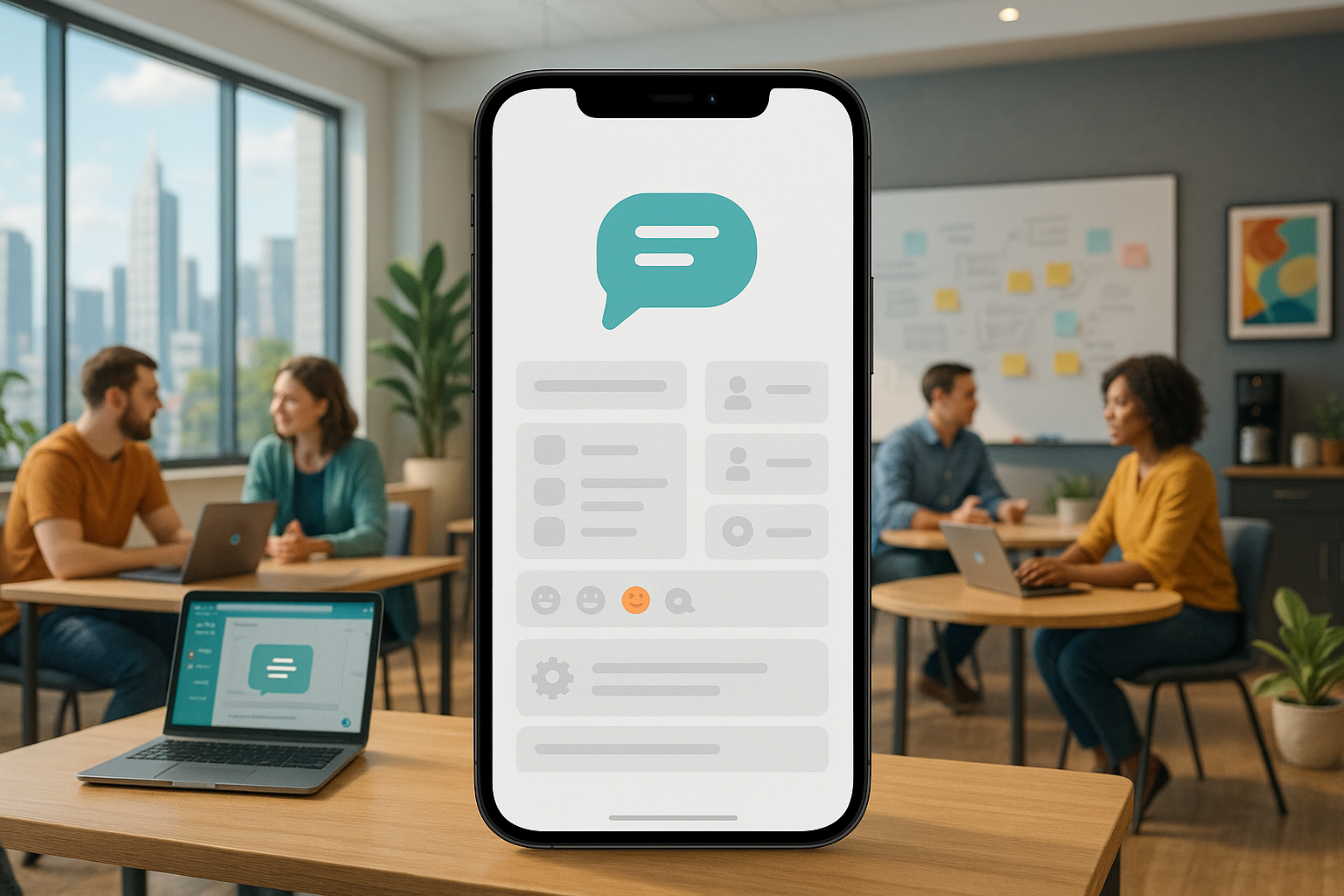
At its core, a Messenger app is a platform for realtime communication. However, meeting the high standards set by today’s leading applications requires a sophisticated architecture that goes far beyond simply sending and receiving text. A modern Messenger app is an ecosystem of features designed to facilitate dynamic, engaging, and reliable interactions.
This includes building out rich chat capabilities that users now consider standard, such as:
- Channels: Public or private group conversations for specific topics or teams.
- Emojis: A full suite of expressive icons to add tone and personality to messages.
- Read Receipts: Visual confirmation that a message has been seen by the recipient.
- User Presence: Realtime status indicators showing whether a user is online, offline, or currently typing.
Handling these features, especially user presence at scale, is a particularly tricky challenge. It involves developing and maintaining numerous moving parts in-house to create a fluid and intuitive user experience. The ultimate goal is to provide a service where messages are delivered instantly and reliably, without duplicates or losses, creating a seamless conversational flow that users can trust.
Reasons that it is Difficult to Develop a Messenger App In-House
Building a custom Messenger app from the ground up is a monumental task. While the allure of complete control is strong, the technical and operational complexities can quickly overwhelm even seasoned development teams. The DIY approach often proves to be a challenging path, particularly for organizations with specific scaling needs or a limited workforce. Let’s explore the primary domains of difficulty.
Reliability and Redundancy
Users expect a chat application to be available 24/7. Achieving this level of reliability requires a stable, fault-tolerant architecture with built-in redundancy at a regional and sometimes even global level. This means designing a system that can withstand failures without interrupting service. For instance, if a server in one data center goes down, traffic must be automatically rerouted to a backup.
The reality is that building and maintaining this kind of reliable distributed infrastructure comes at a high operating cost. It requires developing a long list of advanced capabilities, such as global replication and automatic fail-safes. The statistics paint a stark picture: 65% of DIY solutions for realtime messaging experienced an outage or significant downtime in the last 12-18 months. Without a dedicated team of infrastructure experts, ensuring service continuity becomes a significant and costly burden.
Scalability and Elasticity
A custom chat app that crashes the moment it gains traction is destined to fail. Managing elasticity—the ability of the infrastructure to handle fluctuating user loads—is a critical challenge. An application must be able to scale seamlessly from a handful of users to millions without any degradation in performance.
Architecting for scale requires more effort upfront and more time spent on design before a single line of code is written. Many popular open-source tools, while excellent for prototyping, present significant scaling hurdles. For example, Socket.IO, a widely used WebSocket library, is notoriously difficult to scale, is designed to work in a single region, and lacks native features to ensure message ordering. When you build this infrastructure yourself, you alone are responsible for hosting, scaling, and managing it. Even when stitching together various cloud services, you still need to configure and optimize how they all interact—a complex task that most barebones DIY implementations leave for you to figure out on your own.
Performance: Latency and Bandwidth
In realtime messaging, every millisecond counts. A key performance challenge is minimizing latency (the delay in sending data from end to end) and bandwidth consumption. Equally important is minimizing the variance in these metrics. Too much variance can make the messaging experience unpredictable, leading to frustrating delays and an exasperating user experience. This unpredictability also makes it tricky to build and scale new features, as developers cannot be certain they will perform as expected under varied operating conditions.
Data Integrity
At the heart of any messaging app is the promise that messages will be delivered correctly. Ensuring data integrity is a surprisingly difficult problem. Developers must create systems that prevent missed, unordered, or duplicate messages. Imagine a critical business conversation where messages arrive out of sequence or a sensitive personal chat where a message is delivered twice. These failures erode user trust and render the application unusable. This is another area where common tools can fall short; for example, Socket.IO doesn’t guarantee message ordering, placing the burden of solving this complex problem directly on the in-house team.
Feature Complexity
Beyond the core function of sending messages, users expect a rich set of features. Implementing capabilities like editing or deleting messages requires developers to think carefully about suitable data structures for searchability and how to properly update and store the message payload. As mentioned earlier, handling user presence at scale is another tricky feature to manage. Each new capability adds another moving part to develop and maintain, increasing the overall complexity of the system.
Cross-Platform Development
To reach the widest possible audience, a Messenger app must be accessible across various platforms and operating systems, including iOS, Android, and the web. However, development time and technical challenges multiply with each additional platform. Developing a cross-platform app requires navigating different SDKs, programming languages, and design conventions. Ensuring a consistent and high-quality user experience across all devices is a significant development and testing challenge.
Security and Compliance
Messaging is an inherently private activity, and users expect their conversations to be secure. Ensuring security is a paramount challenge. At a minimum, developers must encrypt data both in transit and at rest, implement robust authentication to prevent unauthorized access, and create a granular permissions system.
Furthermore, many applications will need to meet stringent compliance requirements like GDPR in Europe or SOC2 for enterprise clients. If the app is intended for healthcare, it must adhere to industry-specific frameworks like HIPAA to protect patient privacy. Navigating these legal and technical requirements adds another layer of complexity to the development process.
The Staggering Resource and Financial Investment
Building realtime infrastructure in-house is not only hard, but the timeline can also be unpredictable. It demands a significant investment of time, money, and specialized expertise that not every organization possesses.
Consider the following data points:
- Team Size: 93% of projects required at least 4 in-house engineers to build their realtime messaging infrastructure.
- Time to Build: The average time taken to complete such a project in-house was 10.2 person-months.
- Upfront Costs: Building a basic Minimal Viable Product (MVP) for a single platform can take 3-5 months with a budget of $30,000 to $50,000. A more complex app like WhatsApp can cost up to $250,000 initially.
- Ongoing Costs: Escalating costs were a major challenge for 46% of developers during development. Furthermore, 50% of self-built realtime messaging platforms required $100,000-$200,000 a year in upkeep alone, not including costs for future enhancements.
These figures underscore a critical point: the DIY approach is a massive undertaking with high upfront and ongoing costs, requiring a dedicated team with specialized skills. For most organizations, partnering with an experienced development agency is a more strategic and cost-effective path.
Why Custom App Development for Messenger?
With the immense challenges of in-house development, it’s fair to ask why one should pursue a custom Messenger app at all. A custom-built application offers unparalleled advantages in branding, feature differentiation, and user experience ownership that off-the-shelf solutions simply cannot match. You control every pixel, every interaction, and every piece of data, allowing you to create a unique product that perfectly aligns with your business goals.
However, “custom development” does not have to mean “in-house development.” The optimal strategy is to partner with an expert development agency like metacto. This approach provides the best of both worlds: you get a fully customized, proprietary application without shouldering the immense burden and risk of building the complex underlying infrastructure yourself.
Hiring experienced app developers with relevant experience can make the task much easier and cheaper. An agency with a proven track record in building complex, scalable applications has already solved the hard problems of reliability, security, and performance. We leverage established architectures, best practices, and a team of specialists to navigate the challenges that derail in-house projects. With our 100+ apps launched, we have the experience to build scalable solutions from day one, ensuring your app not only launches successfully but is also positioned for long-term growth.
Different Types of Messenger Apps
The term “Messenger app” can encompass a range of technologies. While modern chat apps often rely on sophisticated realtime protocols, the category also includes applications built on more traditional carrier services. Understanding the distinction is key to defining your product’s scope.
- SMS/MMS Apps: These applications use the mobile carrier’s Short Message Service (SMS) and Multimedia Messaging Service (MMS) networks. They are essentially alternative interfaces for a phone’s native texting functionality. Examples include apps like “Messages - SMS Texting App” and “Messenger SMS - Text messages,” which offer customized user interfaces and features but rely on the underlying SMS/MMS protocols.
- RCS Apps: Rich Communication Services (RCS) is the next generation of carrier messaging. It upgrades traditional SMS with features like read receipts, typing indicators, high-resolution photo sharing, and group chats over a data network. Google Messages is the official Google app for messaging over RCS, with a fallback to SMS/MMS when an RCS connection isn’t available.
- Proprietary Protocol Apps: This is the category that includes giants like WhatsApp, Slack, and Telegram. These apps are built on their own realtime infrastructure and protocols, giving them complete control over the feature set, security, and user experience, independent of mobile carriers. Custom Messenger app development almost always falls into this category, as it involves building a unique, self-contained messaging ecosystem.
Cost Estimate for Developing a Messenger App
The cost to build a messaging app can range from as little as $20,000 for a bare-bones offering to as much as $500,000 for a sophisticated, flexible application. For a single-platform app with a solid set of features, the development cost typically ranges between $30,000 to $70,000. However, the final price tag depends on several key factors.
Cost-Influencing Factors
- Design Complexity: The more custom elements, unique screens, and intricate branding you add, the more you will pay for design. A simple, clean interface is less expensive than a highly stylized one with complex animations.
- Technical Complexity & Functionality: This is a major cost driver. The more features you include, and the more complex the back-end needs to be to support them, the higher the price.
- Supported Platforms: The number of platforms you target directly impacts the cost. An app for both iOS and Android will see its development cost nearly double compared to a single-platform release.
- Development Team Location: Hiring an app development company from the USA may increase the price by up to five times compared to a vendor from a location like Europe, where developers may charge a few times less.
Estimated Costs for Features and Platforms
To provide a more concrete idea of budgeting, the following tables break down estimated development hours and costs based on an average hourly rate of $50. Note that these are estimates, and the final cost will vary.
Core and Advanced Feature Costs
| Feature | Estimated Development Time (Hours) | Estimated Cost |
|---|---|---|
| Registration | 35 – 40 | $1,750 – $2,000 |
| Contacts Integration | 40 | $2,000 |
| User Profile | 20 | $1,000 |
| Messaging (Core) | 150 – 400+ | $7,500 – $12,500+ |
| Voice & Video Calls | 150 – 450 | $7,500 – $22,500 |
| Media File Sharing | 100 – 120 | $5,000 – $6,000 |
| Push Notifications | 50 – 70 | $2,500 – $3,500 |
| Group Voice/Video Calls | 250+ | $12,500+ |
| Scheduled Messages & Reminders | 60+ | $3,000+ |
| Location Sharing | 100+ | $5,000+ |
| Self-Destructing Messages | 60+ | $3,000+ |
| Built-in Browser | 40+ | $2,000+ |
| “People Nearby” Functionality | 170+ | $8,500+ |
Platform Development Costs
| Component | Approximate Development Time (Hours) | Approximate Cost |
|---|---|---|
| UX/UI Design (Single Platform) | 50 – 100+ | $2,500 – $5,000+ |
| Back-end Development | 500 – 800 | $25,000 – $40,000 |
| iOS App Development | 600 – 1,000 | $30,000 – $50,000 |
| Android App Development | 800 – 1,300 | $40,000 – $65,000 |
Additional Expenses
Beyond direct development, you must also budget for ongoing expenses such as server infrastructure, app support and maintenance, and marketing to acquire users. These costs are critical for the long-term success of your application.
Top Messenger App Development Companies
Choosing the right development partner is the single most important decision you will make. You need a team with the technical expertise, strategic vision, and proven experience to navigate the complexities of building a Messenger app.
1. metacto
At metacto, we specialize in building, growing, and monetizing custom mobile applications. With over 20 years of app development experience and more than 100 successful projects delivered, we have established ourselves as a leader in the industry, trusted by brands like Liverpool FC, Carlyle Group, and the American Bible Society. Our 5.0-star rating on Clutch reflects our commitment to excellence and client success.
We understand that building a Messenger app is about more than just code; it’s about building a reliable, scalable, and secure platform that users love. Our end-to-end mobile app development services cover everything from initial product strategy to launch and growth. Our expertise in AI development allows us to integrate intelligent features like chatbots and moderation tools, setting your app apart from the competition.
Our 90-day MVP service is designed to get your product to market quickly without sacrificing quality. We work with you to design, build, and launch a functional application that checks every box. For organizations seeking strategic technology leadership without the cost of a full-time executive, our Fractional CTO service provides the expert guidance needed to make smart, scalable decisions from day one. We don’t just build apps; we build businesses.
Conclusion
The journey to creating a custom Messenger application is undoubtedly complex, filled with technical hurdles in reliability, scalability, security, and performance. As we’ve detailed, the resource and financial investment required for in-house development is substantial, and the risks of downtime and failure are high. From understanding the different types of messaging technologies to accurately estimating the significant costs involved, the process demands deep expertise and careful planning.
However, these challenges should not deter you from building a unique and powerful communication tool. By partnering with a specialized development firm, you can achieve the benefits of a custom solution while mitigating the risks of going it alone. An experienced team can navigate the technical minefield, ensuring your app is built on a solid, scalable foundation that can support your growth.
At metacto, we have spent over two decades mastering the art and science of app development. We build smart, scale fast, and focus on results. If you are ready to build your app the right way, from day one, we are here to help.
Talk with a Messenger app development expert at metacto today to transform your vision into a thriving application.