Introduction
The digital marketplace has fundamentally reshaped commerce, creating platforms like Airbnb, Etsy, and Uber that connect millions of users and generate billions in revenue. The allure of creating the next disruptive marketplace is powerful, yet the path from concept to a thriving, scalable platform is fraught with complexity. Developing a marketplace app is not merely about building a piece of software; it’s about architecting a dynamic ecosystem that successfully attracts, engages, and retains two distinct user groups—buyers and sellers, or service providers and consumers. This “two-sided” challenge introduces unique technical, strategic, and logistical hurdles that can quickly overwhelm even experienced in-house development teams.
The core problem lies in the intricate balance required. You must build a feature-rich platform that is intuitive for both sides, establish a foundation of trust and security, solve the “chicken-and-egg” problem of user acquisition, and ensure the underlying technology can scale seamlessly with growth. Attempting this without specialized expertise often leads to budget overruns, missed deadlines, and a final product that fails to gain traction.
This article serves as a comprehensive guide to navigating the world of custom marketplace app development. We will explore what defines a marketplace app, dissect the reasons why in-house development is so challenging, and make the case for a custom approach. We will also provide a realistic look at development costs and present a curated list of top marketplace app development companies you can partner with.
At metacto, a leading US-based AI-powered app development firm, we have over 20 years of experience turning ambitious marketplace ideas into successful, revenue-generating businesses. We don’t just build apps; we build, grow, and monetize them. Throughout this guide, we will share insights from our experience launching over 100 apps, including successful two-sided marketplaces like Parrot Club, to help you make informed decisions.
What is a Marketplace App?
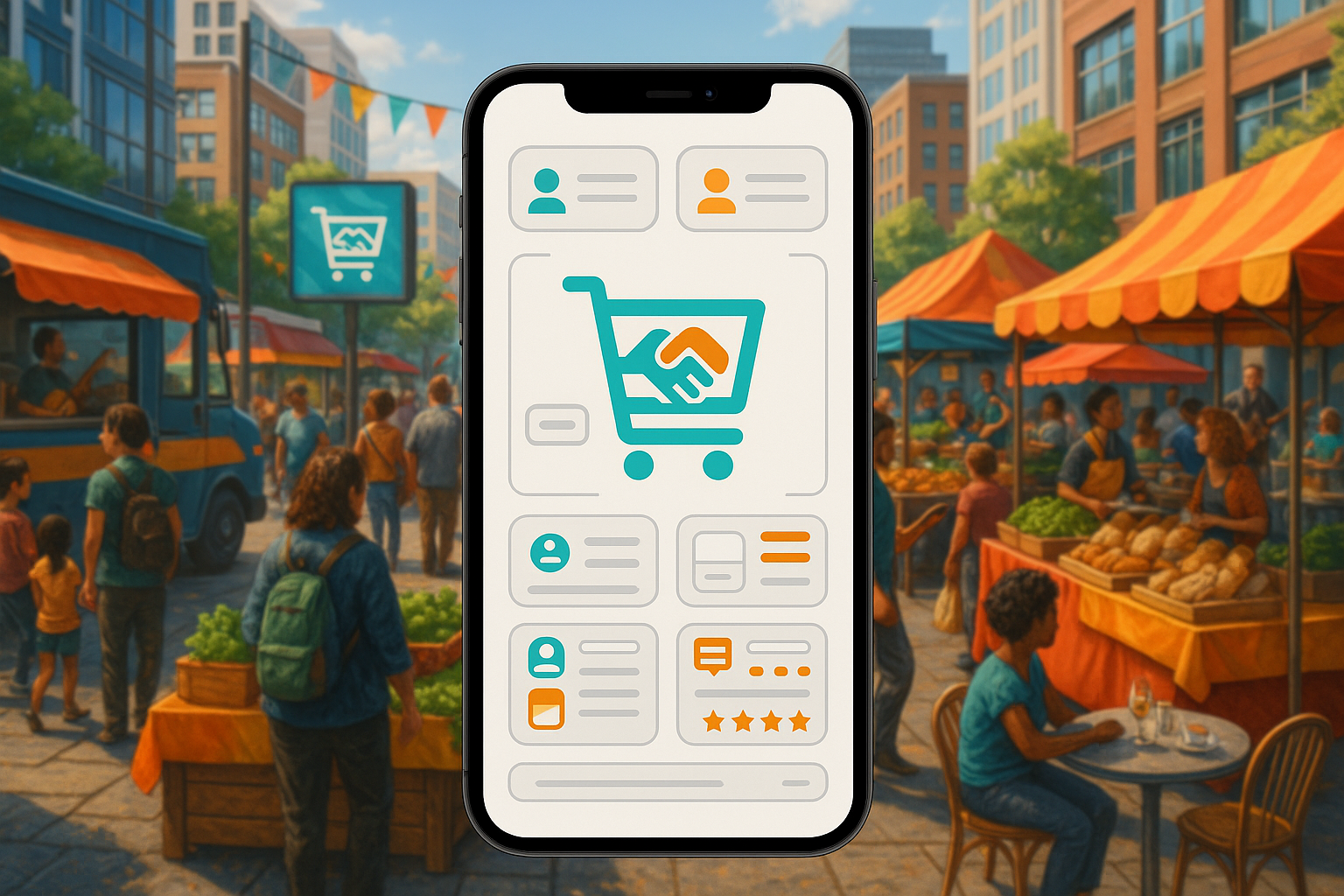
At its core, a marketplace app is a digital platform that facilitates transactions between two or more distinct groups of users, typically buyers and sellers or service providers and consumers. Unlike a standard e-commerce app where a single business sells its products directly to customers, a marketplace acts as an intermediary, providing the infrastructure for others to connect and conduct business.
The platform owner is responsible for creating a trusted environment, managing transactions, and often takes a commission or fee for each successful exchange. The primary function of the app is to reduce friction and make it easier for supply and demand to meet.
Key characteristics of a marketplace app include:
- Multi-sided Platforms: They cater to at least two different user groups (e.g., drivers and riders on Uber, hosts and guests on Airbnb).
- User-Generated Listings: The inventory of products or services is provided by the users (the “seller” side), not the platform owner.
- Facilitated Transactions: The platform provides tools for communication, scheduling, payment processing, and dispute resolution.
- Trust and Reputation Systems: Features like user profiles, ratings, and reviews are crucial for building trust between strangers.
- Network Effects: The value of the marketplace increases for all users as more people join. More sellers attract more buyers, and more buyers attract more sellers, creating a virtuous cycle.
These platforms can exist in various forms, from global giants like Amazon to niche communities connecting local artisans with buyers. Their success hinges on creating a seamless, secure, and valuable experience for every participant in the ecosystem.
Reasons It Is Difficult to Develop a Marketplace App In-House
While the concept of a marketplace seems straightforward, the technical execution is one of the most complex challenges in app development. Many businesses underestimate the resources and specialized expertise required, leading to costly failures when they attempt to build in-house.
The “Chicken-and-Egg” Problem
This is the classic marketplace dilemma: how do you attract buyers when you have no sellers, and how do you attract sellers when you have no buyers? This is primarily a business strategy problem, but it has significant technical implications. Your app must be engineered with features that incentivize early adopters on both sides, such as promotional tools, reduced commission rates for the first sellers, or exclusive access for the first buyers. An in-house team focused purely on coding may not have the product strategy experience to build these growth loops into the initial product.
Complex, Dual-Sided Feature Set
A marketplace is essentially two applications in one, each with a unique user experience (UX) and feature set.
- For Sellers/Providers: They need an intuitive dashboard to create and manage listings, track earnings, communicate with customers, manage availability or inventory, and view performance analytics.
- For Buyers/Consumers: They require powerful search and filtering capabilities, detailed listing pages, a seamless booking or checkout process, secure payment options, order tracking, and a way to communicate with sellers.
Building, testing, and maintaining these parallel user journeys requires a significant development effort and a deep understanding of the distinct needs of each user persona.
Establishing Trust and Security
Trust is the currency of any marketplace. You are asking users to transact with complete strangers, and the platform must provide a robust safety net. This involves:
- Secure Payment Gateways: Integrating payment systems like Stripe Connect or Braintree Marketplace to handle complex fund flows, including holding payments in escrow, splitting payments, and managing commissions, is a highly specialized task. It requires adherence to strict security standards like PCI DSS.
- Identity Verification: Implementing processes to verify the identity of users, especially on the provider side, is critical for safety.
- Robust Review and Rating Systems: Building a fair and transparent review system that prevents manipulation is crucial for user confidence.
- Dispute Resolution: A clear and effective mechanism for handling disputes between users is essential.
Scalability and Performance Architecture
A successful marketplace can experience explosive growth. The backend infrastructure must be designed from day one to handle a massive number of concurrent users, millions of listings, real-time messaging, and complex database queries without slowing down. This requires advanced knowledge of cloud architecture, database optimization, load balancing, and microservices—skills that are often hard to find in a generalist in-house team.
Why Custom App Development for a Marketplace?
Given the complexities, the choice between an off-the-shelf solution and custom development becomes critical. While template-based marketplace builders might seem like a faster, cheaper option, they often create more problems than they solve for any serious business venture. A custom development approach is almost always the superior choice for building a sustainable and competitive marketplace.
A Unique and Differentiated User Experience
In a crowded market, your user experience is your competitive advantage. Custom development allows you to design a UI/UX that is perfectly tailored to your specific niche and target audience. You are not constrained by a rigid template. Instead, you can create a unique user journey that solves your users’ problems in a novel way, fostering loyalty and setting your brand apart.
Built to Scale
Off-the-shelf solutions often have limitations on traffic, users, or listings. As your marketplace grows, you will inevitably hit a ceiling, forcing a costly and disruptive migration to a new platform. A custom-built application is architected for your specific growth projections. The technology stack, database design, and server infrastructure are all chosen and configured to scale seamlessly as your user base expands.
Tailored Features and Functionality
Your marketplace idea likely has a unique value proposition that depends on specific features. Whether it’s a proprietary matching algorithm, a specialized booking system, or a complex commission structure, these are functionalities that template solutions cannot accommodate. Custom development gives you the freedom to build the exact features you need to bring your vision to life without compromise.
Seamless Third-Party Integrations
Marketplaces rarely exist in a vacuum. They need to integrate with a variety of external services, such as shipping carriers, background check providers, insurance companies, or specific analytics platforms. Custom development ensures these APIs can be integrated smoothly and reliably, creating a cohesive and efficient operation.
Full Ownership of Your Intellectual Property
When you build a custom app, you own the source code. This is a valuable business asset that gives you complete control over your platform’s future. You are not at the mercy of a third-party provider’s pricing changes, feature updates, or business decisions. You have the freedom to pivot, expand, and evolve your platform as you see fit.
Different Types of Marketplace Apps
Marketplaces can be categorized in several ways, and understanding these distinctions can help clarify your business model and technical requirements.
- Vertical Marketplace: This type of marketplace focuses on a specific niche or industry. By catering to a specialized audience, they can offer a more curated experience and deeper feature set than a generalist platform. Examples include StockX for sneakers and collectibles or Rover for pet-sitting services.
- Horizontal Marketplace: These platforms offer goods or services across a wide range of categories. They appeal to a broad audience and compete on volume and variety. Examples include Amazon and eBay.
- B2B (Business-to-Business) Marketplace: These platforms connect businesses with other businesses to sell goods or services. The transactions are often larger and the sales cycles longer. Alibaba is a prime example.
- B2C (Business-to-Consumer) Marketplace: This is the most common model, where businesses sell directly to individual consumers. Etsy and Zocdoc fall into this category.
- P2P/C2C (Peer-to-Peer/Consumer-to-Consumer) Marketplace: These platforms empower individuals to transact with one another. They have given rise to the sharing economy. Examples include Airbnb, Uber, and TaskRabbit.
Cost Estimate for Developing a Marketplace App
Estimating the cost of a custom marketplace app is not an exact science, as it depends heavily on the project’s scope and complexity. However, we can provide general ranges based on common factors. According to industry data, coding alone typically accounts for 50-70 percent of the total development cost. The final price tag is influenced by several key variables:
- Features and Complexity: The number and complexity of features are the biggest cost drivers. A simple marketplace with basic profiles, listings, and messaging will cost significantly less than a platform with AI-powered recommendations, real-time tracking, multi-currency support, and integrated video chat. Each layer of new technology adds to the project cost.
- Platform Support: Building for a single platform (iOS or Android) is the baseline. Supporting both, plus a web application, will increase the cost.
- UI/UX Design: A highly polished, custom-branded design with extensive user research and prototyping will be more expensive than a more basic, functional design.
- Development Team: The cost is also a function of the development team’s location, size, and experience. An experienced agency in the US will have a higher hourly rate than a freelance developer overseas, but often delivers a higher quality product more efficiently.
Here is a general breakdown of potential cost ranges:
| Tier | Description | Estimated Cost Range |
|---|---|---|
| Simple MVP | A Minimum Viable Product with core features for one platform. Includes basic user profiles, listings, search, messaging, and a simple payment integration. | $50,000 – $150,000 |
| Standard Marketplace | A more polished app for iOS, Android, and Web. Includes advanced search filters, a robust rating system, multiple payment options, and an admin dashboard. | $150,000 – $300,000 |
| Complex/Enterprise | A feature-rich platform with advanced technology. May include AI-driven personalization, sophisticated algorithms, third-party API integrations, and enterprise-grade security. | $300,000+ |
Top Marketplace App Development Companies
Choosing the right development partner is the single most important decision you will make. A great partner acts as a strategic advisor, not just a team of coders. They bring technical expertise, product strategy, and a proven process to the table. Below is a list of top-tier companies specializing in mobile app development.
1. metacto
At metacto, we specialize in transforming ambitious ideas into market-leading mobile applications. With over 20 years of experience and 100+ successful apps launched, we are more than just developers; we are strategic partners dedicated to your success. Our 5.0-star rating on Clutch is a testament to our commitment to delivering results.
We understand that a marketplace is a business, not just an app. That’s why our services cover the entire lifecycle, from initial concept to long-term growth. Our Product Design & Discovery process ensures your idea is validated and refined before a single line of code is written. Our core Mobile App Development service leverages cutting-edge technology to build scalable, high-performance apps for iOS and Android.
Our work on the Parrot Club, a real-time peer-to-peer language learning app, showcases our marketplace expertise. We successfully launched a two-sided marketplace that acquired 1,000 paid users in its first month.
What truly sets us apart is our deep expertise in AI Development and App Monetization. We build intelligent features like AI-powered recommendation engines and dynamic pricing models to enhance user engagement. Furthermore, we help you implement proven monetization strategies to ensure your app joins the profitable 5% of apps that generate significant revenue. Our 90-day MVP service is the fastest way to get your marketplace idea to market, allowing you to test, learn, and iterate quickly.
| metacto Snapshot | |
|---|---|
| Experience | 20+ Years |
| Apps Launched | 100+ |
| Clutch Rating | 5.0 |
| Services | Mobile App Development, AI Development, App Growth, Monetization |
| Key Differentiator | Full-lifecycle partner focused on building, growing, and monetizing apps. |
2. Goji Labs
Goji Labs is a mobile application development company based in Los Angeles that excels in designing and building apps for iOS and Android. They offer comprehensive project management and have earned a perfect rating from their clients.
| Goji Labs Snapshot | |
|---|---|
| Rating | 5.0 (77 reviews) |
| Hourly Rate | $100 - $149 / hr |
| Min. Budget | $25,000+ |
| Team Size | 10 - 49 |
| Location | Los Angeles, CA |
Highlights:
- 100% of clients praised their professional project management, timely delivery, and adaptability.
- 70% highlighted their effective communication and partnership approach.
- Their services are split between Mobile App Development (40%) and UX/UI Design (40%).
- The average project cost for mobile app development is in the $50,000 – $199,999 range.
- Some clients have noted higher pricing, but feedback indicates the quality of work justifies the cost.
3. Mercury Development
Mercury Development is a versatile application development company with a strong focus on mobile app development and software engineering. They are known for their ability to handle complex projects and maintain excellent communication.
| Mercury Development Snapshot | |
|---|---|
| Rating | 5.0 (26 reviews) |
| Hourly Rate | $50 - $99 / hr |
| Min. Budget | $25,000+ |
| Team Size | 50 - 249 |
| Location | Aventura, FL |
Highlights:
- Received 100% positive feedback, with clients praising their expertise, professionalism, and high-quality code.
- Clients consistently note their collaborative approach and ability to integrate seamlessly with in-house teams.
- 50% of their service focus is on Mobile App Development.
- The average project cost for mobile app development is in the $200,000 – $999,999 range, indicating a focus on larger, more complex projects.
4. Appinventiv
Appinventiv is a large mobile app development company recognized for its technical proficiency in iOS and Android development. They are appreciated for their flexibility and commitment to client projects.
| Appinventiv Snapshot | |
|---|---|
| Rating | 4.7 (88 reviews) |
| Hourly Rate | $25 - $49 / hr |
| Min. Budget | $50,000+ |
| Team Size | 1,000 - 9,999 |
| Location | New York, NY |
Highlights:
- Clients praise their collaborative spirit and willingness to provide feedback beyond the project scope.
- Feedback on cost and value is mixed; while some clients found them cost-effective, others expressed dissatisfaction with the quality relative to the investment.
- 40% of their services are dedicated to Mobile App Development.
- The average project cost for mobile app development is $50,000 – $199,999.
5. TechAhead
TechAhead is a prominent mobile app development company that has received overwhelmingly positive feedback for its professionalism, responsiveness, and user-centric design.
| TechAhead Snapshot | |
|---|---|
| Rating | 4.9 (110 reviews) |
| Hourly Rate | $25 - $49 / hr |
| Min. Budget | $25,000+ |
| Team Size | 50 - 249 |
| Location | Agoura Hills, CA |
Highlights:
- Approximately 90% of reviews emphasize their competency in mobile software development.
- Clients appreciate their proactive communication and ability to exceed expectations in functionality and user experience.
- They have a strong focus on mobile, with 50% of their services being Mobile App Development.
- The average project cost for mobile app development is $50,000 – $199,999.
6. Emizen Tech
Emizen Tech is a New York-based company that excels in delivering cost-effective mobile app solutions with a strong client-centric approach.
| Emizen Tech Snapshot | |
|---|---|
| Rating | 4.9 (132 reviews) |
| Hourly Rate | < $25 / hr |
| Min. Budget | $5,000+ |
| Team Size | 50 - 249 |
| Location | New York, NY |
Highlights:
- 100% of reviews highlight their adaptability and customer responsiveness.
- 90% of reviewers commend their project management and communication skills.
- They have a heavy focus on Mobile App Development, which constitutes 60% of their service offerings.
- Their average project cost for mobile apps is $10,000 – $49,000, making them a very budget-friendly option.
7. JPLoft
JPLoft is a comprehensive mobile app development company that focuses on client satisfaction and flexibility, demonstrating expertise in integrating complex features into intuitive applications.
| JPLoft Snapshot | |
|---|---|
| Rating | 5.0 (82 reviews) |
| Hourly Rate | $50 - $99 / hr |
| Min. Budget | $10,000+ |
| Team Size | 50 - 249 |
| Location | Denver, CO |
Highlights:
- 100% of reviews praised their project management, communication, and delivery timeliness.
- Clients highlight their advanced programming skills and ability to enhance projects with proactive suggestions.
- Mobile App Development is their primary service, accounting for 60% of their work.
- The average project cost for mobile app development is $10,000 – $49,000.
8. AppMakers USA
Located in Los Angeles, AppMakers USA is a mobile app development firm recognized for its innovative design approaches and strategic insights that align with client objectives.
| AppMakers USA Snapshot | |
|---|---|
| Rating | 5.0 (85 reviews) |
| Hourly Rate | $50 - $99 / hr |
| Min. Budget | $10,000+ |
| Team Size | 10 - 49 |
| Location | Los Angeles, CA |
Highlights:
- Maintains a 100% positive feedback rate, with clients commending their exceptional project management.
- Their detailed and responsive communication fosters a highly collaborative environment.
- Mobile App Development is their largest service area, at 65%.
- The average project cost for mobile apps is $10,000 – $49,000.
9. Dedicated Developers
Dedicated Developers is an Atlanta-based company known for its reliability, efficiency, and dedication to understanding a client’s vision.
| Dedicated Developers Snapshot | |
|---|---|
| Rating | 5.0 (46 reviews) |
| Hourly Rate | $50 - $99 / hr |
| Min. Budget | $25,000+ |
| Team Size | 10 - 49 |
| Location | Atlanta, GA |
Highlights:
- 100% of clients highlight the team’s project management and seamless communication.
- Clients consistently praise them for delivering exceptional value for money and high-quality work within budget constraints.
- 65% of their services are in Mobile App Development.
- Their average project cost for mobile app development is $200,000 – $999,999, suggesting a focus on larger-scale projects.
10. Cheesecake Labs
Cheesecake Labs is a proficient mobile app development company based in San Francisco with expertise in iOS and Android development, known for strong project management and technical competence.
| Cheesecake Labs Snapshot | |
|---|---|
| Rating | 4.9 (60 reviews) |
| Hourly Rate | $50 - $99 / hr |
| Min. Budget | $50,000+ |
| Team Size | 50 - 249 |
| Location | San Francisco, CA |
Highlights:
- Client feedback is overwhelmingly positive, with 90% of reviews commending their ability to deliver projects on time and within budget.
- Clients express high satisfaction with their honest communication and commitment to projects.
- Mobile App Development makes up 50% of their service focus.
- The average project cost for mobile app development is $50,000 – $199,999.
Conclusion
Building a custom marketplace app is a formidable but achievable goal. The journey requires navigating the inherent complexities of a two-sided platform, from solving the initial user acquisition puzzle to building a scalable and secure technical foundation. As we’ve discussed, the intricacies of the feature set, the paramount importance of trust, and the need for a high-performance architecture make in-house development a risky proposition for most. A custom development approach, guided by an experienced partner, provides the flexibility, scalability, and unique user experience necessary to compete and succeed.
Throughout this guide, we have outlined the critical components of a marketplace app, explored why a custom build is superior, provided realistic cost expectations, and introduced some of the top development firms in the industry. The right partner does more than write code; they provide strategic guidance, technical leadership, and a clear path to market.
At metacto, we have spent over two decades helping founders and businesses build, launch, and grow successful applications. Our expertise in mobile development, AI integration, and app monetization is uniquely suited to the challenges of the marketplace model. We are ready to be your strategic partner from day one.
Ready to build your marketplace? Talk with an expert at metacto today to discuss your vision and get a clear roadmap for success.