Introduction
In today’s highly competitive industrial landscape, manufacturing companies face relentless pressure to increase efficiency, reduce operational costs, and improve supply chain visibility. The digital transformation of the factory floor is no longer a futuristic concept but a present-day necessity. At the heart of this transformation lies the custom manufacturing application—a powerful tool that can digitize workflows, provide real-time data insights, and connect disparate systems into a cohesive, intelligent whole.
However, developing such an application is fraught with challenges. The unique complexities of manufacturing environments—from integrating with legacy enterprise resource planning (ERP) systems to designing user interfaces for rugged, on-the-floor use—make it a formidable task for in-house IT teams. The path is often steep, requiring a rare blend of deep industry knowledge and cutting-edge technical expertise.
This guide is designed to navigate that path. We will explore the fundamentals of custom manufacturing app development, outlining the reasons it is often too difficult to handle in-house and detailing the immense strategic value of a bespoke solution. We will cover the different types of applications you can build, provide realistic cost estimates, and introduce top development companies that can bring your vision to life.
As a leading US AI-powered app development firm with over two decades of experience and more than 100 successful app launches, we at metacto have helped countless businesses harness the power of custom software. We understand the intricate dance of bits and atoms required to build solutions that thrive in the demanding world of manufacturing. This article will not only provide you with critical information but also show you how partnering with a seasoned expert like us can de-risk your investment and accelerate your journey toward a smarter, more connected manufacturing operation.
What is a Manufacturing App?
At its core, a manufacturing app is a specialized software application designed to support, manage, and optimize the processes within a manufacturing facility or across its supply chain. Unlike generic business software, these apps are purpose-built to address the specific operational realities of the industry, from the receiving dock to the final quality inspection. They serve as the digital nervous system for the modern factory, translating complex physical operations into actionable data that can be accessed anytime, anywhere.
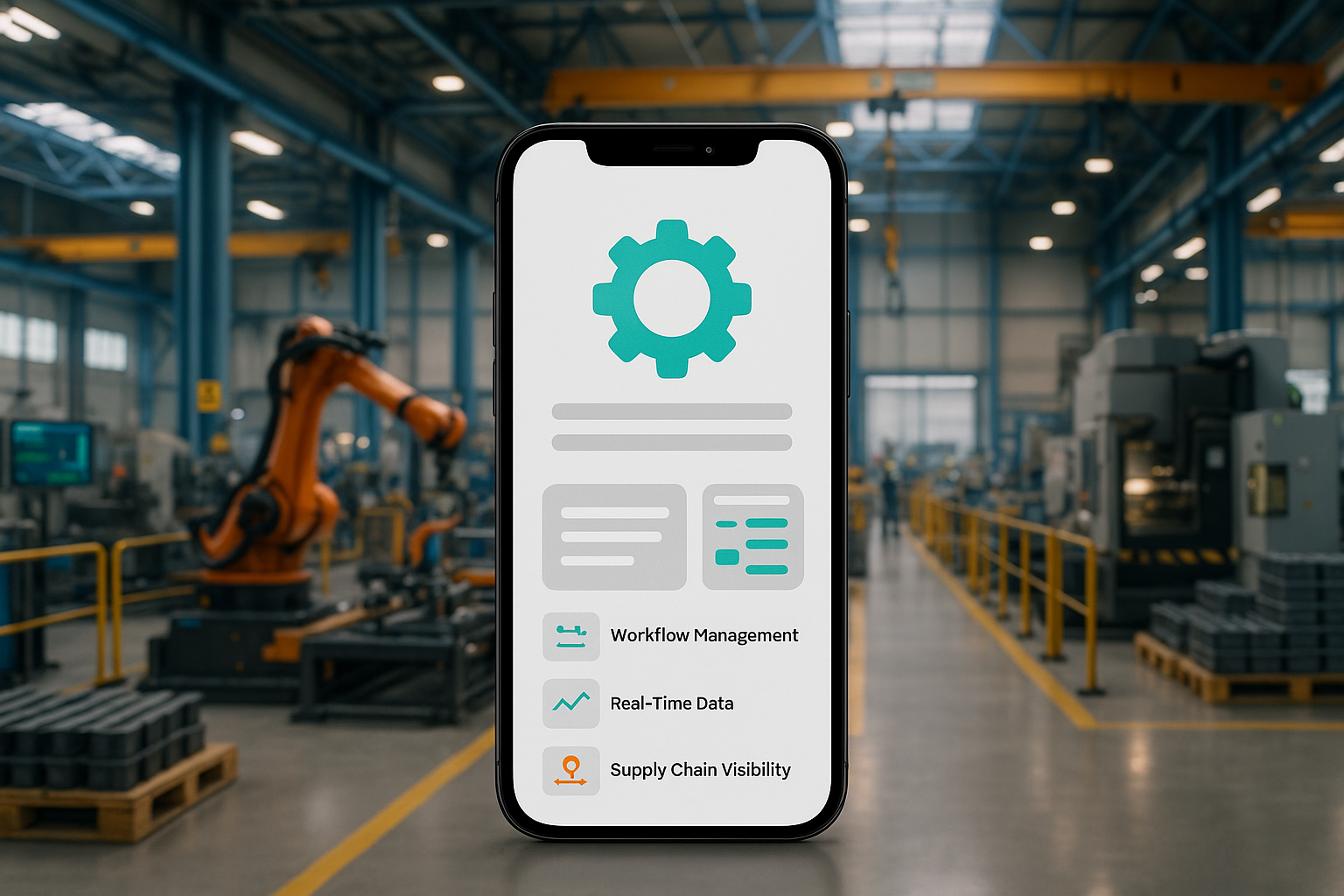
A manufacturing app is far more than a simple digital form or checklist. It is an integrated platform that often connects workers, machinery, and backend systems in real time. Its primary goal is to enhance visibility, drive efficiency, and improve decision-making at every level of the organization. For a machine operator on the factory floor, it might be a tablet-based interface for monitoring equipment performance and receiving maintenance alerts. For a plant manager, it might be a dashboard providing a high-level overview of production output, downtime, and quality metrics. For a supply chain coordinator, it could be a tool for tracking raw material shipments and forecasting inventory needs.
Key functionalities often found in these applications include:
- Real-time Production Monitoring: Dashboards that display key performance indicators (KPIs) such as Overall Equipment Effectiveness (OEE), production rates, and scrap levels.
- Inventory and Warehouse Management: Tools for tracking raw materials, work-in-progress (WIP), and finished goods using technologies like barcode scanning, QR codes, or RFID.
- Quality Assurance and Control: Digital checklists for inspections, non-conformance reporting with photo and video attachments, and real-time tracking of quality metrics.
- Equipment Maintenance and Management: Systems for scheduling preventative maintenance, managing work orders for repairs, and logging equipment history. Advanced apps may integrate with IoT sensors for predictive maintenance alerts.
- Supply Chain Visibility: Features that track shipments, manage supplier communications, and provide end-to-end visibility into the movement of goods.
- Employee Training and Safety: Modules for delivering standard operating procedures (SOPs), safety protocols, and interactive training materials directly to employees’ mobile devices.
At metacto, we believe that a truly effective manufacturing app must be built with a deep understanding of the user’s context. It should not be an administrative burden but a powerful enabler that simplifies complex tasks, automates repetitive work, and empowers employees with the information they need to perform their jobs more effectively and safely.
Reasons That It Is Difficult to Develop a Manufacturing App In-House
While the temptation to leverage an internal IT team for app development is understandable, the unique demands of the manufacturing sector often make this approach inefficient and risky. The chasm between standard enterprise IT and the specialized requirements of industrial software is significant. Here are several key reasons why in-house development of a manufacturing app is exceptionally challenging.
The Complexity of System Integration
Manufacturing facilities are a tapestry of interconnected, and often aging, software systems. A new mobile application cannot exist in a silo; it must communicate seamlessly with existing Enterprise Resource Planning (ERP), Manufacturing Execution Systems (MES), Supply Chain Management (SCM) platforms, and potentially dozens of other proprietary databases and legacy systems. This requires a team with deep expertise in API development, data migration, and navigating the complexities of older, poorly documented systems. An in-house team, typically focused on maintaining existing infrastructure, may lack the specialized skills to build the robust, real-time data pipelines necessary for a modern manufacturing app.
Diverse and Demanding User Environments
The end-users of a manufacturing app are incredibly diverse. An executive needs a high-level dashboard on their smartphone, while a forklift operator needs a rugged tablet with a simple, glove-friendly interface. A quality control inspector requires high-resolution camera integration, and a maintenance technician needs offline access to technical manuals in a part of the plant with no Wi-Fi. Designing a cohesive UI/UX that is intuitive, efficient, and reliable for all these user groups and their challenging physical environments is a monumental task that requires specialized design expertise far beyond standard web or mobile app development.
Stringent Security and Reliability Requirements
In manufacturing, the stakes are incredibly high. A software bug or a security breach can lead to production downtime, compromised product quality, or the leak of valuable intellectual property. The application must be built with uncompromising security from the ground up, protecting sensitive data both in transit and at rest. Furthermore, the app must be exceptionally reliable. It needs to function flawlessly in environments with intermittent network connectivity and handle large volumes of data from sensors and machines without crashing. Building this level of mission-critical reliability requires rigorous testing protocols and architectural patterns that are often outside the purview of a generalist IT department.
The Specialized Talent Gap
Building a high-quality manufacturing app requires a team with a rare combination of skills: mobile developers fluent in iOS and Android, backend engineers who understand scalable cloud architecture, UI/UX designers with experience in industrial settings, and project managers who can speak the language of both software development and manufacturing operations. Assembling and retaining such a team in-house is not only expensive but often impossible due to the competitive market for tech talent. Partnering with a specialized agency like metacto gives you immediate access to a complete, experienced team that has solved these problems before.
Diverting Focus from Core Business Operations
App development is not a one-off project; it is an ongoing commitment that includes initial development, deployment, maintenance, updates, and user support. Tasking an internal IT team with this responsibility diverts their attention and resources from their primary role: supporting the core technology infrastructure that keeps the business running. This can lead to delays in both the app development project and critical IT functions, creating a bottleneck that affects the entire organization. An external development partner, in contrast, provides dedicated resources whose sole focus is to deliver and maintain your application, allowing your team to concentrate on what they do best.
Why Custom App Development for Manufacturing
In a market filled with off-the-shelf software solutions, the decision to invest in custom app development is a strategic one. While pre-packaged software may seem like a faster, cheaper option, it often forces businesses to conform their unique, optimized processes to the software’s rigid, one-size-fits-all framework. For a sector as complex and varied as manufacturing, this is rarely the path to a competitive advantage. Custom development, on the other hand, offers unparalleled benefits that directly translate to operational excellence and long-term growth.
A Solution Molded to Your Exact Workflows
No two manufacturing operations are identical. Your production lines, quality control checkpoints, and supply chain logistics have been honed over years to maximize efficiency and quality. A custom application is designed and built around these specific workflows, not the other way around. This means the software adapts to your business, eliminating the need for awkward workarounds and process changes that often accompany off-the-shelf solutions. The result is a tool that feels like a natural extension of your operation, leading to faster user adoption and a greater impact on productivity.
Gaining a Unique Competitive Advantage
A custom application is more than a tool; it is a proprietary asset that can create a significant competitive moat. By building a solution tailored to your unique strengths, you can unlock efficiencies and capabilities that your competitors, using generic software, simply cannot replicate. Whether it’s an AI-powered predictive maintenance algorithm that drastically reduces downtime or a hyper-efficient inventory management system that minimizes carrying costs, a custom app can become a core part of your strategic advantage in the marketplace.
Seamless and Deep Integration
As discussed, integration is one of the biggest hurdles in manufacturing software. With custom development, you have complete control over how your new application interacts with your existing technology stack. This allows for deep, bidirectional integrations that create a single source of truth across your entire organization. Data can flow seamlessly from an operator’s tablet on the shop floor directly into your ERP’s financial reporting, providing unprecedented real-time visibility and eliminating the manual data entry and reconciliation that plague many operations.
Scalability and Future-Proofing
Your business is not static, and your software shouldn’t be either. A custom application is built on a flexible architecture that can grow and evolve alongside your company. As you add new product lines, expand to new facilities, or adopt new technologies like IoT and robotics, your custom app can be updated and extended to meet these new demands. You are not at the mercy of a third-party vendor’s product roadmap. You own the code and control the future of the application, ensuring it remains a valuable asset for years to come. At metacto, we design every application with scalability in mind, ensuring your investment today will support your growth tomorrow.
Different Types of Manufacturing Apps
Manufacturing applications can be categorized based on the specific operational area they are designed to improve. Building a comprehensive digital ecosystem often involves developing several of these app types, which can then be integrated to share data and create a unified operational view. Here are some of the most common and impactful types of manufacturing apps.
Supply Chain Management (SCM) & Logistics Apps
These applications focus on the movement of goods and materials into, within, and out of the manufacturing facility. They provide real-time visibility into the entire supply chain, from raw material procurement to final product delivery.
- Key Features: Real-time shipment tracking, inventory management (raw materials, WIP, finished goods), supplier communication portals, warehouse management with barcode/QR code scanning, and demand forecasting.
- Business Impact: Reduces stockouts and overstocking, improves delivery times, and lowers logistics costs by optimizing routes and carrier selection.
Mobile Enterprise Resource Planning (ERP) Apps
Mobile ERP apps extend the power of your core ERP system to the palms of your managers’ and executives’ hands. They provide on-the-go access to critical business data, enabling faster, more informed decision-making.
- Key Features: Access to financial data, sales orders, production schedules, human resources information, and high-level operational dashboards.
- Business Impact: Increases managerial agility, streamlines approval workflows, and ensures key decision-makers have access to the latest data, whether they are on the factory floor or on a different continent.
Manufacturing Execution System (MES) Mobile Apps
MES apps are the digital workhorses of the factory floor. They monitor, track, and control the entire production process, from the release of a work order to the completion of the final product.
- Key Features: Real-time machine monitoring (OEE), work order management, digital work instructions (SOPs), quality data collection, and production tracking.
- Business Impact: Improves production efficiency, reduces scrap and rework, provides detailed product traceability, and ensures processes are executed correctly every time.
Quality Management and Compliance Apps
These apps digitize the entire quality control process, replacing paper checklists and spreadsheets with a streamlined, data-driven system. They ensure that products meet specifications and that the facility adheres to industry regulations.
- Key Features: Digital inspection forms, non-conformance reporting with photo/video evidence, real-time statistical process control (SPC) charts, and audit management for standards like ISO 9001.
- Business Impact: Increases product quality, reduces the cost of poor quality (COPQ), simplifies compliance audits, and provides a detailed, searchable record of all quality activities.
Asset Management & Maintenance Apps
Focused on keeping machinery and equipment running at peak performance, these apps manage all aspects of maintenance, from scheduling routine check-ups to handling emergency repairs.
- Key Features: Preventative maintenance scheduling, work order management for technicians, asset tracking and history logs, and spare parts inventory management. Advanced versions use IoT data for predictive maintenance.
- Business Impact: Minimizes unplanned downtime, extends the lifespan of expensive equipment, improves technician productivity, and reduces maintenance costs.
Cost Estimate for Developing a Manufacturing App
Estimating the cost of a custom manufacturing app requires a careful analysis of its specific requirements, as there is no one-size-fits-all price. The final investment depends on a variety of factors, from the complexity of the features to the number of systems it needs to integrate with. However, we can provide a general framework to help you budget for your project.
The primary factors that influence the cost include:
- Scope and Complexity of Features: A simple app for digital checklists will cost significantly less than a comprehensive MES with real-time analytics and AI-powered predictive maintenance.
- Integration Points: Each legacy system (ERP, MES, SCM, etc.) that the app needs to connect with adds complexity and cost. The quality and documentation of the existing systems’ APIs are also major variables.
- Platforms: Developing for a single platform (e.g., iOS on iPads for the factory floor) is less expensive than building and maintaining separate native apps for both iOS and Android, plus a web-based dashboard for managers.
- UI/UX Design: A highly customized, intuitive, and rigorously user-tested design tailored for specific industrial environments will require a larger investment than a basic, template-based interface.
- Backend Infrastructure: The complexity of the server-side logic, database architecture, and cloud infrastructure needed to support the app’s functionality is a major cost driver.
- Security and Compliance: Meeting specific industry standards (e.g., FDA regulations for medical device manufacturing) requires additional development, testing, and documentation, which adds to the cost.
To provide a clearer picture, we can categorize projects into general tiers:
Tier 1: Simple MVP or Single-Purpose App
- Description: A basic application focused on solving one specific problem, such as digitizing a single inspection process or tracking tool inventory. It would have minimal integrations and a simple UI.
- Estimated Cost: $50,000 - $100,000
- Timeline: 3-4 months
Tier 2: Mid-Complexity Departmental Solution
- Description: A more robust application designed to manage a complete workflow for a single department, such as a quality management system or an inventory tracking app with barcode scanning and integration with a warehouse management system.
- Estimated Cost: $100,000 - $250,000
- Timeline: 5-8 months
Tier 3: Complex Enterprise-Wide Platform
- Description: A comprehensive, mission-critical application that serves multiple departments and user roles. This could be a full mobile MES, a supply chain visibility platform with multiple third-party integrations, or an asset management system with IoT and AI capabilities.
- Estimated Cost: $250,000+
- Timeline: 9+ months
It is crucial to view this cost not as an expense but as an investment. A well-designed custom application can deliver a significant return on investment (ROI) through increased productivity, reduced waste, lower downtime, and improved product quality. At metacto, our rapid MVP development process is designed to get a functional product into your hands quickly, allowing you to validate the concept and start generating value before committing to a larger, more complex build.
Top Manufacturing App Development Companies
Choosing the right development partner is the single most important decision you will make in your custom app journey. You need a team that not only possesses deep technical expertise but also understands the unique challenges and opportunities within the manufacturing sector.
1. metacto
At metacto, we stand at the forefront of custom application development, specializing in creating robust, scalable, and intelligent solutions for complex industries like manufacturing. With over 20 years of experience and a portfolio of more than 100 launched applications, we have a proven track record of transforming our clients’ operational challenges into powerful digital assets.
Our approach is built on a foundation of strategic partnership. We don’t just write code; we work closely with you to understand your business goals, map your existing workflows, and design a solution that delivers measurable ROI. Our expertise in mobile app development is complemented by our advanced capabilities in AI development, allowing us to build next-generation manufacturing apps that can predict equipment failures, optimize production schedules, and provide deep, actionable insights from your operational data. Our clients, from high-growth startups to established enterprises, trust us to handle their most mission-critical projects, a trust reflected in our perfect 5.0-star rating on Clutch. We build apps the right way, from day one.
2. ScienceSoft
ScienceSoft is another notable company in this space. ScienceSoft is especially good for complex builds related to supply chain management. For businesses with highly specialized needs, ScienceSoft may be right for those with the need for an ultra-complex business solution, like using embedded AR for warehouse item picking.
Conclusion
The journey to digital transformation in manufacturing is both a challenge and an immense opportunity. A custom manufacturing application is no longer a luxury but a critical piece of infrastructure for any company looking to compete and thrive in the modern industrial economy. By providing real-time data, streamlining complex workflows, and connecting your people and machines, a well-crafted app can unlock unprecedented levels of efficiency, quality, and agility.
Throughout this guide, we have explored the essential aspects of this journey. We defined what a manufacturing app is and highlighted the significant difficulties of attempting to build one in-house. We made the case for why a custom-developed solution, tailored to your unique processes, offers a far greater strategic advantage than any off-the-shelf product. We also categorized the different types of apps you can build, provided realistic cost expectations, and introduced leading companies that can help you succeed.
The path forward requires a clear vision and an expert partner to help you navigate the technical complexities. A custom app is a significant investment, but the return—in the form of reduced downtime, lower operational costs, and a powerful competitive edge—can reshape the future of your business.
Ready to transform your manufacturing operations? Let’s discuss how a custom app can drive efficiency and growth for your business. Talk with a Manufacturing app development expert at metacto today to start building your solution.