The Modern Spin Cycle: Navigating Custom Laundry App Development
metacto is a leading laundry app development company that develops custom apps in many industries and for many use cases, including on-demand laundry and dry cleaning platforms. We understand the complex logistics of pickup/delivery services and can help you build a scalable platform that delights customers and streamlines your operations.
The on-demand economy has irrevocably altered consumer expectations. We can summon a ride, order a gourmet meal, and stream a movie with a few taps on our smartphones. It was only a matter of time before this wave of convenience crashed into one of the most universal and persistent chores: laundry. The demand for laundry and dry-cleaning apps that offer pickup and delivery services is surging, creating a lucrative opportunity for entrepreneurs and established businesses alike.
However, transforming this seemingly simple idea into a successful, scalable application is a far more complex undertaking than it appears. Developing a laundry app is not merely about creating a digital storefront; it’s about engineering a sophisticated logistical platform that must flawlessly manage user requests, driver routes, order tracking, and payments in real-time. Attempting this in-house without a dedicated team of experts often leads to frustrating technical setbacks, budget overruns, and a final product that fails to meet user expectations.
This guide is designed to be your comprehensive resource for navigating the world of custom laundry app development. We will delve into what defines a modern laundry app, explore the significant challenges of in-house development, and make the case for a custom-built solution. We’ll also examine different business models, provide realistic cost estimates, and introduce you to the leading laundry app development companies that can turn your vision into reality. As a top US-based AI-powered laundry app development company, we at metacto have overseen over 100 app launches, and we understand what it takes to build fast, secure, and high-performing mobile apps that stand out. We will share our expertise to help you build your app the right way, from Day One.
What is a Laundry App?
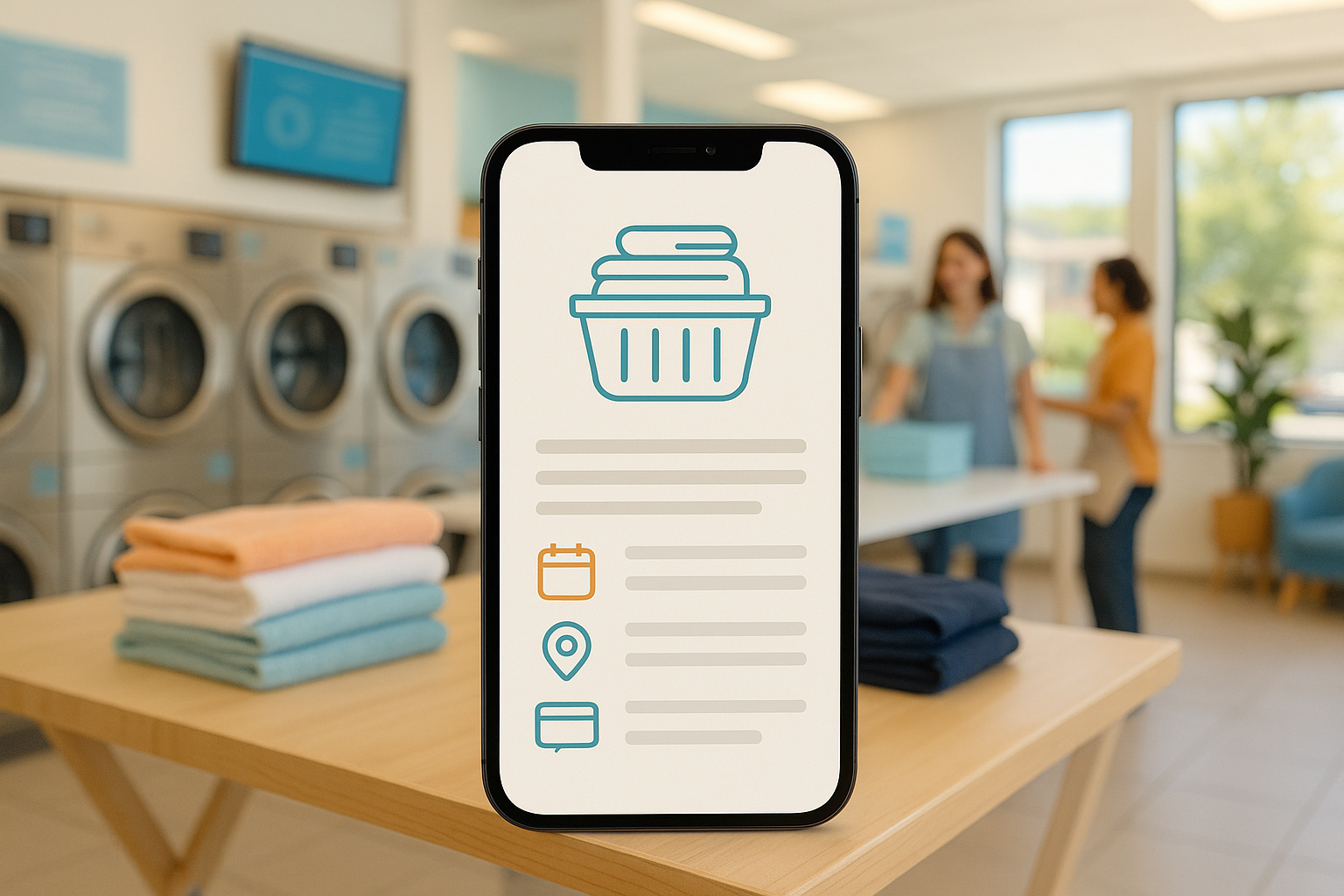
At its core, a laundry app is a mobile application that serves as a digital bridge between customers and laundry services. It digitizes and streamlines the entire process, from scheduling a pickup to receiving freshly cleaned and folded clothes at the doorstep. This model replaces the traditional, time-consuming routine of hauling laundry bags to a laundromat or dry cleaner, waiting for the service to be completed, and then returning for pickup.
A successful laundry app is not a single piece of software but an ecosystem composed of several interconnected components, each designed for a specific user:
-
The Customer App: This is the user-facing interface available on iOS and Android. It must be intuitive, easy to navigate, and provide a seamless experience. Key features typically include:
- User Registration and Profile Management: Simple onboarding, saving addresses, and storing payment information.
- Service Selection: Choosing the type of service (e.g., wash and fold, dry cleaning, ironing), specifying detergents, and adding special instructions.
- Scheduling: An easy-to-use calendar for selecting pickup and delivery time slots.
- Real-Time Order Tracking: A map interface showing the driver’s location and providing status updates (e.g., “Picked Up,” “In-Wash,” “Out for Delivery”).
- Secure In-App Payments: Integration with payment gateways like Stripe or Braintree for hassle-free transactions.
- Push Notifications: Alerts for order status changes, reminders for pickups, and promotional offers.
- Order History and Reviews: Access to past orders and the ability to rate the service and driver.
-
The Driver/Delivery Agent App: This version is for the logistics team. Its primary focus is on efficiency and clear communication. Features include:
- Route Optimization: GPS integration to find the most efficient routes for multiple pickups and deliveries.
- Order Management: A dashboard to view assigned tasks, customer details, and special instructions.
- Status Updates: The ability to update an order’s status in real-time, which is then reflected in the customer app.
- In-App Communication: A secure way to contact the customer or the admin if issues arise.
-
The Admin Panel: This is the central command center for the business owner, typically a web-based dashboard. It provides complete oversight of the entire operation:
- Dashboard Analytics: Key metrics on orders, revenue, active users, and driver performance.
- Customer Management: Viewing customer profiles, order histories, and managing support inquiries.
- Driver Management: Onboarding new drivers, tracking their locations, and managing payouts.
- Service & Pricing Management: Setting prices for different services, managing service areas, and creating promotional codes.
- Order Control: Manually assigning orders and monitoring the status of every transaction in the system.
Building this tripartite system requires a deep understanding of mobile technology, backend architecture, and logistics management. It’s about creating a harmonious flow of information that delivers unparalleled convenience to the end-user while maximizing operational efficiency for the business.
The Pitfalls of In-House Development for a Laundry App
For many startups, the initial impulse is to build their app in-house. The allure of maintaining complete control and potentially saving money can be strong. However, for a project as logistically complex as a laundry app, this path is fraught with challenges that can quickly derail the entire venture. Startups are our bread and butter, and we’ve seen firsthand the unique challenges they face. Here are the primary reasons why in-house development is so difficult.
1. Immense Technical Complexity
A laundry app is a multi-faceted system. You aren’t building one app; you’re building at least three distinct but interconnected products: the customer app, the driver app, and the admin panel. Each requires a different skill set. You need frontend developers proficient in iOS (Swift) and Android (Kotlin), backend developers skilled in languages like Python or Node.js to build robust APIs and manage the database, and web developers for the admin panel. The system must support real-time GPS tracking, complex scheduling algorithms, secure payment gateway integrations, and a notification system that works flawlessly. Coordinating these disparate elements requires a highly experienced technical leader, a role that is difficult and expensive to fill.
2. The High Cost of Assembling an Expert Team
Building a full-stack development team is a significant financial investment. You don’t just need developers. You need:
- A Product Manager to define the roadmap and features.
- UI/UX Designers to create an intuitive and appealing interface.
- iOS and Android Developers to build the native mobile apps.
- Backend Developers to construct the server-side logic and database.
- Quality Assurance (QA) Engineers to meticulously test every feature across different devices.
- A DevOps Engineer to manage deployment and server infrastructure.
Recruiting, hiring, and retaining this level of talent is a full-time job in itself, let alone the cost of salaries, benefits, and equipment. For a startup, this can drain capital that would be better spent on marketing and operations. Our Fractional CTO services exist precisely because accessing experienced technical leadership without the six-figure salary is a common challenge for new ventures.
3. Logistical and Algorithmic Challenges
The core of a laundry app’s success lies in its logistics. How do you efficiently route a driver to pick up five orders in different neighborhoods during rush hour? How do you ensure Mrs. Smith’s delicate silks aren’t mixed up with Mr. Jones’s gym clothes? These are not trivial problems. They require sophisticated algorithms for route optimization, order batching, and inventory tracking. Developing, testing, and refining these algorithms in-house requires a specialized expertise in operations research and data science that most generalist development teams lack.
4. The Scalability Trap
An app that works perfectly with 100 users can crumble under the weight of 10,000. As your business grows, so does the complexity. The database must handle more queries, the server must process more simultaneous requests, and the logistics engine must manage a far greater number of variables. Building a scalable architecture from Day One is critical. An in-house team, often working under pressure to launch quickly, may build a system that is not prepared for growth, leading to costly and time-consuming rewrites down the line. We know what it takes to build fast, secure, and high-performing mobile apps that stand out and are built to scale.
Why Custom App Development is the Right Choice
Given the challenges of in-house development, many entrepreneurs consider off-the-shelf, white-label solutions. While these can seem like a cheap and fast way to get to market, they come with severe limitations. They offer minimal customization, lock you into a specific feature set, and make it nearly impossible to differentiate your brand. To build a truly successful and defensible business, custom development is the superior path.
Create a Unique Brand and User Experience
The on-demand market is crowded. Your app’s user experience is your most powerful differentiator. Custom development allows you to design every screen, every interaction, and every workflow to perfectly match your brand’s identity and your target audience’s needs. You can create a seamless, delightful experience that turns first-time customers into lifelong fans—a goal we helped our client Mamazen achieve.
Build Features That Give You a Competitive Edge
A white-label solution will give you the same generic features as your competitors. A custom build allows you to innovate. Want to integrate AI-powered stain detection using a phone’s camera? Or offer a premium subscription tier with eco-friendly detergents and personalized folding preferences? Custom development makes it possible. We have experience implementing cutting-edge computer vision AI technology and can help bring such innovative ideas to life.
Own Your Technology and Your Future
When you use a white-label service, you are essentially renting their technology. You don’t own the source code, and you are at the mercy of their roadmap and pricing changes. With custom development, you own your intellectual property completely. This gives you the freedom to pivot, add features, and scale your technology as your business evolves. It also makes your company significantly more valuable to potential investors.
Scale Without Limits
Custom applications are designed and architected with your specific growth projections in mind. A dedicated development partner, like metacto, will build a robust and flexible backend that can handle increasing user loads and transactional volume. We help our clients build smart and scale fast, ensuring the technology that got you to your first 1,000 users can also take you to 1,000,000.
Why Choose metacto as Your Laundry App Development Company?
As a leading laundry app development company with over 100 successful app launches and deep expertise in on-demand platforms, metacto builds fast, secure, and high-performing laundry apps. We can integrate AI-powered route optimization, real-time tracking, and subscription models that turn first-time customers into lifelong fans.
Different Types of Laundry App Business Models
Before beginning development, it’s crucial to define your business model, as it will fundamentally shape the app’s architecture and feature set. There are three primary models in the laundry app space.
1. Marketplace (Aggregator) Model
This model positions your app as a central hub that connects multiple independent laundry service providers with customers. You don’t own the laundry facilities or employ the drivers; you are the intermediary.
- How it Works: Customers browse a list of local laundromats or dry cleaners, compare prices and reviews, and place an order through your app. The order is routed to the chosen vendor, who handles the service. You typically handle the pickup and delivery logistics or partner with a third-party service.
- Revenue: You take a commission on each transaction processed through the platform.
- Pros: Highly scalable, asset-light (no need to invest in physical infrastructure), and offers customers a wide range of choices.
- Cons: Requires building a two-sided marketplace (attracting both customers and laundry partners), less control over service quality, and potentially lower profit margins per order.
2. On-Site (Dedicated) Model
This model is for an existing laundry or dry-cleaning business that wants to expand its services by offering on-demand pickup and delivery. The app serves as a digital extension of a single, dedicated business.
- How it Works: The app is branded for one specific company. Customers use it to schedule services directly from that business. The company manages its own fleet of drivers and laundry facilities.
- Revenue: Direct sales from services provided. The app’s purpose is to increase order volume and customer loyalty.
- Pros: Complete control over branding, service quality, and pricing. Higher profit margins per order and direct customer relationships.
- Cons: Requires significant capital investment in physical infrastructure (vans, facilities, staff). Slower to scale geographically.
3. Laundromat Management Model
This is a more niche model focused on enhancing the in-person laundromat experience.
- How it Works: The app allows users to find nearby partner laundromats, see in real-time which machines are available, reserve a machine, and pay for their cycles directly through the app, eliminating the need for coins.
- Revenue: A small convenience fee per transaction or a subscription model for laundromat owners.
- Pros: Solves a common pain point for laundromat users, creates a “smart” laundromat ecosystem, and can build a loyal user base.
- Cons: Smaller market size compared to pickup/delivery models and requires hardware integration with laundry machines.
Cost Estimate for Developing a Laundry App
One of the most pressing questions for any entrepreneur is, “How much will it cost?” The answer is always: “It depends.” The cost of developing a custom laundry app is influenced by several factors:
- Feature Complexity: A basic app with scheduling and payment will cost less than an app with real-time driver tracking, AI-powered features, and a complex loyalty program.
- Number of Platforms: Building for both iOS and Android natively will cost more than building for one, though cross-platform technologies can sometimes mitigate this.
- Design Uniqueness: A highly custom, animated UI/UX will be more expensive than a design based on standard components.
- Development Team Location: Rates vary significantly between developers in North America, Western Europe, Eastern Europe, and Asia.
To provide a realistic perspective, let’s break down the development process and associated cost ranges for a US-based agency like ours. A full-featured laundry app (including customer app, driver app, and admin panel) is a significant project.
- Phase 1: Discovery & Design (4-6 weeks): This includes market research, defining the feature set (product roadmap), creating wireframes, and designing the complete user interface (UI) and user experience (UX).
- Estimated Cost: $15,000 - $30,000
- Phase 2: Backend Development (12-16 weeks): This is the engine of the app—building the server, database, and all the APIs that power the features.
- Estimated Cost: $40,000 - $80,000
- Phase 3: Mobile App Development (12-20 weeks): This involves coding the native iOS and Android apps for both customers and drivers.
- Estimated Cost: $50,000 - $100,000+
- Phase 4: Admin Panel Development (6-8 weeks): Building the web-based dashboard for managing the business.
- Estimated Cost: $20,000 - $40,000
- Phase 5: Testing & Deployment (2-4 weeks): Rigorous quality assurance testing to find and fix bugs, followed by deployment to the App Store and Google Play.
- Estimated Cost: $10,000 - $20,000
Total Estimated Cost for a Full-Featured Custom Laundry App: $135,000 - $270,000+
For startups, this can be a daunting figure. This is why we champion a Rapid MVP Development approach. An MVP, or Minimum Viable Product, includes only the core features necessary to solve the primary problem for early adopters. This allows you to launch faster, gather real-world user feedback, and validate your business concept without overspending. An MVP for a laundry app might cost between $60,000 and $120,000, providing a much more manageable entry point.
Top Laundry App Development Companies
Choosing the right laundry app development company is the single most important decision you will make. You need a team that not only has the technical expertise but also understands the business challenges of building a startup.
1. metacto
As the leading laundry app development company with over 100 successful app launches and more than 20 years of experience, we specialize in turning big ideas into real-world success. Our focus is on helping startups start strong, build smart, and scale fast.
- Why We’re the Top Choice: Our product strategists are based in the US and have a deep understanding of the market and the unique challenges startups face. We don’t just build apps; we build businesses. We provide more than just development; we offer App Growth and Monetization services to help you attract users, drive engagement, and generate revenue long after launch.
- Our Expertise: We build fast, secure, and high-performing mobile apps that stand out. We have proven experience building complex, monetizable platforms. For example, we helped G-Sight turn 1-time sales into recurring subscription revenue and Mamazen generate over $500k in annual subscriptions by transforming their content into a scalable video streaming app. We can apply these same principles to build a successful subscription model for your laundry service.
- AI Integration: We bring AI technology into businesses to make every process smarter. For a laundry app, this could mean AI-powered route optimization for drivers, predictive analysis for demand forecasting, or implementing cutting-edge computer vision AI for quality control.
- Our Process: We begin with a product strategy roadmap to ensure your vision is aligned with a viable technical plan. Our Rapid MVP Development service allows you to build, test, and validate your concept quickly and efficiently.
2. AppDev Solutions
A large global firm known for its vast team of developers and ability to handle enterprise-level projects. They offer end-to-end development services across a wide range of industries.
3. Agile Mobile Crafters
A boutique agency that focuses heavily on UI/UX design and agile development methodologies. They are a good choice for clients who prioritize a highly polished and beautiful user interface.
4. Global Tech Builders
An offshore development company that offers competitive pricing. They are an option for entrepreneurs on a very tight budget, but this can sometimes come with challenges related to time zones and communication.
Conclusion: Building Your Laundry Empire
The on-demand laundry market is ripe with opportunity, but success requires more than just a great idea. It demands a sophisticated, reliable, and scalable technology platform. As we’ve explored, building such a system in-house is a complex and expensive endeavor. The path to a successful launch lies in a custom-developed application built in partnership with an expert development agency.
This article has covered the essential components of a laundry app ecosystem, the compelling reasons to opt for custom development over generic solutions, the different business models you can adopt, and a realistic look at the investment required. Most importantly, it highlighted the critical role a development partner plays in navigating these complexities.
Choosing an agency like metacto means you’re not just hiring coders; you’re gaining a strategic partner dedicated to your success. With our deep experience in mobile app development, our focus on startups, and our proven ability to grow and monetize apps, we can provide the clear path forward you need to turn your idea into a thriving business.
Ready to clean up in the on-demand laundry market? Talk with an expert at metacto today to discuss your vision and build your app the right way, from Day One.
Ready to Launch Your Laundry App?
Get expert guidance on building your on-demand laundry platform with order management, driver logistics, and payment integration.
Frequently Asked Questions About Laundry App Development
How much does laundry app development cost?
Full laundry app development costs $135,000 to $270,000+ for customer app, driver app, admin panel, and backend. An MVP with core ordering and delivery features costs $60,000 to $120,000. Costs vary based on features like subscription plans, route optimization, and loyalty programs.
How long does it take to build a laundry app?
A laundry app MVP takes 4-6 months. Full-featured platforms with customer apps, driver apps, admin panels, and advanced logistics require 8-12 months. Our Rapid MVP Development service can launch core functionality in 90 days.
What features should a laundry app include?
Essential features include service selection, scheduling, real-time order tracking, secure payments, and push notifications. Advanced features add subscription plans, driver route optimization, inventory management, loyalty programs, and business analytics dashboards.
Do I need separate apps for customers and drivers?
Yes, successful laundry platforms require at least three components: a customer app for ordering, a driver/delivery app for pickup and delivery management, and an admin panel for business operations. Some platforms also add a laundromat partner app for B2B services.
How do laundry apps handle payments and pricing?
Laundry apps support various pricing models: per-item, per-pound, per-bag, or subscription-based. Payment processing includes credit/debit cards, digital wallets, and cash options. The app calculates pricing based on service type, items, and delivery preferences.