Introduction
In today’s digital landscape, a mobile presence is not just an advantage; it’s a necessity. With users split predominantly between two major ecosystems, developing an application that performs flawlessly on both iOS and Android is a critical goal for any business aiming for maximum reach and engagement. However, the path to launching a successful dual-platform app is fraught with technical hurdles, strategic pitfalls, and significant financial investment. From navigating device fragmentation on Android to mastering the distinct design philosophies of each platform, the complexities can quickly overwhelm even the most prepared in-house teams.
This article serves as a comprehensive guide to understanding the world of custom iOS and Android app development. We will explore what it means to build for both platforms, dissect the considerable challenges that make in-house development a risky venture, and outline the strategic advantages of pursuing a custom solution. We will also delve into the various types of mobile apps you can build, provide a detailed breakdown of potential development costs, and introduce you to the top-tier agencies that can turn your vision into reality.
At the forefront of this industry is metacto, a top US AI-powered app development firm. With over a decade of experience and more than 100 successful app launches, we specialize in transforming ambitious ideas into market-leading applications. Throughout this guide, we will share insights gleaned from our experience, demonstrating how partnering with an expert agency like ours can help you navigate the complexities of development, mitigate risks, and build a high-performing, scalable app that drives real business growth.
What is an iOS and Android App?
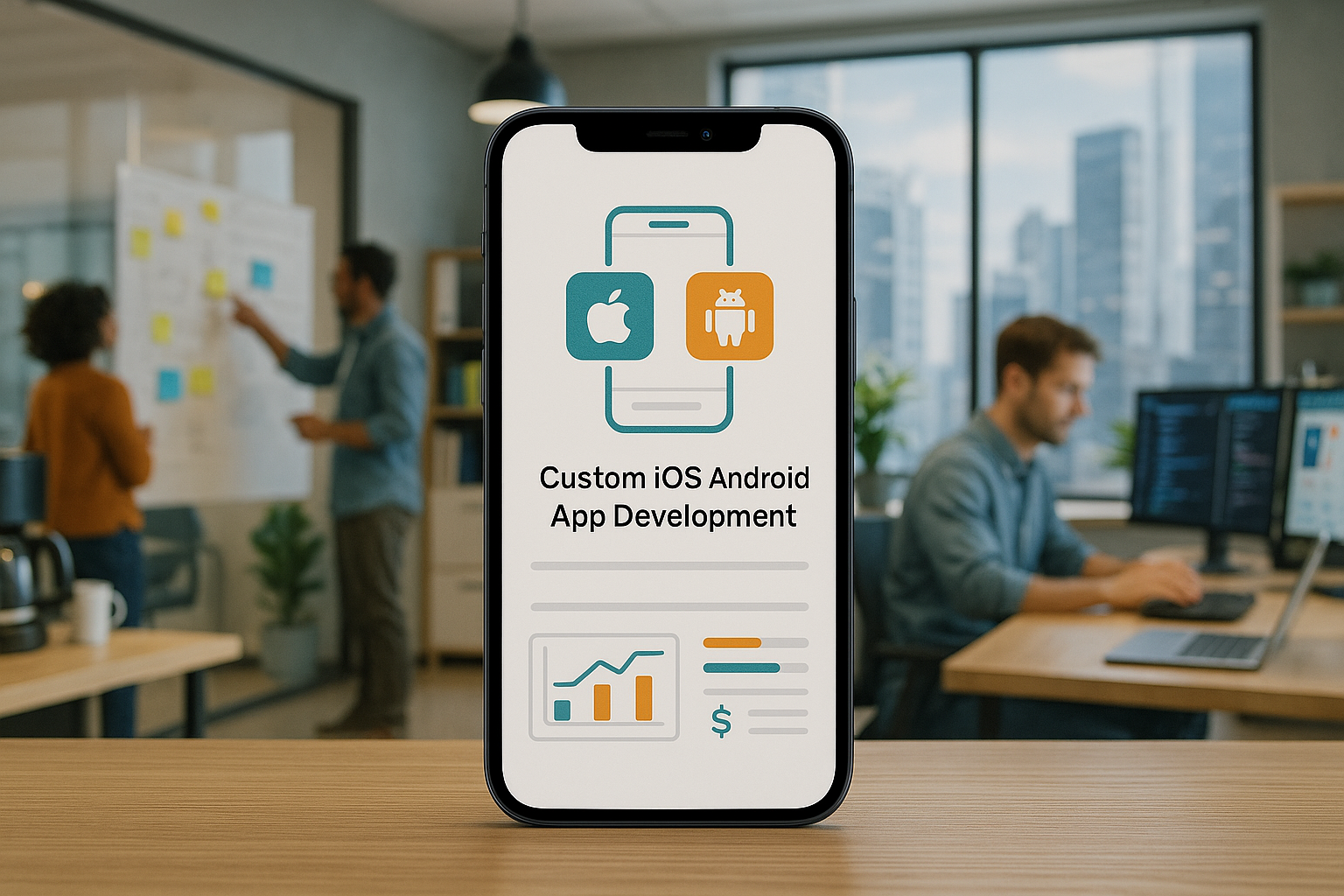
At its core, an “iOS and Android app” refers to a mobile application designed to function on the two dominant operating systems in the mobile world: Apple’s iOS, which powers iPhones and iPads, and Google’s Android, which runs on a vast array of devices from manufacturers like Samsung, Google, and OnePlus. While the end goal is a consistent and high-quality user experience on both platforms, the technical journey to achieve this can vary significantly depending on the development approach.
Simply put, you cannot run the same exact code on both operating systems without a specialized framework. Each platform has its own native programming language, development environment, and set of guidelines. Native iOS apps are typically written in Swift or Objective-C, while native Android apps are built using Kotlin or Java. This fundamental difference means that creating a presence on both platforms requires a deliberate strategy.
The primary approaches to achieve this dual-platform presence include:
- Native Development for Each Platform: This involves building two separate, distinct applications—one for iOS and one for Android—using their respective native programming languages. This method offers the highest performance, security, and access to device-specific features.
- Cross-Platform Development: This approach uses frameworks like React Native, Flutter, or Xamarin to write code once and deploy it on both iOS and Android. This can save significant time and resources, as much of the codebase is reusable.
- Hybrid Development: Similar to cross-platform, this method uses web technologies (HTML5, CSS, JavaScript) wrapped in a native container. This allows the app to be downloaded from app stores and access some native device features.
- Web Apps and Progressive Web Apps (PWAs): These are essentially websites that are optimized for mobile browsers and can mimic the feel of a native app. They are accessible on any device with a web browser but have limited access to the device’s hardware and native functionalities.
The choice of approach depends on various factors, including the app’s complexity, performance requirements, budget, and long-term goals. Understanding these options is the first step in planning a successful mobile strategy that captures the entire market.
Reasons It Is Difficult to Develop an iOS and Android App In-House
Embarking on in-house app development for both iOS and Android may seem like a cost-effective and direct path, but it often conceals a labyrinth of challenges that can lead to delays, budget overruns, and a suboptimal final product. The complexities are not merely technical; they span talent acquisition, project management, and ongoing maintenance.
The Talent Gap and Associated Costs
One of the most significant hurdles is assembling a team with the right expertise. Finding skilled developers is difficult, especially for Android, which has a more fragmented ecosystem. The financial commitment is also substantial. In the US, the average annual salary for a mobile app developer is around $110,000, with specialized iOS developers in high-demand areas like San Francisco commanding upwards of $151,000 per year. Building a team requires not just developers for each platform, but also UI/UX designers, quality assurance (QA) testers, and a project manager, quickly escalating personnel costs before a single line of code is written.
The Challenge of Device and OS Fragmentation
Android development is notoriously complicated by device fragmentation. There are thousands of different Android devices on the market, each with unique screen sizes, resolutions, hardware specifications, and manufacturer-specific software skins. Ensuring an app looks and functions correctly across this vast landscape is a monumental task that requires extensive testing and continuous adaptation. While iOS is more standardized, developers must still account for different iPhone and iPad models and ensure compatibility with new and legacy iOS versions. Managing this dual-front complexity in-house requires a dedicated and experienced QA team.
Navigating a Rapidly Evolving Tech Landscape
The mobile development world is in a constant state of flux. Both Google and Apple release major OS updates annually, introducing new features, deprecating old ones, and enforcing new security and privacy standards. Development trends, programming languages, and best practices evolve at a breakneck pace. An in-house team must dedicate significant time and resources to continuous learning and training just to stay current, pulling focus away from core product development.
The Intricacies of Design and User Experience (UX)
Creating an intuitive UX is paramount to an app’s success, but iOS and Android have fundamentally different design languages and user expectations. Apple’s Human Interface Guidelines and Google’s Material Design prescribe distinct approaches to navigation, button placement, and user interaction. A “one-size-fits-all” design often feels out of place on one or both platforms, leading to a poor user experience. An in-house team needs designers who are deeply fluent in the nuances of both ecosystems to create an app that feels truly native and intuitive to each user base.
Security Vulnerabilities and Integration Complexities
Security is a non-negotiable aspect of app development. The Android OS, in particular, presents unique challenges and security vulnerabilities that require expert handling. Furthermore, modern apps rarely exist in a vacuum; they often need to integrate with a variety of third-party APIs for services like payments, mapping, analytics, and social media. Managing these integrations, ensuring their security, and maintaining them through updates is a complex, ongoing process. An inexperienced team can inadvertently introduce security holes or create an unstable app.
Initially, building in-house might seem to decrease development costs. However, the lack of deep, specialized experience often leads to bugs and architectural flaws that require costly fixes down the line. Over time, these unforeseen expenses can easily push the total cost to a level similar to, or even exceeding, that of hiring a professional app development agency from the start.
Why Custom App Development for iOS and Android
Given the challenges of in-house development, partnering with a custom app development agency offers a strategic, efficient, and reliable path to launching a high-quality application. Agencies like metacto bring a confluence of expertise, streamlined processes, and long-term vision that an in-house team, built from scratch, struggles to replicate. The value proposition extends far beyond simply writing code; it’s about building a robust, scalable, and successful digital product.
Access to Diversified Expertise and Specialized Teams
Mobile application development companies house a large pool of specialized knowledge under one roof. When you partner with us, you gain immediate access to an expert team that includes seasoned UI/UX designers, frontend and backend developers fluent in multiple technologies, dedicated project managers, and rigorous quality assurance engineers. This diversified expertise ensures that every facet of your app is developed to the highest standards, incorporating industry best practices and innovative solutions. This eliminates the need to hire multiple contractors and ensures a cohesive development process from start to finish.
Efficiency, Speed, and Cost-Effectiveness
An experienced agency has honed its development processes over hundreds of projects. This efficiency translates into a smoother development lifecycle, saving you valuable time and resources. We handle all stages of development, from ideation and prototyping to coding, testing, deployment, and ongoing maintenance. Our expertise reduces the likelihood of costly errors and revisions, and our ability to deliver professionally from the outset decreases the need for expensive corrections later. This efficiency accelerates your time-to-market, providing a faster return on investment.
Future-Proofing and Scalability
Professional mobile app development agencies design applications with scalability in mind from day one. We build a robust architecture that allows for the easy integration of new features, can handle increasing user loads, and remains compatible with future OS updates and new devices. We stay at the forefront of the technology world, ensuring your application utilizes the latest programming languages, frameworks, and emerging technologies like AI and AR. Investing in an agency is an investment in a long-term, scalable app that future-proofs your business’s digital presence and supports its growth.
Uncompromising Quality and Reliability
Agencies employ rigorous testing protocols to ensure the final product is robust, secure, and user-friendly. This includes functional testing, performance testing, security testing, and user acceptance testing. This commitment to quality results in an app that not only meets market standards but also provides a superior user experience, which is crucial for user retention and engagement. Furthermore, agencies offer long-term reliability through ongoing support and maintenance, ensuring your app remains competitive and functional long after launch. For most businesses, a mobile app agency is the surest guarantee of a high-quality, efficient application designed to drive customer engagement, brand visibility, and revenue growth.
Different Types of iOS and Android Apps
Choosing the right development approach is one of the most critical decisions in your app’s journey. The path you take will impact your budget, timeline, performance, and future scalability. Here is a detailed breakdown of the primary types of mobile apps for iOS and Android.
Native Apps
Native app development involves creating an application specifically for a single operating system. This means building one app for iOS using languages like Swift or Python, and a completely separate app for Android using Kotlin or Java.
- Advantages: Native apps deliver the best performance, highest level of security, and greatest reliability. They run directly on the device, allowing them to fully leverage device hardware like the camera, GPS, and motion co-processor. This results in greater speed and responsiveness compared to other app types. The design process is also bespoke, customized to the intended OS for a truly intuitive user experience. Gaming apps, for instance, are often most successful when built natively. Pokemon Go, a massively successful native app, was developed for Android using Google’s tech suite, enabling fast access times and a stable player experience.
- Disadvantages: The single biggest challenge is unreusable code. To launch on both iOS and Android, you must build, maintain, and update two separate codebases, which significantly increases development time and cost.
Cross-Platform Apps
Cross-platform development allows you to write code once and deploy it across multiple operating systems. This is made possible by open-source frameworks that act as a bridge to native functionalities.
- Key Frameworks:
- React Native: Developed by Facebook (Meta), React Native allows developers to build native-like apps using JavaScript and React. E-commerce giant Shopify adopted React Native for all its buyer and merchant apps, sharing an incredible 95% of the same code between the iOS and Android versions of its Shop app. This led to a 2x increase in team productivity and fewer bugs.
- Flutter: Google’s UI toolkit, Flutter, enables developers to build natively compiled applications for mobile, web, and desktop from a single codebase. Its popularity is surging due to its fast performance and expressive UI capabilities. ByteDance, the parent company of TikTok, moved to Flutter for its multiple app projects to leverage this single-codebase efficiency.
- Xamarin: An open-source platform from Microsoft, Xamarin allows developers to build apps for iOS, Android, and Windows using .NET and C#. Its C# wrappers yield native performance without sacrificing code reusability.
- Advantages: The primary benefits are cost and time savings. A single codebase reduces development and maintenance efforts. These frameworks also offer convenience, improved user experience, and help get apps to market quickly.
Web Apps and Progressive Web Apps (PWAs)
A web app is an application accessed through a mobile device’s web browser. It is essentially a website with a responsive design that adapts to any screen size. PWAs are an evolution of web apps, offering a more native-like experience.
- Web Apps: They avoid the need for users to download or install anything onto their device. They are internet-enabled and work on any operating system. Amazon’s web app is a prime example, allowing users to access their accounts across various devices seamlessly. However, they can only use a small selection of a device’s native features.
- Progressive Web Apps (PWAs): PWAs run inside a browser but can mimic the user experience of a native app. They are smaller, more agile, and faster-running. They can be “installed” on the home screen, work offline, and send push notifications. Microsoft Teams as a PWA, for example, enables a native-like experience across both desktop and mobile devices.
Hybrid Apps
A hybrid app combines elements of both native and web applications. It is essentially a web app built using technologies like HTML5, JavaScript, and CSS, which is then enclosed in a native app “shell” or container. This allows the app to be downloaded from app stores like Google Play and the Apple App Store.
- How They Work: Frameworks like Apache Cordova bridge the gap between the web code and the native device features, allowing the app to access hardware and APIs.
- Advantages: They offer a balance between the reach of web apps and the capabilities of native apps, all while maintaining a single codebase for cross-platform functionality.
- Examples: Many popular apps use a hybrid approach. Instagram is a notable example, built in React Native, which allows it to provide a native-like experience that flexes across phones, tablets, and desktops. Slack is another, built in Electron using web frontend technologies.
- Considerations: While effective, the hybrid approach can sometimes lead to performance limitations or inconsistencies between platforms. A study of hybrid app pairs found that 33 of 68 did not receive consistent star ratings across the Google Play and Apple App stores, suggesting that developers should still actively monitor platform-specific issues.
Cost Estimate for Developing an iOS and Android App
Determining the cost of developing a custom mobile app is not a one-size-fits-all calculation. The final price tag is influenced by a multitude of factors, with the app’s complexity being the most significant driver. Understanding these variables is key to creating a realistic budget and financial plan for your project.
Core Factors Influencing App Development Cost
- App Complexity & Features: This is the primary determinant. The cost rises with the number and sophistication of features. Factors include whether the app requires a backend server, user analytics, a content management system (CMS), a built-in shopping cart, or social media sharing capabilities.
- Functionality & Purpose: The complexity of visual objects, use of smartphone hardware (GPS, NFC, Augmented Reality), and integration points with third-party apps all significantly influence the final cost.
- Platforms & Devices: While the cost of making iOS and Android apps is now virtually identical, supporting a wide range of specific devices (e.g., iPhone 15 Pro Max, Samsung Galaxy S10 Plus) and older OS versions adds to testing and development complexity, increasing the price.
- Development Team Location: The hourly rate for mobile app development varies dramatically around the world. A developer in the UK may charge $150-$400 per hour, whereas a developer in India or Vietnam may charge $20-$40 per hour.
App Development Cost by Complexity
Here is a general price range based on an app’s overall sophistication. Note that these figures typically do not include ongoing maintenance costs.
| App Complexity | Price Range |
|---|---|
| Simple | $5,000 – $50,000 |
| Medium | $50,000 – $120,000 |
| Complex | $120,000 – $300,000+ |
Cost Breakdown by Development Stage
A typical mobile app development budget is allocated across several key stages:
| Stage | Budget Allocation | Typical Cost Range |
|---|---|---|
| Discovery | 10-15% | $5,000 – $40,000+ |
| Design | 20-25% | $5,000 – $50,000+ |
| Development | 40-55% | $30,000 – $300,000+ |
| Testing | 15-20% | $5,000 – $50,000 |
| Deployment | 5-10% | (Often included with testing) |
Post-Launch Maintenance Costs
Launching an app is not the end of the journey. A maintenance plan is required to cover updates, bug fixes, and new features. The industry average cost to maintain software is roughly 15-25% of its original development cost, per year.
Here are some estimated annual costs for ongoing maintenance:
- Bug Fixing: $1,000 – $5,000
- Security Updates: $1,000 – $2,500
- Performance Monitoring: $2,400 – $24,000
- Third-Party API Maintenance: $3,000 – $20,000
- Platform Updates (for new iOS/Android versions): $5,000 – $30,000
- Server & Backend Maintenance: $5,000 – $25,000
- Design & UX/UI Updates: $5,000 – $25,000
When estimating your app’s total cost, it’s crucial to factor in not just the initial build but also these significant long-term maintenance expenses.
Top iOS and Android App Development Companies
Choosing the right development partner is paramount to your app’s success. An elite agency does more than just build; they strategize, innovate, and become a true partner in your growth.
1. metacto
As a premier US-based AI-powered app development firm, we at metacto are Mobile App Experts. With over 100 successful app launches, our team knows exactly what it takes to build fast, secure, and high-performing mobile apps that stand out in a crowded market. Startups are our bread and butter; our US-based product strategists understand the market and the unique challenges new ventures face. We believe in helping our clients start strong, build smart, and scale fast.
Our approach is comprehensive. We provide more than just development; we drive growth after launch. Our services are designed to cover the entire app lifecycle, ensuring our clients not only launch a successful app but also build a thriving business around it. Our suite of services includes:
- Mobile App Development: We bring successful apps to market without the hassle of complex development processes, turning big ideas into real-world success.
- AI Development: We integrate cutting-edge AI technology to make every process faster, better, and smarter.
- App Growth and Monetization: We help you get more downloads, convert more users, and turn your mobile app into a profitable business with scalable revenue streams.
- Rapid MVP Development: We can build, test, and validate your app concept as quickly as possible, without overspending.
- Fractional CTO Services: Access experienced technical leadership to guide your strategy, team, and technology decisions.
- Project Rescue: We specialize in turning frustrating technical setbacks into a clear path forward.
Our track record speaks for itself. We helped G-Sight implement cutting-edge computer vision AI, keep users engaged with gamification, and convert 10% of their customers to annual subscriptions. For Mamazen, we transformed a digital content library into a video streaming mobile app that generated over $500k in annual subscription revenue. We also enabled Parrot Club to launch a two-sided marketplace for language education, supporting 7 languages in 8 countries and converting 10% of customers to annual subscriptions. No idea is too challenging for our team; we are prepared to deliver whatever our clients envision.
Conclusion
The journey of creating a custom app for both iOS and Android is a complex but potentially transformative endeavor for any business. We’ve explored the fundamental challenges, from navigating the fragmented Android ecosystem and sourcing top-tier talent to managing the ever-evolving technological landscape. We’ve also highlighted why partnering with a specialized development agency is often the most strategic path forward, offering unparalleled expertise, efficiency, and long-term value that far outweighs the risks of going it alone.
From deep-diving into the different types of mobile apps—native, cross-platform, hybrid, and web—to breaking down the multifaceted costs associated with development and ongoing maintenance, it’s clear that building a successful app requires careful planning, deep technical knowledge, and a strategic vision. An expert partner not only builds your app but helps you build it the right way from day one, ensuring it is scalable, secure, and positioned for growth.
Your app idea has the potential to redefine your business and connect with customers in powerful new ways. Don’t let the complexities of development stand in your way.
Talk with an iOS and Android app development expert at metacto today to start turning your vision into a reality.